
Mass is more versus less is more

Mies Van Der Rohe Pavilion in Barcelona - but Made of Wood, Please

 - Heide Wessely

Climate neutrality was not an issue for Mies van der Rohe when he designed the pavilion for the 1929 World's Fair. But how would he build it today? Would he replace marble and travertine with wood?
Mies Van Der Rohe Pavilion in Barcelona - but Made of Wood, Please
© Adriá Goula

Climate neutrality was not an issue for Mies van der Rohe when he designed the pavilion for the 1929 World's Fair. But how would he build it today? Would he replace marble and travertine with wood?

© Adriá Goula

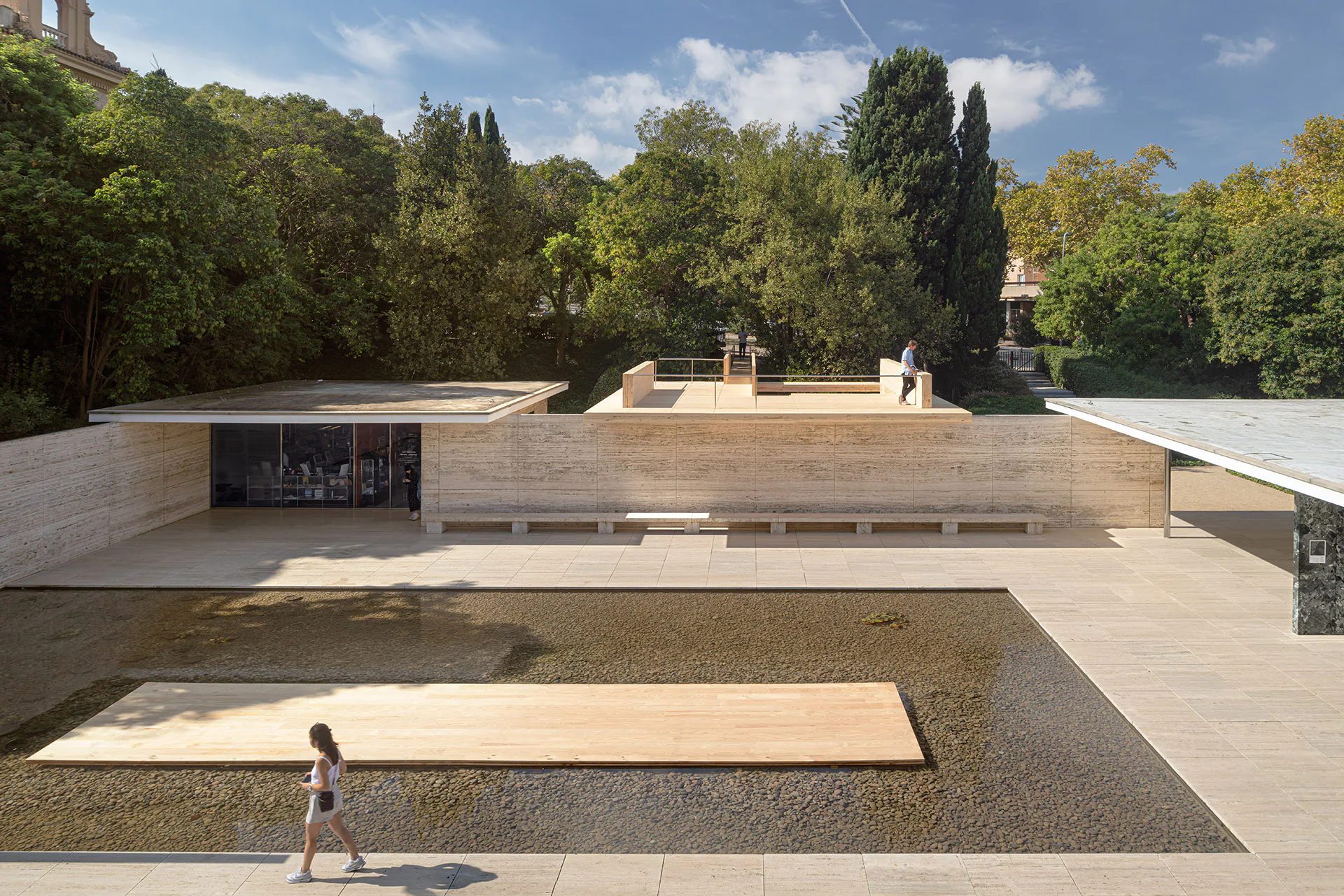
The Mies van der Rohe Pavilion in Barcelona is a magnet for architects. No architect comes to the city without paying a visit to the famous building. The impact of installations that do not take place there all that often is correspondingly great. “Mass is More" can now be seen until 9 October. The exhibition is dedicated to the theme of how the magic of marble and travertine could be recreated with CLT. And not entirely unimportant: what would be the carbon footprint of a building made of wood?

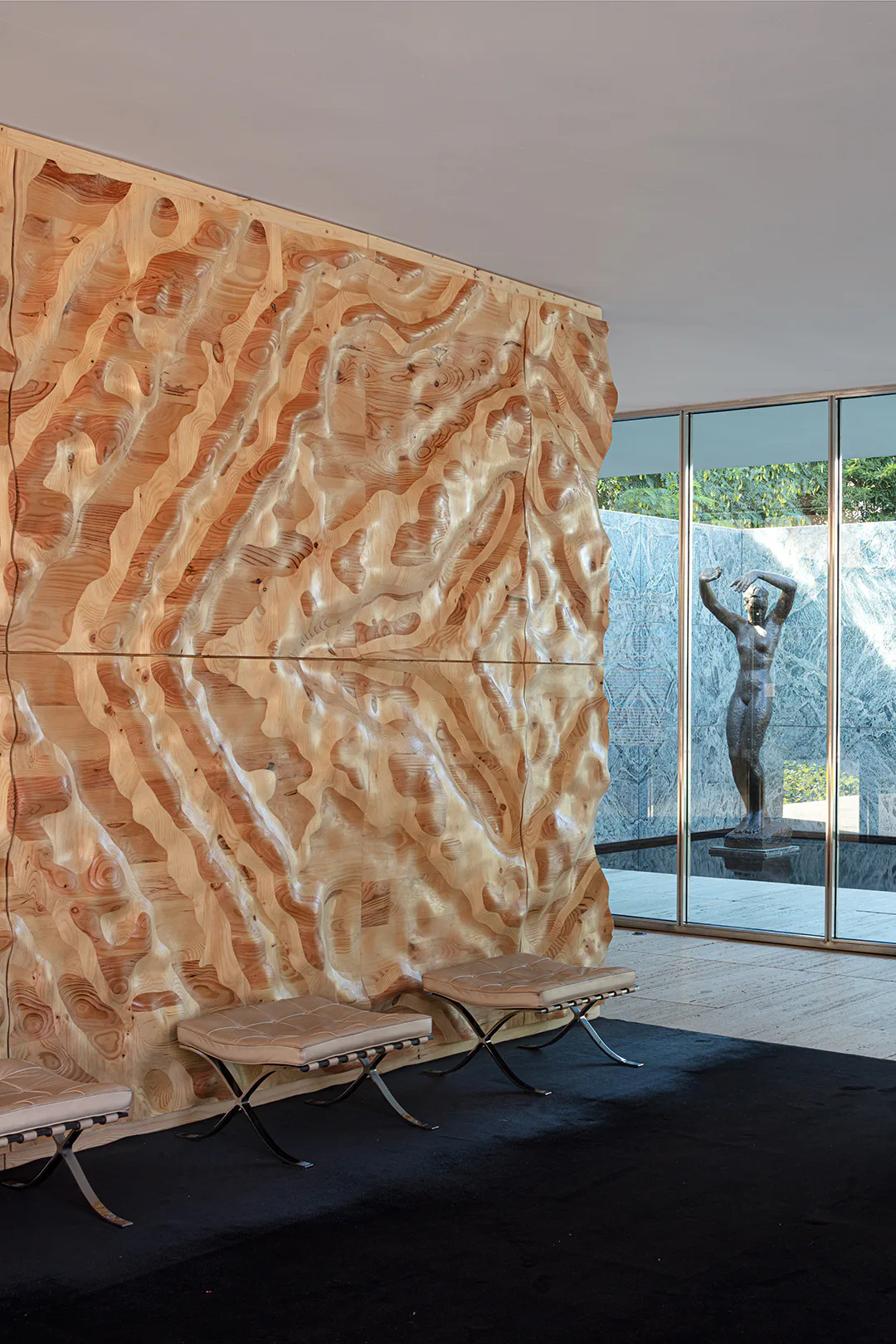
The authors work with panes, light, shadows and surfaces just as the original does. Instead of the green marble wall in the main room, the interplay of different wood colours currently provides the visual attraction there. Different woods were laminated and milled to different depths.
© Adriá Goula

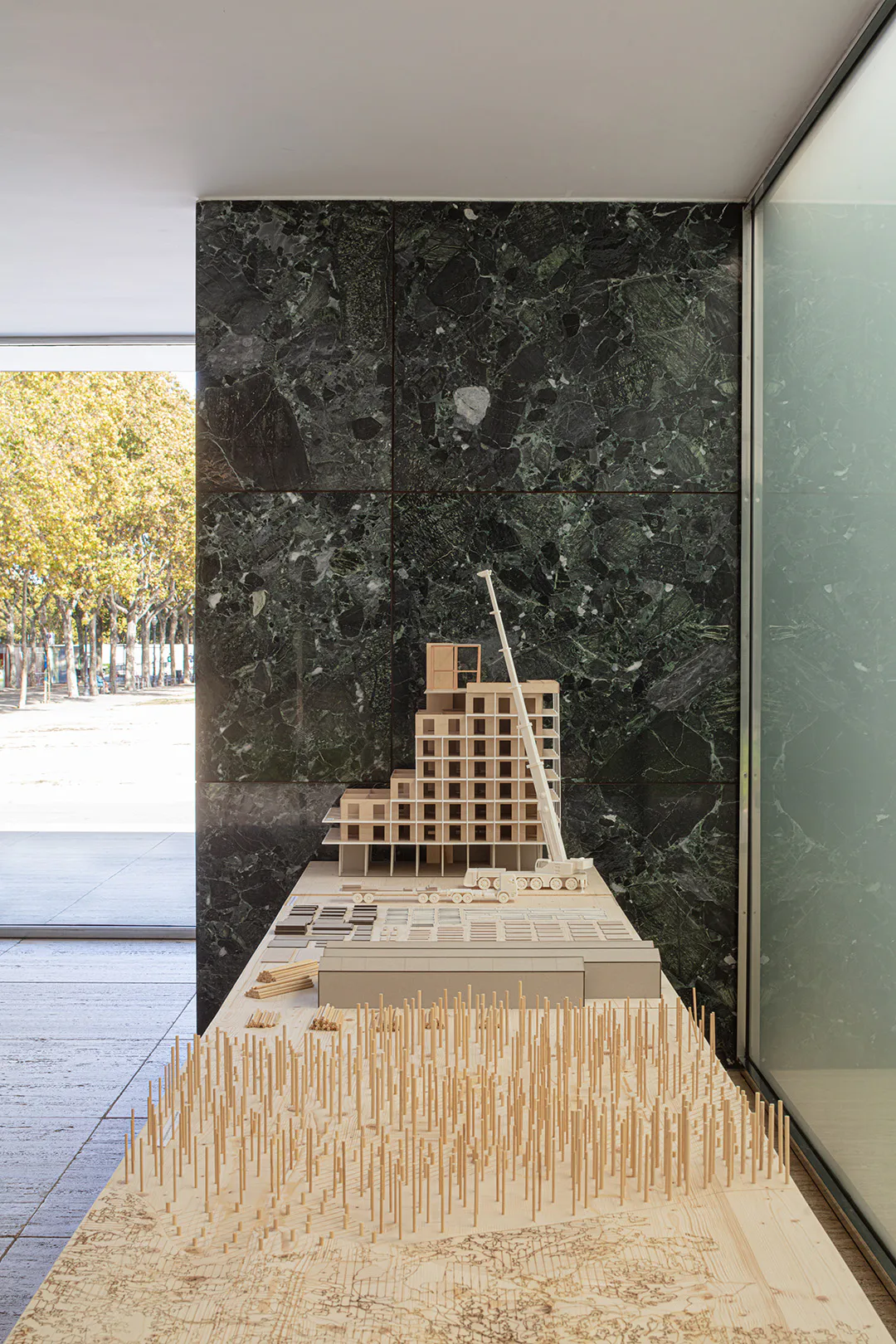
Thus, the surface is wavy and, depending on the depth of the milling, different woods with different colours and grains appear. In the same room, a 4,8 m long diorama shows the path of wood as a carbon store from the forest to the city.

© Adriá Goula
© Adriá Goula

Visitors can interactively compare the environmental impact of the Barcelona Pavilion of 1929 and that of the installation made of solid wood. For this purpose, the components roof, walls, columns and floor were taken into account. The comparative analysis includes the embodied carbon in each element in terms of the energy consumed in extraction, manufacturing, transportation and assembly. On boards on individual components, visitors can compare CO2 emission in kg, transport distance in km and the number of work steps from the extraction of the material to the assembled component.
© Adriá Goula

With their installation, the artists want to give an impulse as to how wood could be used on a large scale in cities. Wood is still rather rare as a building material in Spain. The discussion about this is sure to be sparked among visitors to the pavilion - sometimes certainly also as a complaint about the fact that the climate discussion is currently covering everything, including the popular Mies Pavilion.


Architecture: Daniel Ibánez (IAAC), Vicente Guallart (IAAC), Alan Organschi (Bauhaus Erde)
Project participants: IAAC, Bauhaus Earth, Mass Madera, Built by Nature
Location: Pavelló Mies Van Der Rohe, Av. Francesc Ferrer i Guàrdia, 7, 08038 Barcelona (ES)


Installation: Bestiario
Bauunternehmen: Finsa and Xilonor


  • "A White Box is the Most Aggressive Form Anyone Can Design"

    Known for its bold use of colour and material contrasts, the Porto-based practice fala is now bringing that same approach to social housing, says co-founder Filipe Magalhães.

  • At the last Detail Award in 2025, Esch Sintzel Architekten won one of the three main prizes for their conversion of a wine warehouse in Basel into flats. This year, Detail is introducing a separate category for affordable housing as part of the award.

    Great Architecture on a Small Budget 

    2027 brings a new edition of the Detail Architecture Award - and, for the first time, a prize for affordable housing. Entries close end of October.

  • The new seven-storey building on Hohlstrasse in Zurich will comprise a ground floor with retail space and public service areas, and five upper floors with commercial space.

    Railway Tracks as a Supporting Structure - How Does That Work? 

    Around 180 kilometres of track are replaced every year on the Swiss rail network. Until now, all this scrap metal has been melted down. However, the first building with a steel framework made from recycled rails will soon be constructed in western Zurich.

  • Landscape architect Line Ramstad is the new chief curator of the Oslo Triennale.

    „One Size Does Not Fit All" 

    Facades made from waste wool, recycled steel from decommissioned ships, housing rather than investment property: Line Ramstad, chief curator of the Oslo Triennale, shows what happens when nature takes precedence.

  • Paul Van Ostaijen Culture Campus in Leuven

    Lava architecten transformed an old mission building in Leuven into a place where circus arts, music, theatre, and dance coexist under one shared roof. Effective soundproofing is the precondition for the shared use of the facility.

  • Even though the main exhibition pavilion in the Giardini was closed, the 2025 Architecture Biennale featured more exhibits than ever before.

    Self-Exploitation in the Celebrity Circus

    At every Architecture Biennale, the curators face the same obstacles: a lack of funding, a great deal of red tape, and an organisation that ignores collective achievements. Why do they put themselves through this? We speak to Albena Yaneva, who spent a year observing the development process of the 2025 Biennale.