The Hepworth Wakefield
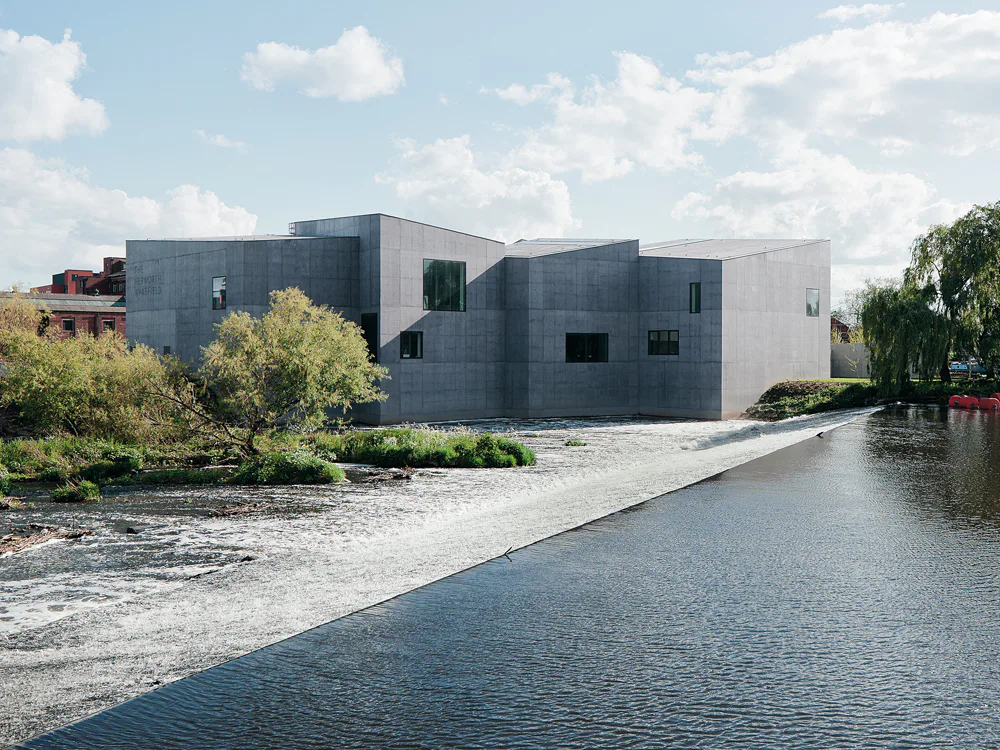
Like other cities in Northern England, Wakefield was faced with the decline of mining and manufacturing. Its new museum commemorating Barbara Hepworth, a sculptor who spent her early years in Wakefield, demonstrates its will to look to the future. The art museum is the prelude to a larger-scale urban intervention: the regeneration of the river front to the south of the city centre. The site is visible from all directions; accordingly, the architects developed a building with no clear back or front. Thanks to the museum’s scale and building massing – which calls to mind geological formations – the building does not enter into competition with the historic warehoues and factory buildings, but instead is well integrated in its surroundings. The nature of the composition is additive and has its source in the program: the collection is presented sequentially in rooms that are similar in character, yet with different dimensions, responding to the proportions of the respective artworks they contain. In this manner, with a system of recurring angles, a densely packed cluster of irregularly shaped cubes is arranged around a central stairway. The exhibition spaces, all in white, are all situated on the upper level and employ controlled indirect daylight emanating from skylights. In some rooms there is a window in an exterior wall, providing views to the river, the sculpture garden, or the relics of the days of manufacturing. These views allow visitors to orient themselves. The auxiliary functions typically associated with a museum are located on the ground foor: the foyer and café face west, where the new access bridge docks onto the building. The concrete surfaces of the load-bearing exterior walls and the roof underscore the impression that the building is monolithic. Inside, concrete columns, arranged in most cases in pairs, support the building; they are concealed within thick, non-load-bearing plasterboard walls. These walls also contain the building-services ductwork. Barbara Hepworth’s artwork – including prototypes, models, and drawings – constitutes the core of the museum’s collection. The permanent collection also includes work by Henry Moore, who had his origins in Yorkshire, as well.