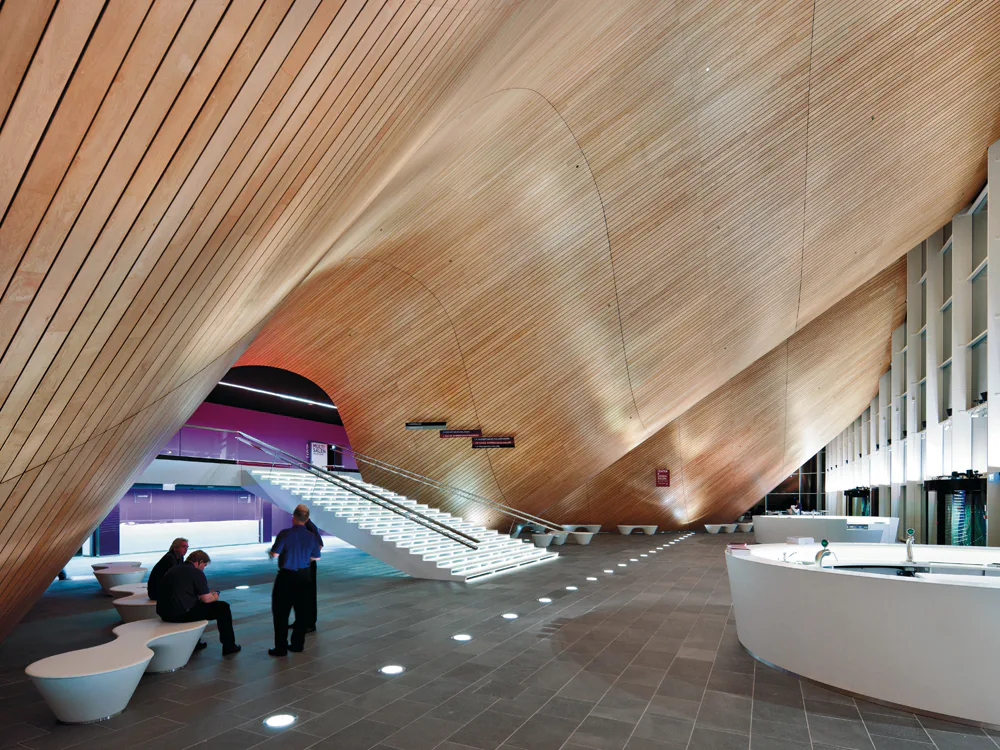
Theatre and Concert Hall in Kristiansand
Containing a concert hall for an audience of 1,200 as well as four further auditoriums, this new, free-standing structure in the municipality of Kristiansand, southern Norway, unites all aspects of the performing arts beneath a single roof. Access to the large halls, which are lined up next to each other, is from an elongated foyer that is oriented to the sea and covered by a wave-like roof clad with oak boarding. The 3,500 m² sloping, overhanging facade consists of prefabricated timber elements and opens in a grand gesture on to the harbour. The structure is not just the new landmark and symbol of Kristiansand. It forms a protective canopy for the intervals in performances, when the audience goes outside. This wave-like timber wall is borne by a steel structure that cantilevers far out and is fixed, in turn, to the in-situ concrete cubes of the rectilinear concert halls. The planning and implementation of this structure had its origins in the concept of a Norwegian timber construction concern. In conjunction with three Swiss specialists for three-dimensional building in wood, this concern developed a modular facade system, consisting of 126 different timber elements. Initially, the planners translated the architects’ design into a mathematically precise ruled surface between a straight top edge and a wave-like bottom edge. The purpose of this was to ensure the straight-line layout of all boards and joints. With the aid of a specially created parametric CAD model, the planners finally defined the approximately 14,000 individual parts as well as all connections. Each of the elements suspended from the steel structure consists of two straight and numerous curved beams in laminated timber. Fixed to these members are as many as 180 wooden boards that are not curved, but that are laid out in a conical arrangement. The building components were manufactured in various places in Norway and Switzerland. With the aid of self-aligning connection details, they were joined to form large-scale elements and finally transported by ship to Kristiansand, where they were assembled.