Gerberplatz and Open Spaces of the District Administration Office in Schwäbisch Hall

A grand staircase, punctuated by landings, connects the entrance hall of the district administration building with Gelbinger Gasse in the old town, which lies approximately 8 metres below. The design of Gerberplatz as a stair-driven plaza was crucial for the urban integration of the elevated district administration building with the half-timbered houses of the historic old town. The sculptor was consulted early in the planning process. In close collaboration, the design for the staircase, with its axially arranged sculptures along a handrail, was developed.

Gerberplatz and Open Spaces of the District Administration Office in Schwäbisch Hall

A grand staircase, punctuated by landings, connects the entrance hall of the district administration building with Gelbinger Gasse in the old town, which lies approximately 8 metres below. The design of Gerberplatz as a stair-driven plaza was crucial for the urban integration of the elevated district administration building with the half-timbered houses of the historic old town. The sculptor was consulted early in the planning process. In close collaboration, the design for the staircase, with its axially arranged sculptures along a handrail, was developed.
Architecture
Sven Kohlhoff, Klaus Neupert, Peter Schenk, Folker Trostdorf
Location
Schwäbisch Hall (DE)

  • Paul Van Ostaijen Culture Campus in Leuven

    Lava architecten transformed an old mission building in Leuven into a place where circus arts, music, theatre, and dance coexist under one shared roof. Effective soundproofing is the precondition for the shared use of the facility.

  • The Lost Shtetl Museum in Lithuania

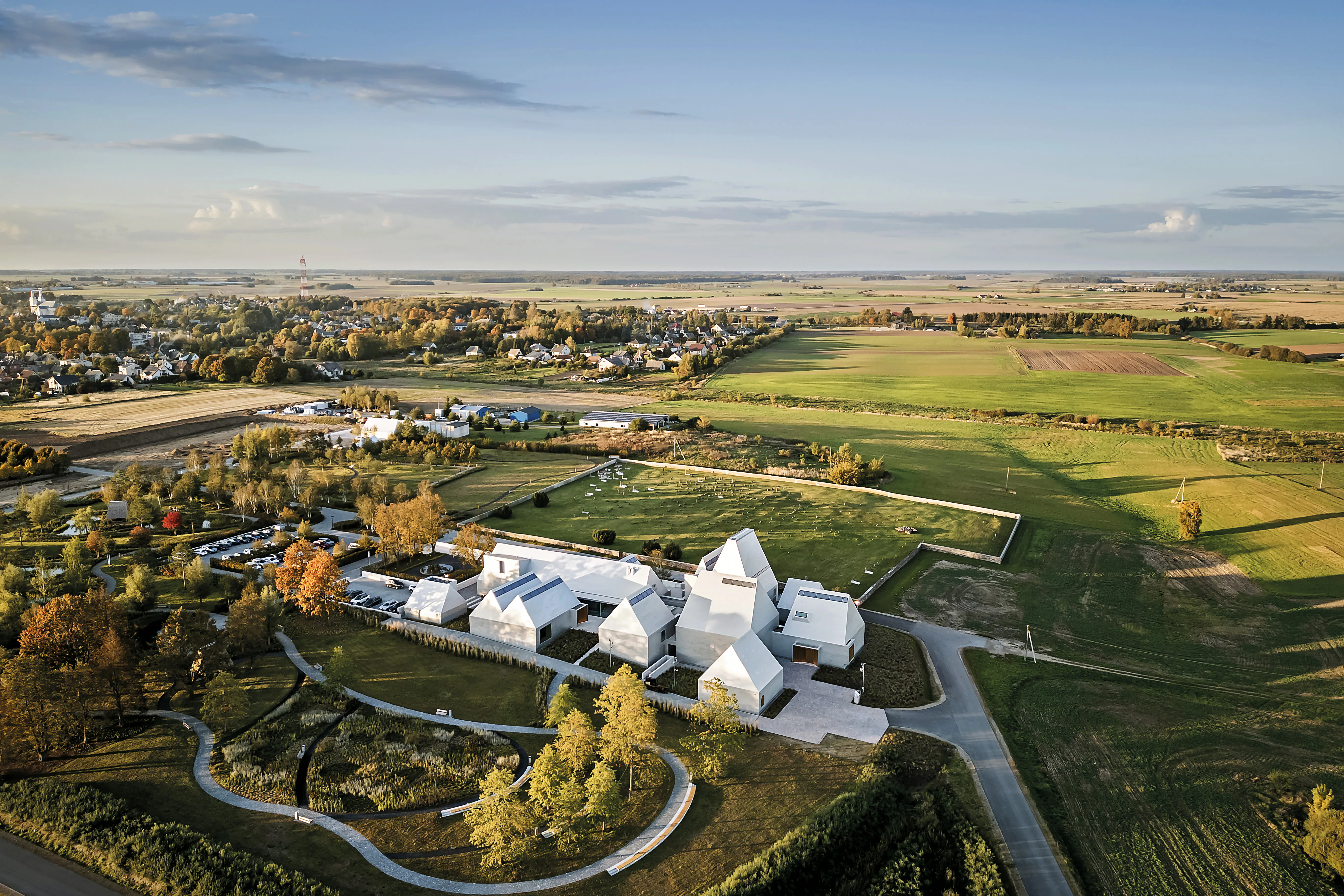
    The Jewish Museum in Šeduva commemorates the culture of Eastern European towns before World War II. With their building, Lahdelma & Mahlamäki Architects from Finland reimagine the small-scale structure of one such village. Its residents were murdered in 1941 by Nazis and their local collaborators.

  • Resembling a bridge, the scaly armour of the UCCA Clay Museum spans across the passageways to the neighbouring buildings. Where this structure touches the ground, Kengo Kuma & Associates arranged shallow water basins.

    Museum of Ceramic Art in Yixing

    The new UCCA Clay Museum advances the millennia-old tradition of artisanal ceramics the Chinese metropolis Yixing is renowned for. An armour of red clay tile encloses the exhibition spaces and the open timber roof constructions above them – an expressive space for the presentation of modern ceramic art.

  • The fly tower of the Glasshouse Theatre consists of textured prefabricated concrete elements, while the ­existing QPAC displays smooth in-situ concrete. The continuity of colouration, however, is clearly visible.

    Glasshouse Theatre in Brisbane

    The Glasshouse Theatre adds a fifth venue to the heritage-listed Queensland Performing Arts Centre. It can be flexibly used for concerts, operas, and dance and theatre performances. The glass facades of the deeply cantilevered foyer visualise the theatrical art of illusion on the exterior.

  • The monastery originally comprised four wings and a cloister. In the south, a squat church with a single nave connects to the complex. The head building with its three apses, a bell tower, and a transept were added in the 13th century.

    Monastery of Santa María of Sijena

    In their restoration of the Monastery of Santa María of Sijena, Pemán y Franco and Sebastián preserve traces of destruction, rebuilding, and decay spanning 800 years. Recently, they remodelled the east and north wings into an exhibition space for the convent’s valuable artworks.

  • The medical facility features a separate entrance in the east. A pergola made of prefabricated concrete elements welcomes the clients.

    Overnight Shelter and Medical Facility in Munich

    Housing for the homeless often consists of stacked contain ers. While the overnight shelter designed by Hild und K utilises prefabrication, thoughtful details adorn the robust building through which the Munich-based office conveys impres sions of warmth and home.