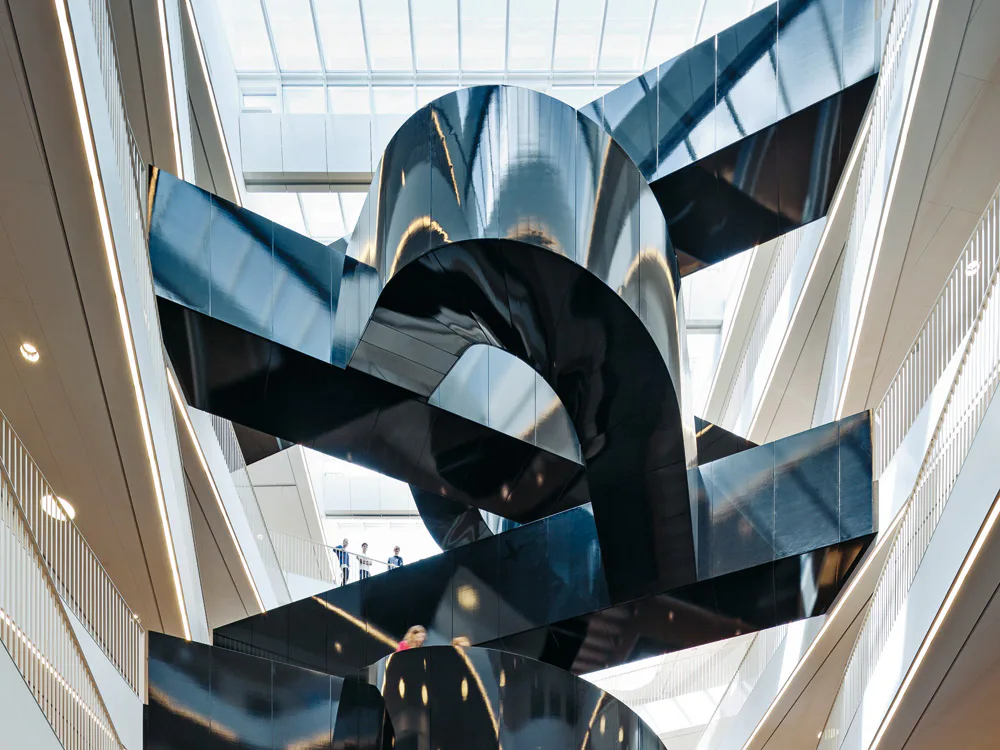
UN Administration in Copenhagen
- Julia Liese
The United Nations embraces a number of subsidiary bodies like the World Health Organization (WHO) and UNICEF, which are represented by regional establishments in various countries. Hitherto, the offices of the eight institutions in Copenhagen were scattered about the entire urban area. Now, the new UN City administrative building unites the entire staff of 1,250 beneath a single roof. The location, on an artificial island north of the city centre, allows the high security requirements to be met, while the prominent position on the waterfront establishes the visual presence of the structure in the cityscape. The heart of the building, which is organized in a star-shaped form, is without doubt the light-filled atrium with its ample and dynamic sculptural staircase, which links the foyer with the five upper floors of offices. Black externally and lined internally with wood, the flights of stairs swing upwards in roughly semicircular curves, linking up with the diagonal bridges across the atrium. To encourage the staff to climb the stairs, the lifts were deliberately somewhat concealed (see also interview, page 272).