Knife Manufacturer’s Showroom in Sanj?
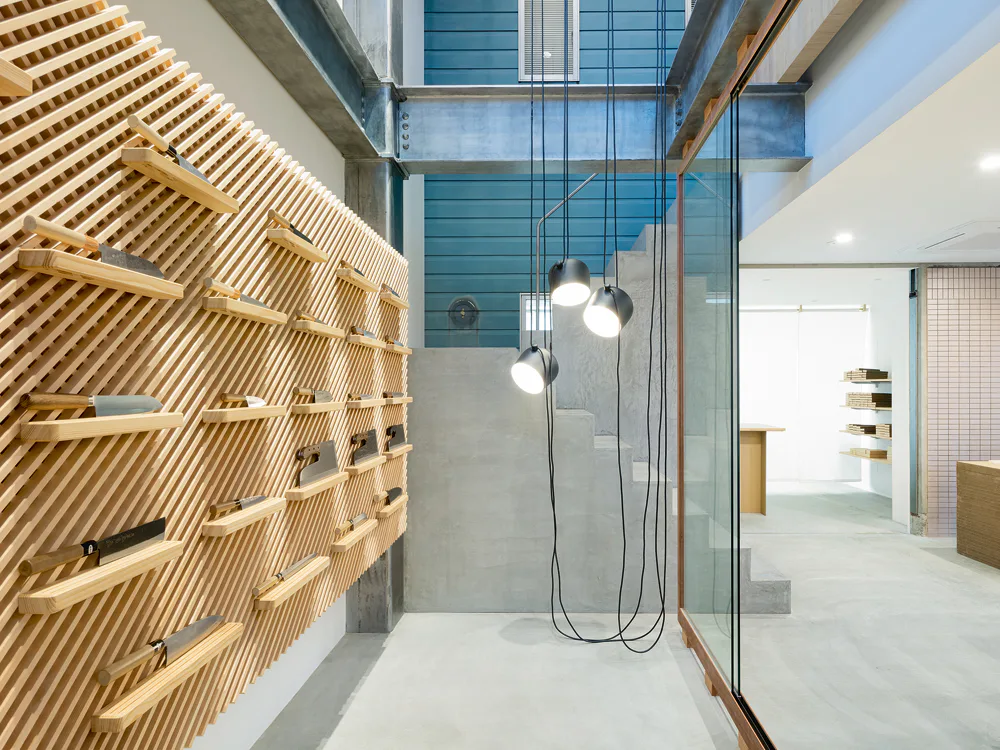
The knife-manufacturer Tadafusa is located in the Japanese city of Sanjō on the west coast of Honshū, Japan’s main island. The town and its industrial outskirts have been renowned for the manufacture of high-quality handforged knives for over three centuries. The recently added small showroom with its separate entrance features a direct connection to the company’s production facilities. Visitors enter the small shop through two ceiling-height timber doors in an otherwise entirely glazed entrance. In keeping with the raw industrial character of the adjacent factory the architectural elements such as steel beams, exposed concrete staircase and floors and white painted walls are restrained and low-key so that the focus is on the products. The knives are displayed on a striking wall of latticed wood located in a walk-in cabinet with glass sliding doors and a detached wooden frame wall. By placing the knives in a sort of “glass safe“ the design implies the “value“ of these products. The effect is heightened once the threshold is crossed; the process of entering is celebrated in a comparable way to the reverence with which one would enter a temple. The knives are laid out on small shelf inserts made out of carbonised spruce that can be removed from the wall element and reinserted with ease. The diagonal battens are hand-made by local craftsmen using traditional timber joints without any glue. The wood used was treated thermally to give it antibacterial properties that are particularly important when handling knives. This type of finish is also used by blacksmiths when manufacturing knife-handles and cutting boards. The knives are lit by a series of round lamps hanging from long cables that emphasise the tall ceilings in this space. In order to cultivate the connection between manufacturing, product and customer even further, a space upstairs will be used to host seminars in the future. The brand’s professional range of knives can be tested on corrugated cardboard tables and wooden worktops.