Discussion: Building Super-Capitalism
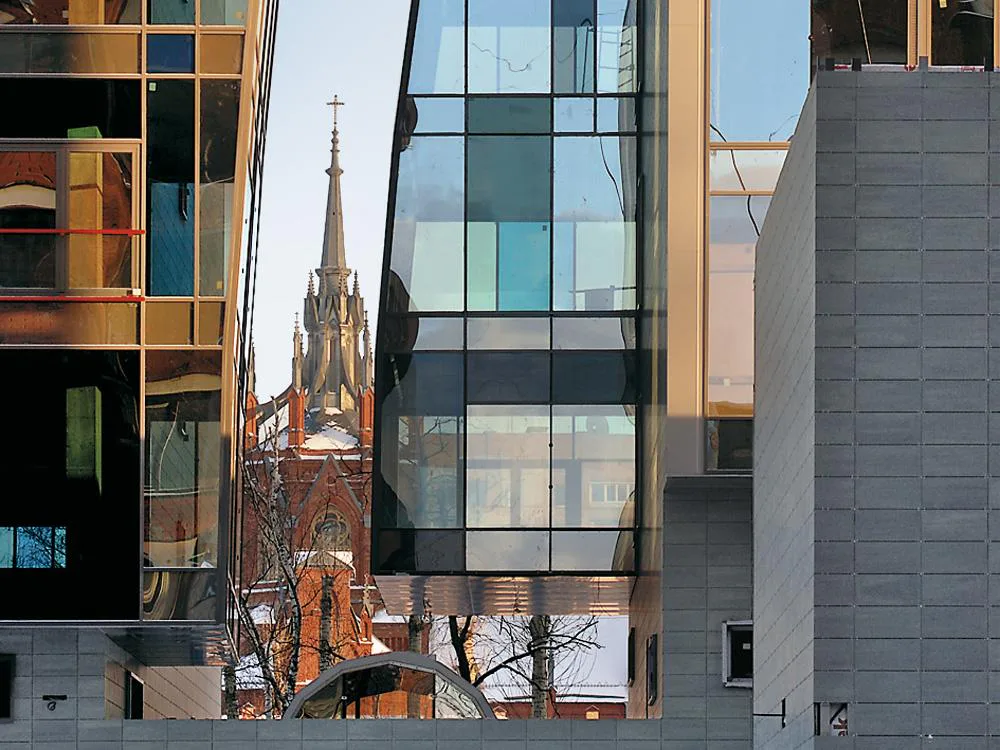
Building in Super-Capitalism Whenever Russia wanted to be modern it looked to the leading lights of European culture. Architecture, which as the most functional of all the arts always tells future generations a great deal about a society's level of development, has never been an exception to that rule. Europeanizing Russia In 1703 Tsar Peter I founded St. Petersburg - a new capital - and invited famous architects from all of Europe to participate. The new capital's architecture was to become the benchmark for much of the Russian Empire. The Europeanisation of St Petersburg through Baroque architectural imports exerted a lasting influence on the formal canon of Russian architecture. Yet the baroque pomp also represented an outdated feudal system which, unfazed by the rise of the bourgeoisie and industrialisation in Central and Western Europe, endured until it was eliminated in the fury of the October Revolution. Industrialisation and mechanisation accompanied the building of the new political system, culminating in Lenin's slogan: "Communism is Soviet power plus the electrification of the whole country. The USSR became a laboratory of international progressive architecture, including projects by Le Corbusier, Bruno Taut and Albert Kahn. This culminated in the grotesque situation in which a good part of the architectural elite of the capitalist West headed east to help build a new state whose leadership made no secret of its intention to destroy the capitalist world. But, by 1931 the limits of the "global political experiment" in urban design had become evident. At the time, Lazar M. Kaganovich, Stalin's preferred urban designer, demanded that the old cities be reconstructed and the new ones implement "moderately modern" designs. The authoritarian party doctrine of the young USSR had pulled the rug out under the rising ambitions of modernism. Alternately, the new artistic doctrine invigorated the creative energies of the older native architects from the tsarist era. Stalin's rule actually gave rise to buildings that - regardless of whether they made economic sense - represented milestones of moderate modernism. The contribution of Stalinist architecture to the international debate has rarely been taken seriously. In fact, one could propose the provocative thesis that the way today's Russian architecture draws on its Soviet heritage makes it the most traditionally grounded architecture in Europe. In a sense, the Russian Bauhaus offshoot of constructivism and Soviet functionalism as the USSR's post-war strain of Western modernism (which came to the fore under Nikita Khrushchev) could both be seen as failed developments that were superseded by Stalinism and neo-Russian regionalism. But that would not do justice to either. Soviet functionalism was a spartan version of constructivism - a socialist variety of the West's International Style - with the purpose of creating as much inexpensive housing as possible, and at the same time, as an artistic form of expression, reinforcing the country's internal cultural unity. From Minsk to Vladivostok, nearly identical buildings went up, their permits issued in Moscow and each given a centralised serial number. Rationalisation of planning and construction - the spirit of the age in West and East alike - led to the disappearance of the building trades. When the West returned to conventional building methods, partly for reasons of economy, prefabrication in the USSR had become the prisoner of its own success. Outwardly too, architecture had become a means of artistic self-representation in the struggle for control over a world that had been paralysed by the Cold War but was growing together at breakneck speed with scant regard for political divisions. Suddenly modernism came to be seen as the ally of the state, for which its reputation fell just as hard as it had in the West. Russia had yet again taken the West as its model. During the Brezhnev era the post-Stalinist USSR torpefied into sober functionalism which "surpassed even the Western disaster of container architecture", only to complete an about-turn in 1991, now doing everything possible to fast-forward through all the Western cultural phases the Russians felt they had missed. After the collapse of the USSR, neo-traditionalism is one of the main currents in architecture. Renaissance of neo-traditionalism The political explosion of glasnost and perestroika encouraged architects who had for years realised their utopias and fantasies only on paper to build their ideas in reality. Their "inner emigration" had been a reaction to the creative impasse and a protest against a "politically paralysed state and a correspondingly paralysed architecture, whose liaison was confirmed on a daily basis by firmly entrenched party architects". A kind of bureaucratic cronyism guaranteed one assignment after another for architects who toed the official line, while simultaneously wiping out every last shred of human imagination. Those who had been prevented from practising rebelled, either leaving the country or retreating into the creative backrooms and niches of society. Freed of all bureaucratic control, creative imagination blossomed and spawned sometimes bizarre images of buildings and the city. The only taboo restraining these architects was that there was no taboo. Everything was possible and so it came to a meeting of the drawn architectures of Russian constructivism of the 1920s, sixteenth-century classicism à la Giovanni Battista Piranesi, Schinkel's Prussian classicism, and the early modernism of people like Adolf Loos. Inventing a new history "Historic buildings are disappearing even more quickly than in Soviet times", complains Nikolay Malinin, to be replaced by new buildings with a whiff of history. "Reconstruction gave way to restoration" - following the motto "demolition followed by rebuilding" - right down the line and had, he says, consequently transgressed its brief, which can only relate to places where previously nothing or only unfitting buildings stood. But these days the authority to decide what is fitting and what is not no longer lies with the Central Committee but with local authorities, which in this respect act like little feudal lords or political commissars. Alongside the raw materials business, property is one of the most lucrative sectors of the new Russian economy. The enormous profits in the Russian property market do not necessarily guarantee good buildings. This is due to three factors: the investors themselves, a general mistrust of architects, and the naivety of condominium buyers. "Clients in Moscow are penny-pinching, cowardly and unostentatious. They save on everything: building materials, technology, building workers, architects. Most investors mistrust their architects, they favour those who get all the formalities dealt with fastest." In the meantime Malinin too sees signs of a turn to more quality, to more imaginative architecture in place of historicism. In the end, after the crash of 1998, a new class of investors formed who understood that money should be invested not just in floor space but also in architecture. Current tendencies in Russian architecture It would be presumptuous to single out one dominant style of architecture in Russia, but tendencies can be identified. Buildings by Meganom (ill. 6), DNK (ill. 8), and Sergey Skuratov (ill. 9) are examples of an "International Style". This tendency is evident in Moscow's Ostoschenko district, where the price for luxurious dwellings has risen to ™10,000 per m2. Architects such as Mikhail Filippov, Mikhail Belov or Sergey Tkashenko (see ills. 1, 5) formulate a contrasting architectural vocabulary. Their buildings embody the so-called Moscow Style, neo-classicist forms with special attention to opulent details. The "Patriarch" apartment building (see ill. 1) near the Mayakovskaya rapid-transit station and the administration building at Paveletsky Railway Station exemplify this style. It appears that public commissions are still awarded according to the old rules. Above all the former planning departments in Moscow and the regional centres produce designs for the government's numerous investment projects, whether complete cities, railway stations or theme parks. In Moscow "Mosproject-2" - comprising more than a dozen studios - has become the mayor's creative "right hand"; their work is well suited to his populist, post-Soviet taste. Architects such as Alexander Brodsky, Art-Blya or Kuzmin/Savinkin take a playful approach with concepts for unfinished or ephemeral buildings. Their work, which has been publicised as "Russian Roots", reflects a Russian trait: masterful improvisation. Back during the Soviet era, this direction was considered especially creative, a way to conspire against the official architectural doctrine with apolitical means. Brodsky in particular is provocative to the present day, creating masterpieces from recycled building materials (see ill. 4). In the meantime Russian clients have realized that a high standard of architecture can be bought by holding competitions. Among the architects who have had success are big-name firms: Norman Foster, Zaha Hadid, or Dominique Perrault, who won the competition for the extension of the Mariinsky Theater in St. Petersburg (see ill. Europe's tallest skyscraper, the Federation tower, is currently being built there, under the direction of the German firms NPS Tchoban Voss and Peter Schweger. Interior architecture: the trendsetters Interior architecture is also quickly gaining ground, following decades of neglect. Paradoxically, in a country in which the climate dictates that people spend most of their time indoors, the leaders' vision for "Soviet" communitarianism destroyed the private sphere. The USSR's consistent shortage of dwellings was due both to failings of the planned economy and to the broader demise of dwelling as a cultural practice. Many endured miserable living conditions (or still do) in communal apartments. In this light, the continuing building boom in the private sector can be considered a process of catching up. The gradual accrual of middle-class comfort is reinforced by the country's unparalleled dynamics: In Moscow the new economic elite are commissioning luxury apartment complexes, expensive penthouses and exclusive lofts. And in the process Russian interior architects are also increasingly receiving opportunities, many of them from a younger generation which has gained experience abroad. With their small offices the large commissions are out of reach, but smaller jobs are plentiful (see ill. The heterogeneity of the new interiors reflects once again, in any case, the wide range of architectural design in contemporary Russia.