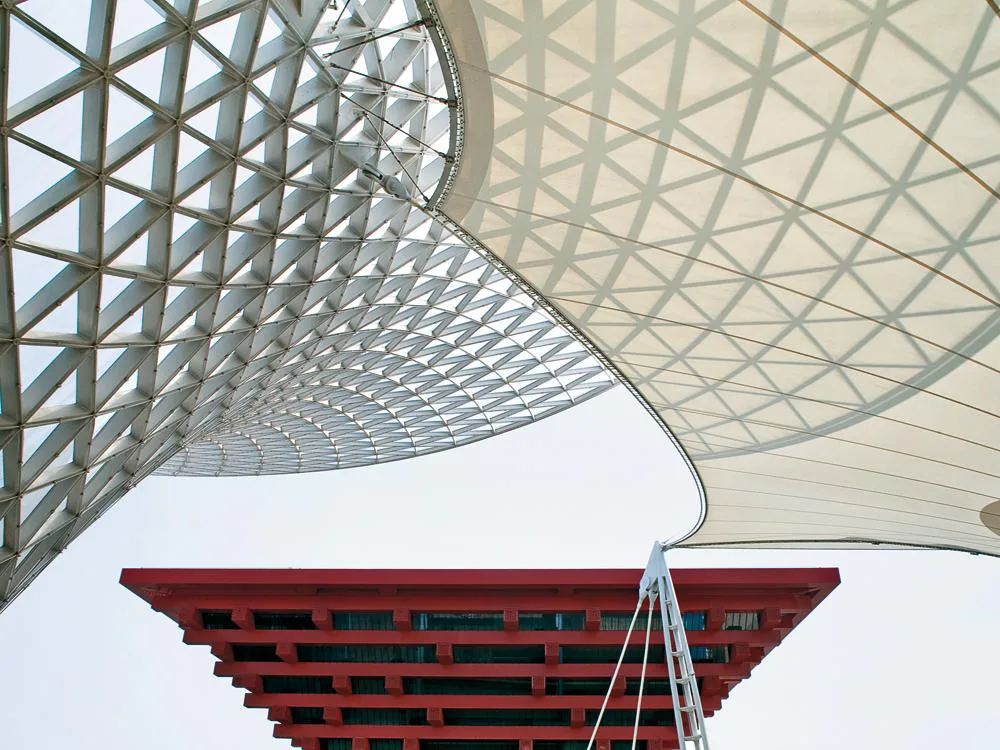
Discussion: Expo 2010 Shanghai - Just a Big Front?
At the onset of the industrial revolution in England, Sir Henry Cole had a brilliant idea: to bring together in one exhibition technical innovations from around the globe, to be hosted in London, then the capital of the world's economical powerhouse. At this first world exposition in 1851, with his Crystal Palace, Joseph Paxton - originally trained as a gardener - almost unwittingly designed a prelude to modern architecture. The Eiffel Tower (1884) paved the way for skyscrapers. Later, in 1929, Mies van der Rohe's Barcelona Pavilion became synonymous with flowing space. And in 1958, Le Corbusier and Yannis Xenakis created the first computer-operated, multi-media, Gesamtkunstwerk merging spatial dramaturgy with the building shell. All along, world expositions have been far more than a laboratory for architectural experiments. They are seismometers of a global society that is growing ever closer together, a reflection of the Zeitgeist, and, in the best-case scenario, a projection into the future. But where do we stand today? Is the Expo pavilion outdated per se in an era in which information is ever-present on the Internet? Or are they in demand more than ever by a crowd that wants to experience the global event with all five senses?