
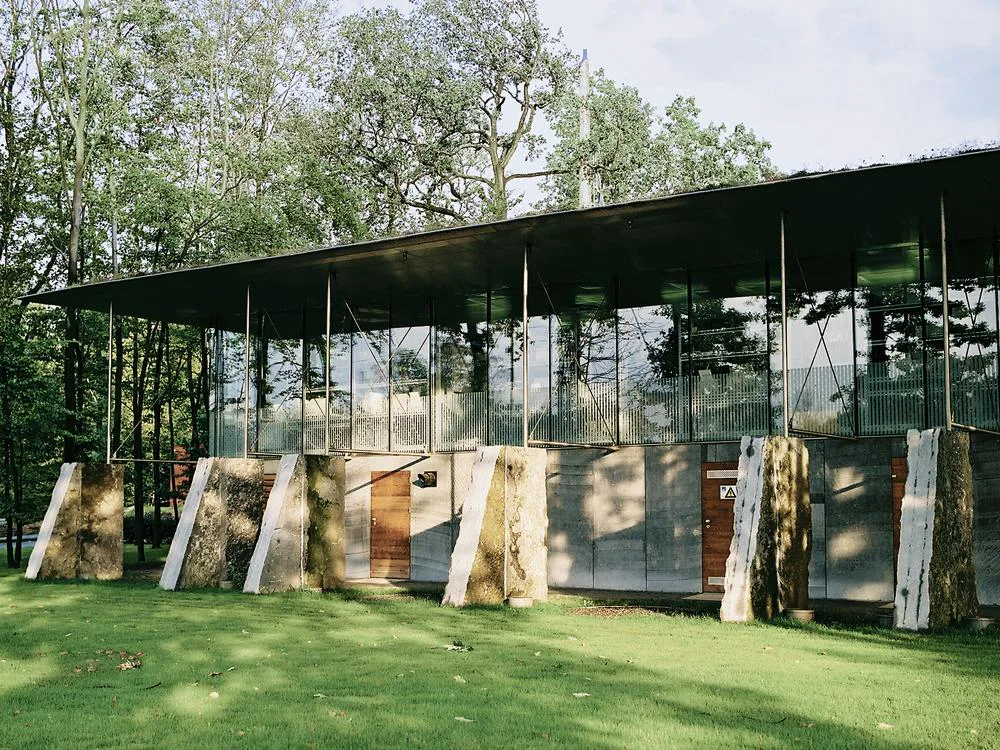
Belgium is for many the first country that springs to mind as a source of natural stone, yet only very few contemporary stone buildings rise up above its flat plains. Stone is of course present in architecture in Belgium, almost omnipresent in fact, but it is used extremely sparingly. Which is a curious anomaly in a country famous for its quarried stone. The Belgian architect Jos Delbroek remarked ironically, “Belgium is a country dominated by the colour grey, as you can see from the two typically Belgian building materials, natural stone and zinc. No Belgian building seems to manage without these materials, from the smallest farmhouse to […] the most luxurious town villa.” 1. Norbert Nelles, a committed user and advocate of natural stone, believes that, if there is a general resurgence of interest in stone, then Belgium is “still right at the very beginning”. The main reasons for this, he argues, are lack of funds, lack of the relevant trade associations and building skills, and a serious shortage of people with a proper understanding of the material and the different kinds of stone available. All of which leads to a disinclination to take risks, concludes Nelles. His own architectural practice, Artau, is the exception, with stunning designs that re-interpret the tradition of building in stone, like the rubblestone-clad house in Mont-Malmédy (1999; see page 1270 ff.Although most architects in Belgium seem uncomfortable about designing with stone, upon closer inspection, the picture is perhaps not so bleak. Throughout the country there are examples of contemporary buildings in stone – the projects of Daniel Dethier & Associés and the office building of CCB-VKB/Jo Crépain spring to mind. For architect Charles Vandenhove, one of the most highly respected designers in natural stone, the benefit of the material lies in its durability. His buildings reveal his tremendous sensitivity and feeling for the use of stone. Vandenhove’s renovation of a house in Liège (2001) is a demonstration of his skill and eye for sculptural and chromatic effects.
The use of natural stone today
Today stone in building construction has lost the structural function it had in the past. It is used exclusively as an outer skin, prized more for aesthetic and symbolic values rather than for its protective function. Stone is irrefutably a symbol of power, a fact demonstrated very well in the recently completed banking district by the canal in Brussels, in most public buildings and in prestige projects. Stone is associated with ‘quality work’; it engenders respect, lends authority and brings recognition.
Stone also speaks of a certain tradition, even though today it serves merely as cladding. In more elaborate private homes – often under a neo-modernist banner – the choice of facing often falls on this lively building material, which stains easily and quickly takes on a patina. The houses designed by architects like Marc Corbiau, Baudouin Courtens, Vincent Van Duysen and Christine Conix demonstrate this trend. Shops, entrances, important public buildings, and works for public spaces are often built using stone. Examples are the luxurious boutiques of François Marcq and Raoul Cavadias. And the public space projects of architects A.V.A. in Brussels, and the design of the Place d’Armes by Atelier 4D in Namur. An imposing example is the bridge at Val Benoît in Liège, designed by architect René Greisch (1997–2000), which is a symbolic blend of granite, steel and glass.
Although stone is always associated with technical and financial constraints, the material undeniably has its own language and traditions – and its limits. Also, each type of stone has its own specific characteristics which determine how and where it can be used. The material itself has an inherent aesthetic, which the architect is generally glad to work with. Yet the risks must always be borne in mind, explains Yves Delhez, who has designed and built many private houses. He admits to liking stone, but he tends to use it in combination with other materials and then only as a facing. In this way he solves the problems of damp and insulation, and keeps costs down – the biggest cost factor with stone not being the acquisition costs, but labour on site. This is a strategy many architects adopt. Instead of devoting themselves to just one material, they keep an open mind, and decide which materials to use in the particular context.
Across all architectural trends – ‘organic’, ‘experimental’, or ‘new’ – no one material is automatically preferred over another. In some cases using stone would be the wrong thing to do – for reasons of function, principle, setting, or the expected lifetime of the building. Architect Philippe Samyn, for example, opts in faceless inner cities for ‘dishwasher-proof’ buildings, generally in metal and glass. When an architect decides to use stone – Belgium’s ‘indigenous’ building material, as it were – then he is deliberately tapping into deep-rooted associations. In the residential and office building in Vodelée (1997) by Jos Delbroek, for example, we find an archetypal fantasy house, such as children might draw. The building is clad entirely in stone – pink marble rubblestone and slabs of bluestone and Vinalmont limestone. Here the use of stone enables a dialogue with the location, an approach towards the ‘genius loci’.
Connecting with the natural environment
Location and environment can inspire the choice of building material. Many rural buildings seek integration with the landscape, in line with the theory that the best building material is the one found locally. At the same time stone gives a structure meaning and corporeality. Marc Grondal showed this particularly well in his Environmental Education Centre in Saint-Hubert (2001), and Nelles in the Pavillon Lilien in Berinzenne (2000); there stone was actually cut from the site itself. In a similar vein, Eduard Cornil and Philippe Hermans’ Bat Study Centre in Comblain-au-Pont (2001), built on the site of a former quarry, was faced with rubble sandstone, stacked in layers, following the local style of dry stone walling. Elsewhere buildings are placed on stone plinths, as a way of literally and figuratively anchoring then in their natural surroundings and local traditions.
This new enthusiasm for stone extends not only to new builds, but also to renovation and conversion projects, like the meat hall in Liège by Pierre Hebbelinck and Alain Richard. Perhaps now stone is finding its way into contemporary architecture in Belgium – slowly, cautiously, but hopefully, permanently. I look forward to further developments over the coming years.
Belgium has always been rich in raw materials. With the decline of coal mining, however, attention has turned to the country’s natural stone reserves. The industry is worth 100 million euros per year, of which 20–30% is exported1. Its output of an estimated 850,000 tonnes/year accounts for 1.4% of total world production, but it’s consumption is at 1.7% of world output2. Today 17 different types of stone are quarried in Wallonia; these are divided into calcareous and siliceous. Calcareous stone: The most well known are the highly versatile bluestones. Meuse limestones are similar in characteristics, but when used outside their ground surfaces gradually become lighter. Tournai limestones are excellent for marble work, but they need a resting period before use in outdoor applications. The very evenly surfaced Black Golzinne marble, used for floors, interiors, sculptures, etc., has to undergo the same treatment. The red, pink and grey toned marble from Philippeville is popular for decorative purposes inside and out. Grand Antique de Meuse marble is only for internal use. The light colour and the hardness of the sandy limestones mean they are a good choice for floors, walls, facings and interiors. Siliceous stone: The hard sandstones are traditionally used as split stone on walls and floors, to give a rustic effect. Arkose, with various surface finishes, is found in ashlar work in northeast Ardennes. Quartzite is highly resistant to grinding, and so it is generally left unfinished, or only coarsely broken up. Schists are suitable as a flat stone for traditional rubblestone facings or dry walls, floors, graves and interiors. Slate is used as a covering, for shingle roofs and walls, but also for indoor and outdoor floors. Flint is used not only for industrial applications, but also for facing masonry or cobbles.


