
Bamboo grows around the world, particularly in the tropics, and is endemic to all continents except Europe, where it died out during the last major ice age roughly 11,500 years ago. Belonging to the sweetgrass family (i.e. to the large and important family of Poaceae), which includes rice, maize, wheat and sugar cane, it is most widespread in Asia and South America. Bamboo grows as a grass from a branching rhizome or rootstock. After two to three years, the individual stems become lignified and ultimately die off after eight to ten years. This process of lignification is of prime importance for the application of bamboo as a building material; only at that stage are the canes dense and strong enough for use. Furthermore, the network of roots is an important means of protection against erosion. The roots also store moisture and filter out impurities. Bamboo is the fastest-growing plant of all, reaching its maximum height (between 15 cm and 40 m) in a matter of weeks or months. Diameters of between a few millimetres and 30 cm are possible. On average, stalk lengths range between 8 and 15 m, with a 5–12 cm diameter and a wall thickness of 10 mm. The enormous growth rate is based on the older stems storing and liberating large amounts of starch.
Although bamboo undergoes a process of lignification, it does not form wood in the normal sense of the word. Nevertheless, it is described as a “wood” because its technical properties and lignifying cell structure are quite similar to those of wood tissue.
The date of harvesting is of decisive importance for the quality of the material. Only lignified stems that are at least three years old have adequate strength. Either the canes have to be regularly marked, or great experience is necessary to recognize the age and degree of maturity. If the canes are harvested too early, the material will be of poorer quality, and the further life of the plant itself will be jeopardized. With the correct treatment, however, bamboo will continue to grow and does not have to be replanted. The best time for harvesting is after new shoots have emerged. At that point, the energy stored in the plant will have been used up, and the cut canes will be much less vulnerable to parasites, which also consume the starch as nourishment.
After being cut, a proper bamboo cane is virtually ready for use and is thus a model for the efficient application of materials. A hollow tube has roughly twice the moment of resistance of a solid member of the same cross-section. In most cases, bamboo is hollow and made up of a series of nodes, internodes and diaphragms. As a plant stalk, bamboo is slender and conical in form. Not only is its diameter largest where it has to resist the greatest bending forces, namely at its base; its wall is thickest there, too. In addition, the diaphragms, which have a bracing effect, are closest together at this point (ill. 2). The internodes consist of parallel fibres in a strictly axial alignment. Only at the node points do they intersect in all directions. If one studies the wall of an internode, one sees a dark outer zone of approximately 30 per cent with a dense arrangement of fibres (ill. 3). This structure possesses a tensile strength almost twice as great as that internally.
The arrangement of the dense, strong fibres in the outer areas is further evidence of the structurally logical make-up of a bamboo cane. The outer fibres are enclosed in an extremely dense, hard skin. The surface is usually very smooth and offers good resistance to chemical or mechanical damage (through insects, for example). Bamboo does not have an outer bark in the conventional sense of the word, however. During its growth, the young stalk is merely protected by leaves that grow from the nodes and that wither and often fall off after a few months.
Because of their hollow, cylindrical structure, bamboo canes have special properties that differ from solid, homogeneous materials. Expressed in simple terms, one might say that they have similar characteristics to softwoods and hardwoods, occupying a place somewhere between the two.
One difference, though, lies in the strictly parallel, axial arrangement of bamboo fibres, which means that canes split readily along their length. As a result, they are ideally suited to making baskets or similar woven objects. The behaviour of bamboo in terms of swelling and shrinking resembles that of conventional buiding timbers; and as with solid wood members, too rapid drying and a humid indoor climate are likely to lead to splitting. The mechanical, technical properties of bamboo are regarded as extremely good; sometimes they are even compared to those of steel.
Only the dense outer zone of the cane has such high values, however. The density of common varieties ranges from about 600 to 800 kg/m3 in a dry state. The chemical structure of lignified bamboo ready for harvesting is very similar to that of the wood from fir trees. The elasticity of bamboo is considerably greater, though. With the appropriate design of a load-bearing structure, therefore, it is a good material for areas subject to earthquakes. It is combustible, but flame resistant.
Bamboo cane comes from various countries and has many different dimensions and colours. The drying process is important to ensure rot-free transport, since the material may be enclosed for up to six weeks in airtight containers. Young bamboo stalks are greenish in colour and turn yellowish-brown and even black when they are older. Artificially coloured canes are also available (ills. 21–23). Chinese phyllostachys varieties with diameters of between 10 and 180 mm and lengths of up to six metres are commonly obtainable on the market. Chinese bamboo is known under the general name of “Moso”; it has a uniform yellow or yellowish-brown coloration and a smooth glossy surface with projecting nodes. The distance between the nodes increases quickly with greater height, whereas the wall thickness and diameter of a cane decrease upwards. This conical form varies from one type to another. The Latin American Guadua bamboo is something of an exception in this respect. It can reach a height of up to 30 m and has a diameter of 100–150 mm, but is only slightly conical in growth. As a result, it is popularly used in load-bearing situations. Guadua has a lively yellowish-brown appearance, sometimes with black patches. It has a smooth, but matt, surface so that paint adheres relatively well. Less common types on the market include the black Nigra bamboo, the brown-black mottled Boryana (both from East Asia and up to 40 mm in diameter),
Dendrocalamus varieties (30–35 m high and up to Ø 250 mm) and the black Wulung (Ø 50–150 mm, with relatively large node spacings of 40–70 cm). Both the latter varieties come from South and South-East Asia.
The durability of bamboo stems is influenced by a number of factors. The cane does not contain a natural protective agent as larch and oak do. It is important, therefore, to ensure the selection of good-quality material, proper treatment and a sound form of construction. The dense, hard surface of bamboo guarantees good durability in the short to medium term; but for longer life, various precautions have to be taken against surface weathering, parasites, rot and the growth of fungi. As described above, the time of harvesting is extremely important in this respect. After cutting, the branches and leaves should not be removed immediately, since they continue the process of photosynthesis and use up any residual starch in the cane. Other advantages of this “clump-curing” method, as it is known, are an improved drying process and a reduced risk of splitting. Nutrients are removed by means of soaking, steaming or boiling. The material can also be smoked or treated with boracic salt or other protective substances.
A moisture content of less than 18 per cent guarantees sound material. When building with bamboo, therefore, it is important to ensure a form of construction that allows the material to dry out regularly. Constant contact with moisture should be avoided. Waterrepellent coatings or paint are also useful, and they help to maintain the visual quality of the material. But it is wiser to avoid the absorption of moisture as far as possible by means of sound constructional measures.
Bamboo is sometimes straightened in its country of origin through a heat process. It cannot be bent to the extent that rattan can. For bending, a certain moisture content is needed. Exposed to high temperatures over a long period, the material may be weakened, however. Bamboo can be worked in a similar way to timber – in other words, it can be sawn, ground, planed, etc. The high silicic acid content of the outer skin requires the use of particularly sharp tools and special care to avoid fraying. The material has a wide range of applications. In addition to its use in building, bamboo is also utilized in the production of foodstuffs, charcoal and textiles. There are (or were) many more applications for this material in Asian countries, where the saying exists: “You can live without meat, but you die without bamboo.
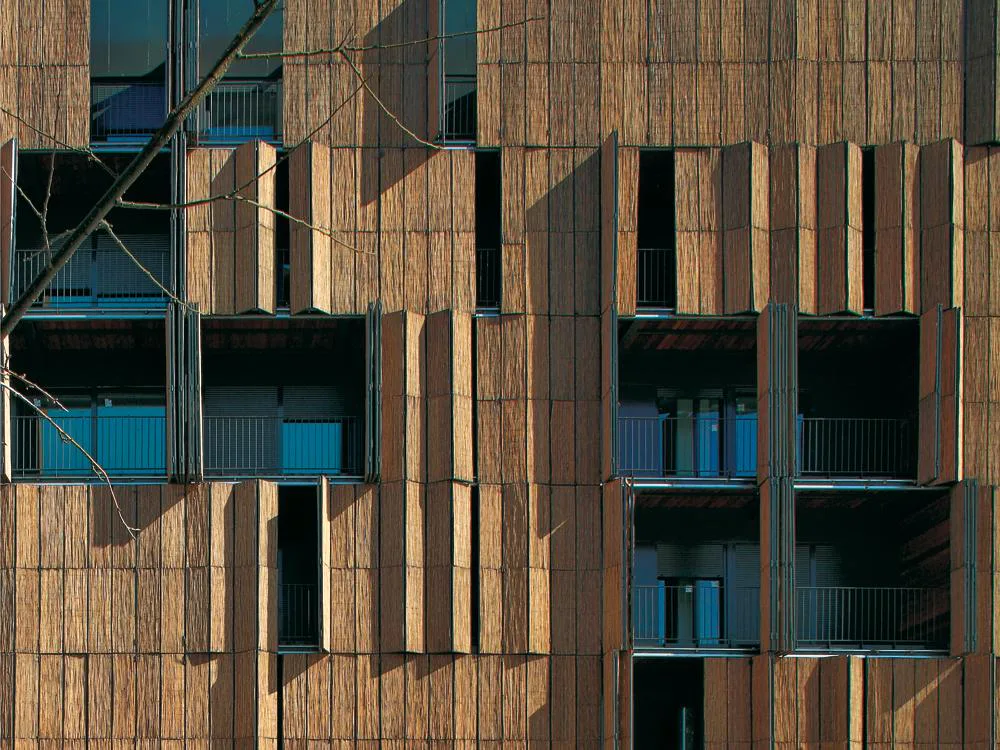
In the building sector, bamboo is enjoying increasing popularity today. The market for sheeting products made from this material is growing all the time, too, although it still leads a marginal existence compared with wood. Ecological criteria for its use include the fact that bamboo is a quickly regenerable material, and helps to avoid the felling of trees. In the meantime, however, bamboo forests are endangered through the great demand for this material and through the harvesting of canes that have not matured. Bamboo sheets are used as flooring and in laminated boarding, while the canes are increasingly applied to make facade cladding, partitions, screens and fences. A striking example of this may be seen in a house near Badaling in China by Kengo Kuma (see ill. page 651 and Detail 5/2003).
The many different types of bamboo, with their lively, natural appearance, make the material popular for decorative purposes and sculptural elements, too. Any lingering sense of a neo-colonial look can be avoided by employing modern design forms. Despite all the advantages it offers, though, bamboo is used to only a limited extent in the West. That is largely because designers and craftsmen lack the know-how for its application. The labour input is often expensive, and certain bureaucratic barriers have to be overcome as well. Nevertheless, even in Europe, some notable structures have been built with this material.
Bamboo consists of hollow tubular canes with different internal and external diameters that are never perfectly circular, so that jointing them poses special problems. Care has to be taken to avoid longitudinal cracks, too. Traditionally, the canes are jointed by means of inserted connections, or straps and cables. In East Asia, connections are made by tying the members together, with plastic often used for this purpose today (ill. 27). In Colombia, a modern form of construction has been developed over the past 20 years using native Guadua bamboo. In the meantime, these techniques have spread around the world, with screw-threaded members used to connect the canes. For additional strength, the hollow sections may be filled with mortar and/or reinforced with steel straps screwed on the outside. In this way, space-frame structures are created of quite individual form. Because of the low performance of the connections, structures have to be executed with additional material. In the context of the seminar “Building with Bamboo” held by the department for load-bearing structures in the faculty for architecture of the Rhenish-Westphalian University of Technology (RWTH) in Aachen, intensive work was carried out from 2000 to 2004 to address this problem. Initially, the idea was to use bamboo stems to build filigree framed structures similar to those constructed in steel. The jointing technique proved inadequate for the implementation of this concept, however. Confronted with this challenge as a student, the author undertook a period of practical training in Colombia with the bamboo specialist Jörg Stamm and began to develop an efficient connection for bamboo canes. This work was continued at the RWTH in a team headed by Dr.-Ing. Evelin Rottke; and in collaboration with Dr.-Ing. Hans-Willi Heyden, the group followed a design and constructional approach. Laboratory tests were carried out and experimental structures built. Load-bearing trials were undertaken in the neighbouring materials laboratory of the faculty for building engineering. The aim was to come to terms with the material and its geometric pecularities, to exploit the load-bearing capacity of naturally grown stems and to create a product that would have a design quality of its own.
With the appearance of modern materials such as steel and cement, bamboo gained the reputation in its countries of origin of being a material for the poor. In the meantime, however, various projects have demonstrated that it is suited to more than simple settlements and publicly assisted low-income housing. Prominent architects like Renzo Piano and Shigeru Ban have experimented with bamboo; and to mark the opening of the ZERI pavilion for the Expo 2000 (ills. 8–11), the Vitra Design Museum devoted a whole book to this “fantastic grass”. The Colombian architect Simón Vélez, who designs striking bamboo structures for wealthy clients, was responsible for this pavilion. It attracted great attention, but was pulled down after the exposition to make place for a parking area. Gunther Pauli had commissioned Simón Vélez with the construction of a bamboo pavilion for his Zero Emission Research Initiative (ZERI), but in the run-up to the World Exposition, the German authorities regarded the scheme extremely critically, since there was no safe body of knowledge relating to this non-native material. Vélez’s design was also questioned, and considerable work had to be done to prove the structural stability of the building. A prototype of the pavilion was built in Colombia and subjected to various loading tests by Prof.
Dr Klaus Steffens, who at that time was head of the Institute for Experimental Structures at the University of Bremen. Steffens was impressed, since the deformation under loading was in part considerably less than calculated. Parallel to the experimental structural analysis, Dr Simon Aicher at the Otto Graf Institute in Stuttgart investigated both the material, bambus Guadua angustifolia, and the jointing techniques. Ultimately, a proposal was simply made for improving the process of granting permission for the building. Further loading tests carried out on a complete structure in Hanover demonstrated the actual functional efficiency. The German-Colombian joiner Jörg Stamm was responsible for the constructional drawings for the submission, since Vélez makes only hand-drawn sketches for his audacious schemes.
As early as 1996, Jörg Stamm built the first modern bamboo bridge in Colombia. He, too, had to struggle with the local authorities on that occasion, because he could find no structural engineer in the area to do the calculations for him, and without the appropriate structural analysis, building consent could not be granted. Prof. Dr Wilfried Führer and his team in the department for load-bearing structures at the RWTH, Aachen, was most enthusiastic about Stamm’s idea and provided the relevant calculations.
In the meantime, Jörg Stamm has made a name for himself worldwide as a master builder specializing in bamboo bridges. With two structures on Bali, he recently gave an impressive demonstration of the potential of this material. A jewellery producer commissioned a bridge (ill. 5) and a hall, both of which were implemented. The load-bearing structure of the tent-like hall consists of three slender, hyperbolic cylinders with tension rafters (ills. 13–15). Here again, Stamm enjoyed the support of German engineers. Prof. Dr Ulrich Neuhof and students in the department of building engineering of the University of Applied Science in Erfurt investigated and calculated the load-bearing structure during an excursion to Bali. The first permanent building in Europe to be executed in bamboo – the Vergiate Pavilion in northern Italy – was erected in 2003 to meet local public needs (ills. 19, 20). The initiators of this project, Valeria Chioetto and the architect Neri Braulin, drew inspiration from the work of Simón Vélez. The building was erected during an international workshop and uses similar connecting techniques to those found in the ZERI pavilion.
In Luxembourg in 2004, a bamboo dome was built that is probably the largest of its kind in the world. It was designed by the author as part of his diploma studies (ill. 26). The construction of this dome was aided by the development of an efficient cane connection and not least by the active support of numerous students and Scouts during the erection phase. With a diameter of 13 m and a height of 11 m, and using up to eight-metre-long canes, the bamboo dome is an impressive demonstration of the effectiveness and structural potential of this material.
Using the same connection technique, the first permanent load-bearing bamboo structure in Germany was erected in Darmstadt. The Shaktihaus planning team created an office building in that city with a roof structure borne by 33 bamboo columns (ill. 29). In addition to using bamboo, other ecological solutions and materials were applied, such as clay-rendered bales of straw for the walls. This bamboo structure stands in a public open space in front of a high-rise student hostel and is surrounded by large fountains and coloured mosaics. With its organic lines, the office building forms the balanced, harmonious centrepiece of this ensemble. Externally, the curved lines and bold dome light are the outstanding features. The offices are used by a car repair shop. The 33 bamboo columns stand visibly in the internal space. Without demanding any further examination, the Ministry for Economics and Technology in Wiesbaden granted its approval for the individual elements of the construction on the basis of the conclusions reached in Aachen.
In the meantime, the jointing system has been developed further by the Conbam company.
It has also been successfully applied and has won a number of prizes (ill. 25). In 2005, the architects Anna Heringer and Eike Roswag built a school with earth and bamboo in Bangladesh (see Detail 4/2007), for which they received, among other things, the Aga Khan Prize for Architecture.
The international standards and regulations relating to bamboo that have been issued to date are concerned with its dimensions and relevant forms of construction (ISO 22156), as well as with its physical and mechanical properties (ISO/22157 – parts 1 and 2).
If one considers that there are more than 300 standards relating to wood, the enormous backlog in terms of bamboo becomes apparent. A lot remains to be done on all fronts – from forestry to the application of the material – to establish bamboo as a useful product. For example, there is a lack of reliable information on the properties of the different types, such as their strength and behaviour when exposed to fire; and no classification system exists either.
Examples from the past ten years demonstrate the enormous potential of bamboo as a building product. But because of the lack of standards and regulations relating to this material, legislation limits its application. To make bamboo accessible to a broader public, further efforts need to be made in the fields of basic research, teaching, product development and marketing.


