
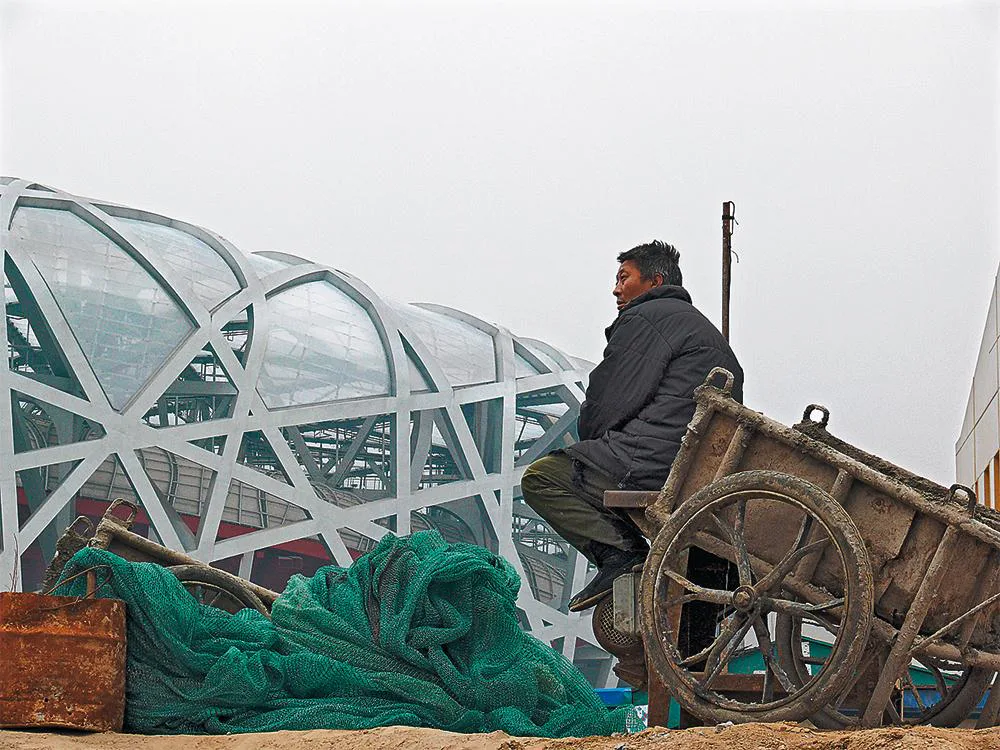
Clearly accidents, even fatal ones, happen at all large-scale building sites. But the lack of freedom in China poses special, moral issues for European architects working in this environment. China does not have free trade unions. The vast majority of the workers building all the prestige projects in the Olympic city have no insurance against accident or illness. Nor, coming as they do from the countryside, have they been properly trained to handle the risks of the building site. Just how many of them have died at the site of the National Stadium or any of the other Olympic projects is not known.
The death of migrant worker Li Weidong is another instructive example. He worked in the cellars of Rem Koolhaas’ CCTV Tower, laying electric cables, in a cold, poorly ventilated area, according to his widow, Wan Cuiyou. Then he was moved to the Bird’s Nest, also to work in the cellar. He contracted pneumonia and then lay unattended for about a week in his hut next to the stadium, before dying. A poignant contrast to the hype surrounding the celebrity architects of boomtown Beijing.
Examples like these have fanned debate in Europe. Is it right for architects to work in a dictatorship like China? Not surprisingly opinions cover the whole spectrum. At its heart this debate is not new. It started in the late 70s, early 80s, when the reforming Chinese Communist Deng Xiaoping first invited foreign investors into the country. Equally long-standing is the debate as to whether to do business in China. Most Chinese pundits now, however, support integrating China into the world community through commercial and business relations. Isolation would not bring about the desired improvements, they argue. What is nevertheless difficult to stomach are the self-righteous arguments of those business representatives who not only benefit from the boom in China, but also claim they are helping to improve the human rights situation there. Or they gloss over the real situation in China insisting that it’s nowhere near as bad as “the media” report.
To sum up: The camp in favour of economic engagement with China is not merely content to do business there. No, they then also stab those in the back – the regime critics and human rights groups – who, often with great personal sacrifice and courage, fight to achieve modest improvements in China. Now it seems Germany’s architects have also entered the fray. All the familiar elements are there: avoiding critical issues, defiant justification of one’s own involvement in China, even denying that there are any human-rights problems in China.
Happily we live in a free society, we have freedom of opinion and action. Some get involved wholeheartedly, some turn their back, others take a qualified approach, turning down only prestige Communist party projects. All of which is ok. Yes, it’s ok to build in China. It’s even ok to keep your mouth shut on the human-rights situation there. But you can do both: build in China and still speak out publicly in support of our democratic values. For example, pick up your architect’s fee in Beijing, but leave at least a little there to cover the needs of the workers who beaver away in the cellars of those new buildings. Participating in the economic development and showing backbone in political issues are not mutually exclusive, not even for architects. But if I may, I would like to make one plea: Those who build in China and enjoy the tributes they receive for their bold creations, should please refrain from claiming that they are also fighting for human rights, or improving working conditions in China. This has so far not been the case, sadly. The facts tell a different story.


