
Revitalisation of an urban space
UH Infonavit Santa Fe Park Redevelopment by AmasA Estudio
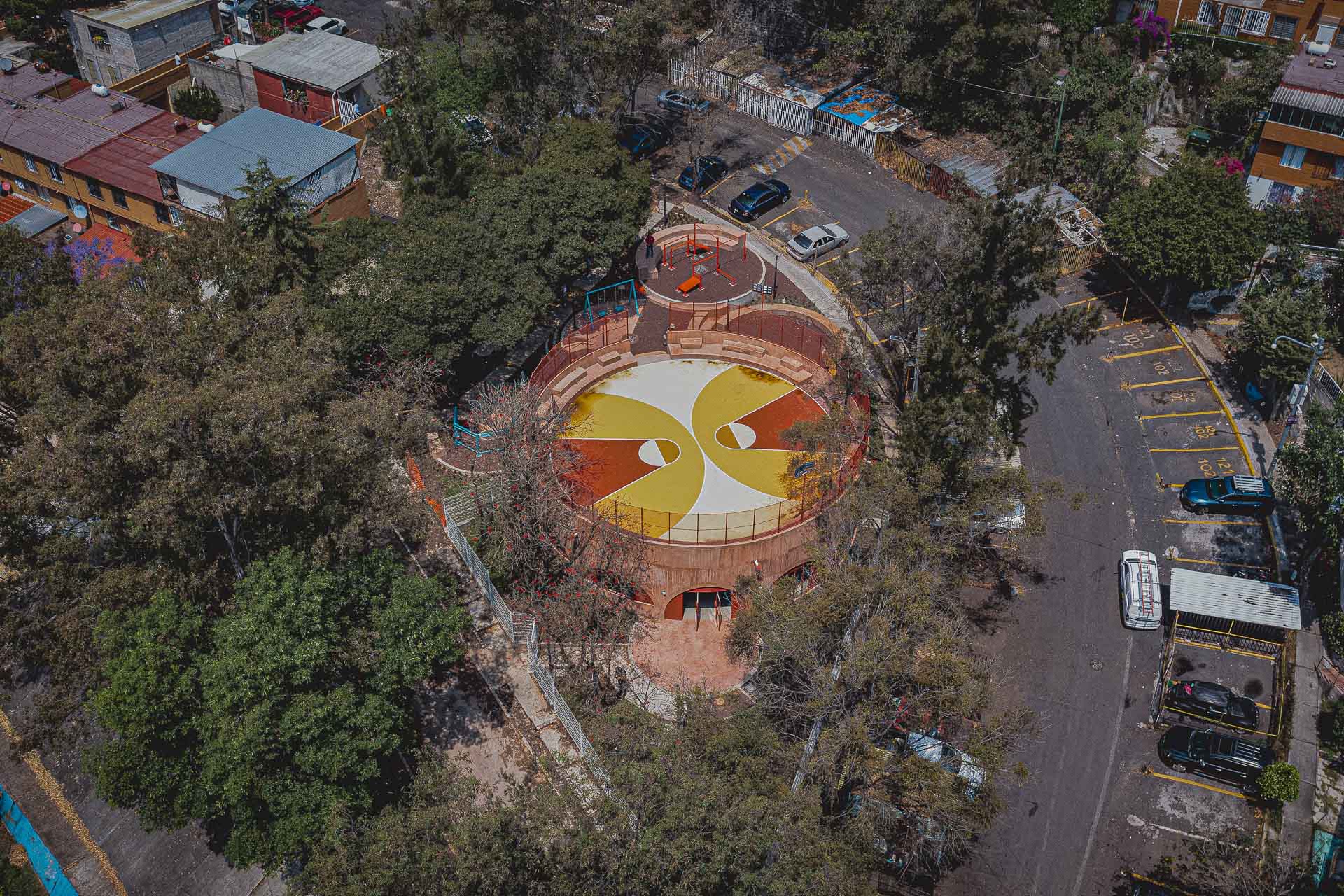
View of the newly revitalised triangular plot on the western edge of Mexico City, © Gerardo Reyes Bustamante
On a triangular plot of land on the southern edge of the Infonavit Santa Fe residential complex, the architects have breathed new life into a previously unused site. Due to structural decay, the neighbourhood hardly used the site anymore and it was increasingly considered unsafe. Rather than accepting the area as derelict infrastructure, Infonavit commissioned a comprehensive renovation of the site. The result is a new multi-purpose hall, children's playgrounds, outdoor fitness areas, and a restored sports field. Today, the area functions as an urban hub — a place that combines activity, community and safety.
Topographical conditions and challenges
One of the biggest challenges was the site's demanding topography. The Infonavit Santa Fe residential complex and the triangular plot border a 6 m deep ravine. The area also lies between two roads at different elevations, which made development even more difficult. The elevation profile presented the following technical difficulties: poor rainwater drainage; potential landslide risk; water and mud accumulation in lower-lying areas; and very dense vegetation.
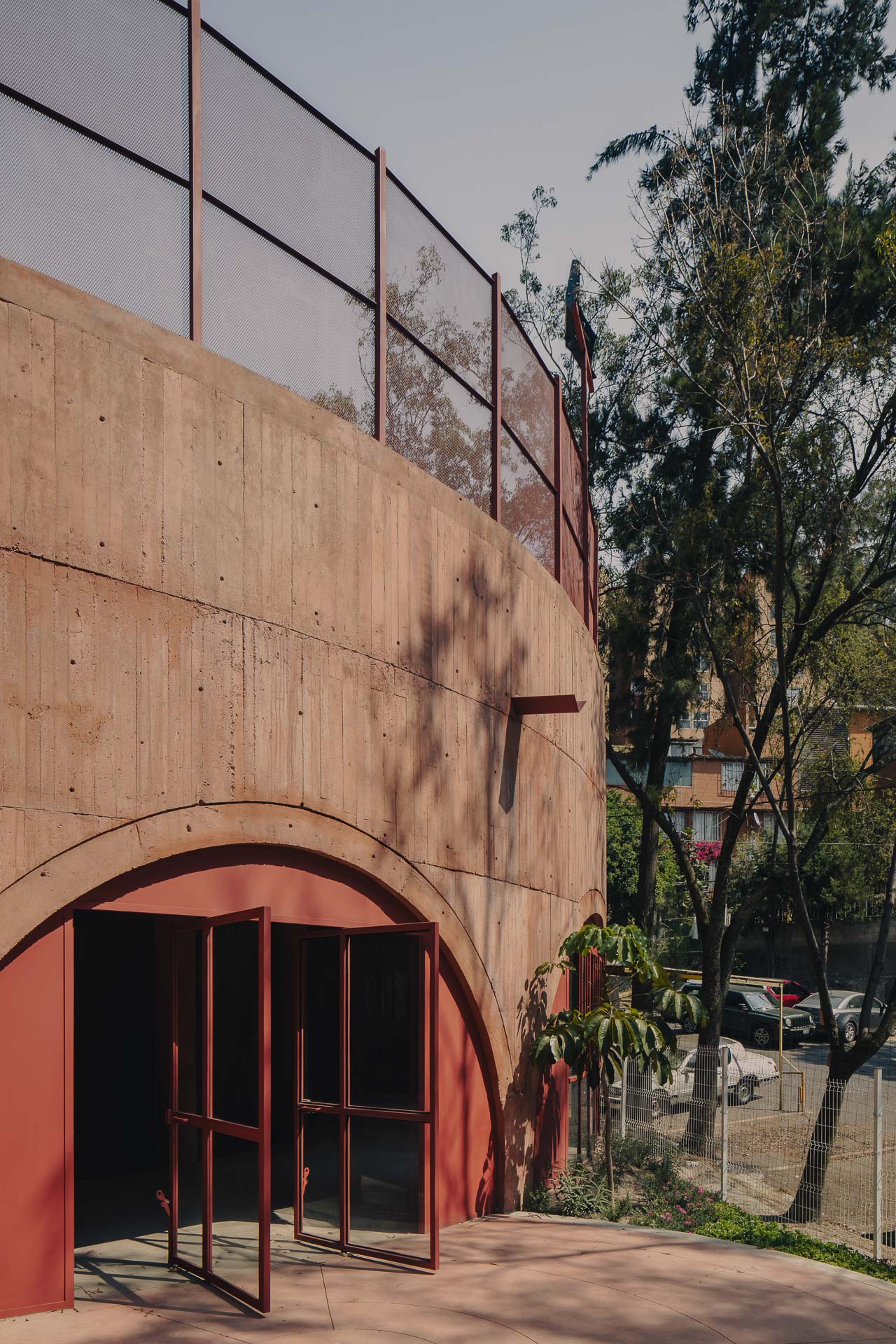
Exterior of the cylindrical multi-purpose hall, © Zaickz Moz
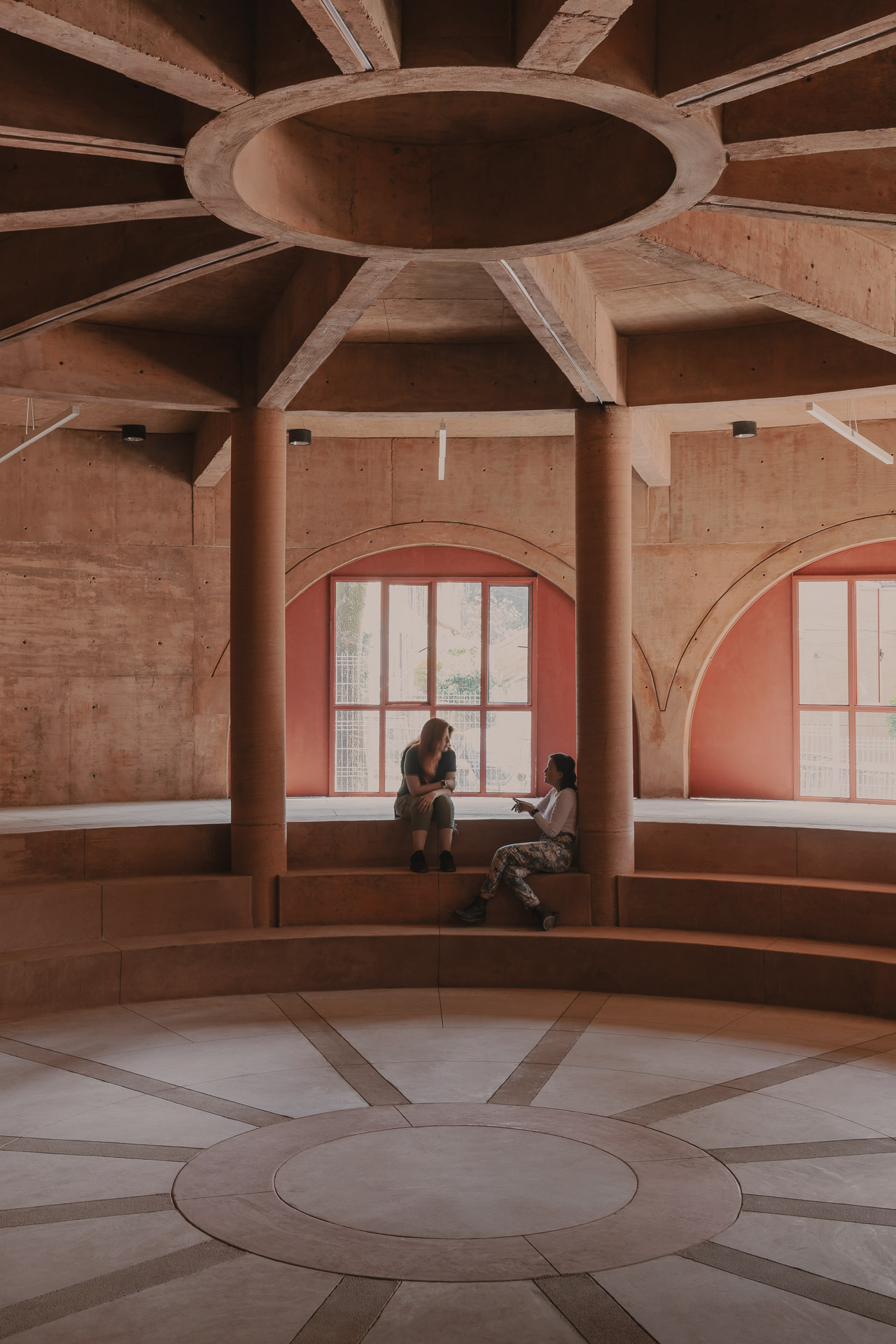
The supporting structure of the multi-purpose hall consists of radially arranged concrete columns and beams connected by a pressure ring in the centre. © Zaickz Moz
Cylindrical multi-purpose hall
The central element of the redesign is a cylindrical multi-purpose hall, deliberately positioned in the middle of the site. Its circular floor plan minimises contact with the property boundaries. This creates unobstructed sightlines and preserves existing green spaces. The compact building footprint allows for an architectural programme on several levels, making the best possible use of the challenging terrain. Terrace-like platforms at different heights surround the building in a ring, forming a continuous spiral park. The hall's supporting structure consists of radially arranged concrete columns and beams connected by a pressure ring at the centre. A double, pigmented concrete slab spanning across serves as weather protection and forms a new basketball court.
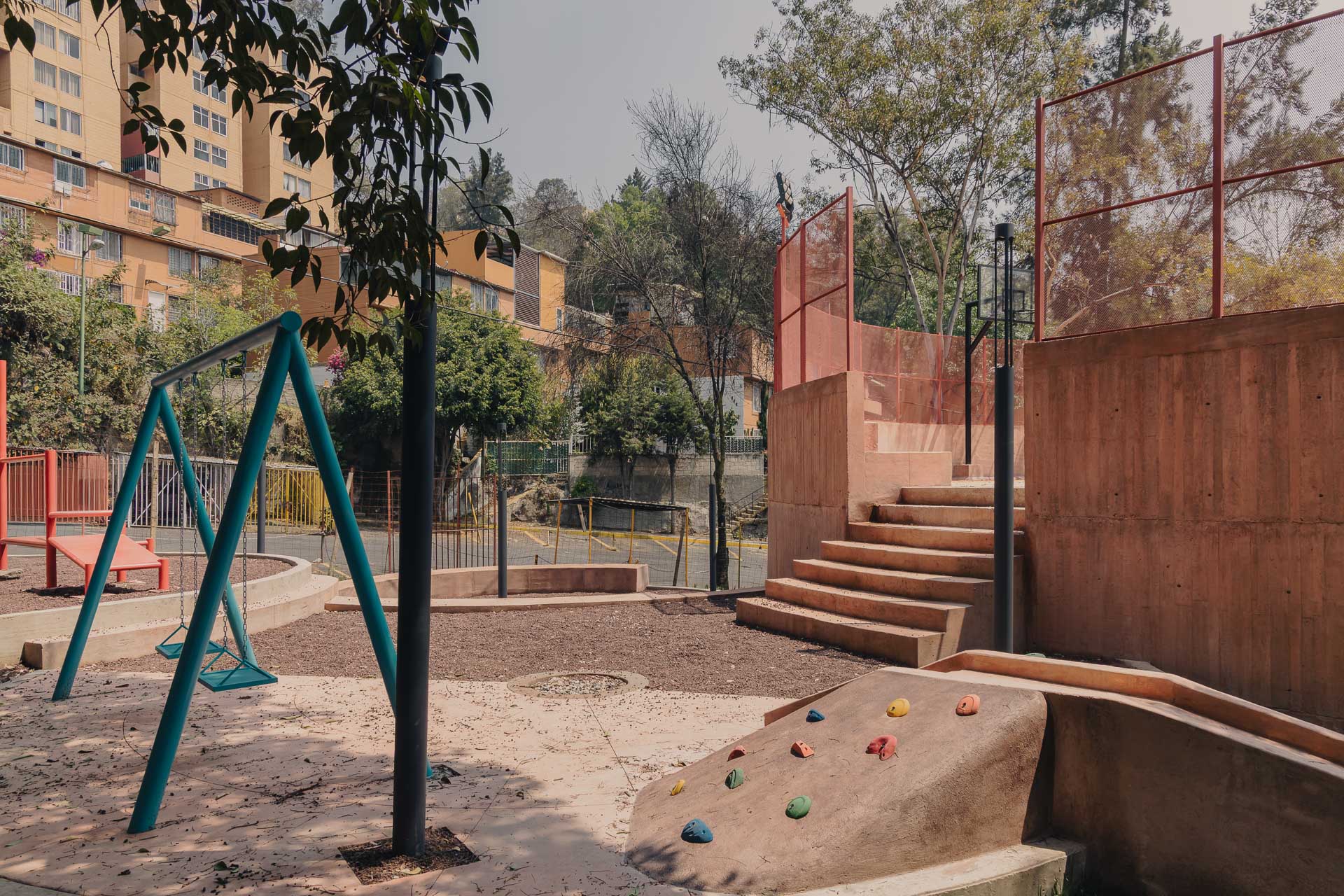
Children's playground on a terraced platform, © Zaickz Moz
Integration and protection of the natural environment
The site is surrounded by a variety of trees, including eucalyptus, pine and clorín. Therefore, a central design principle was to preserve as much of the existing vegetation as possible. The positioning of the trees was crucial for determining the location of the multi-purpose hall and the terraced platforms. The building's circular shape and carefully coordinated layout create a coherent, continuous open space. To counteract the challenges posed by the terrain and protect the new park, the architectural team installed two absorption wells to collect and drain rainwater.
More on architecture as a social and ecological catalyst: While the revitalization of UH Infonavit Santa Fe Park creates new spaces for community, Tatiana Bilbao talks about diversity and mutual care as key factors in dealing with the climate emergency in the interview “Climate Change as a Social Issue” – discover more in our database Detail Inspiration.
Architecture: AmasA Estudio
Client: INFONAVIT
Location: Santa Fe, Mexico-City (MX)
Structural engineering: Juan Felipe Heredia
Gallery


