
Urban building block in the style of the 1930s
School in Copenhagen's Slaughterhouse District
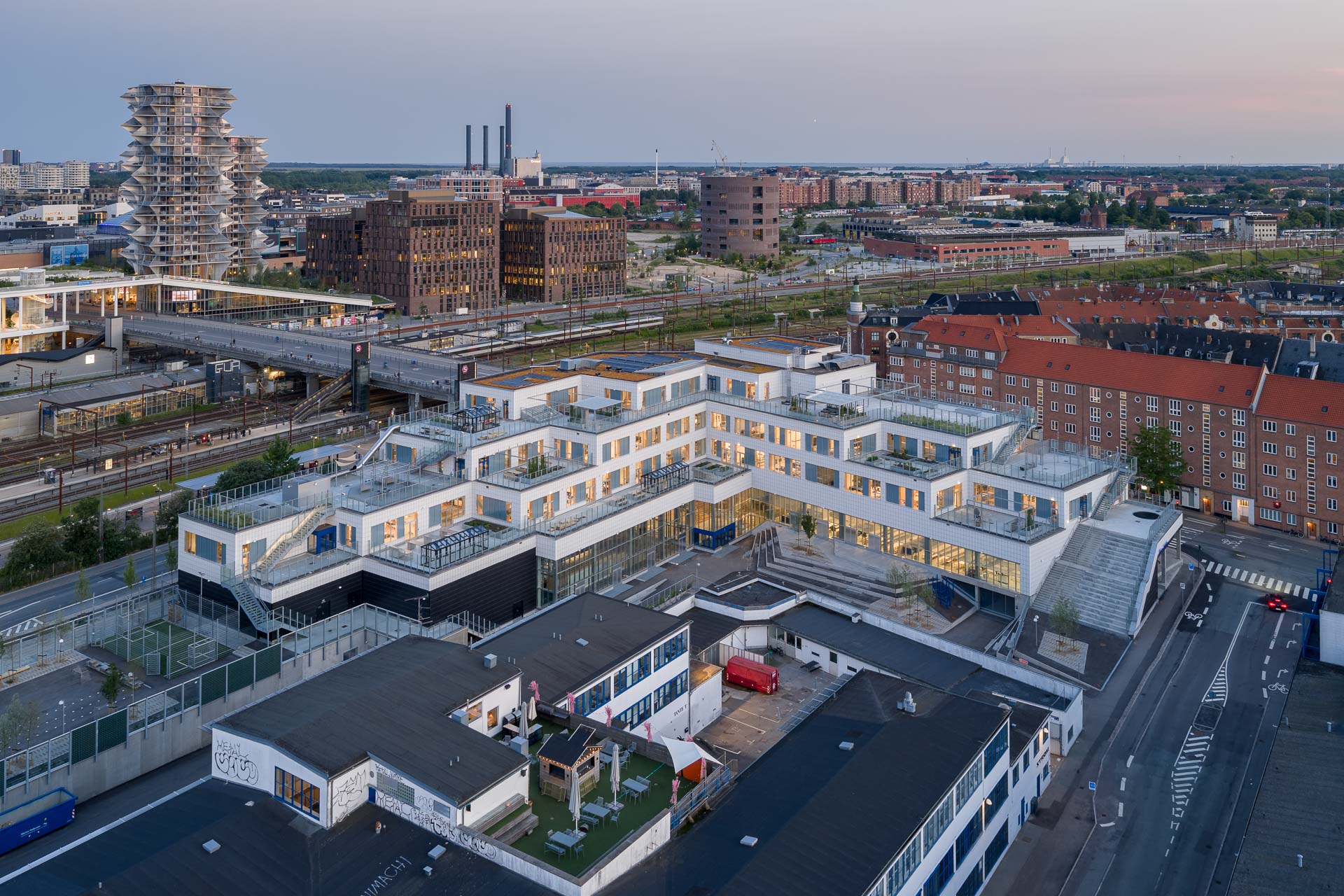
At the south-facing street corner, the school building rises to five storeys. Three of the roof levels are available to pupils as a playground. © Adam Mørk
The former Copenhagen slaughterhouse district, located south of the main railway station, is affectionately referred to by locals as “Den Hvide Kødby” – meaning “The White Meat City”. The uniformly white, functionalist-style, low-rise buildings were constructed in the 1930s and modelled on the Stockholm World Exhibition. Fifty years later, operations ceased and the buildings were listed as historic monuments in 1999. Since the area opened in 2005, it has blossomed into a popular creative and nightlife quarter.
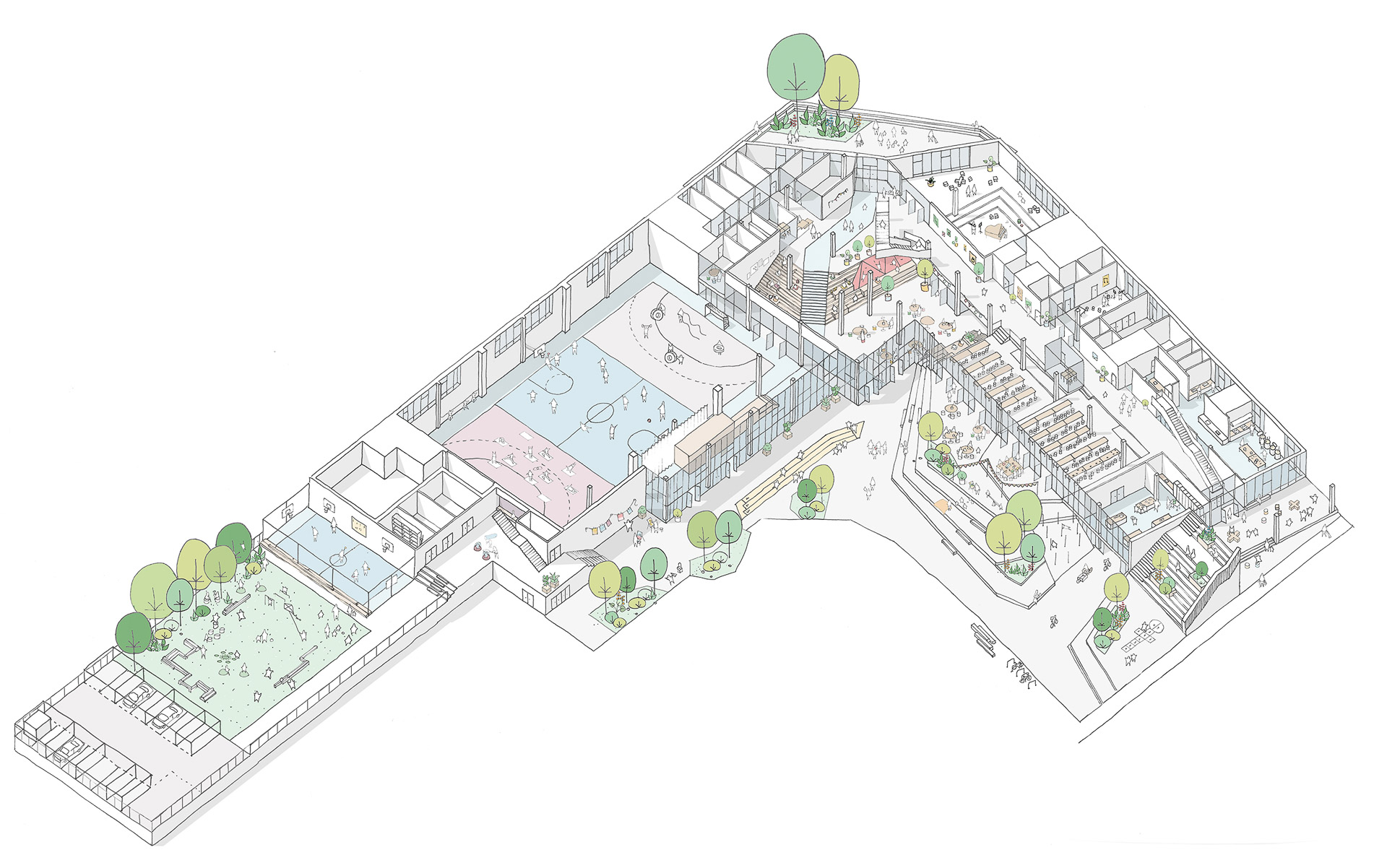
Axonometric projection of the ground floor, Graphic © Nord Architects/BBP Architects
Reinterpreting functionalism
Given the historic buildings, it was implicitly clear that the new school building designed by Nord Architects and their partners at BBP Architects would have to be stylistically aligned with them. Horizontal window bands structure the facades, while the remaining surfaces are clad in white, profiled ceramic tiles. The L-shaped building blocks off the slaughterhouse district to the south. As all the prominent Danes had apparently already been immortalised as the namesakes of Copenhagen streets or public buildings, the school was given the prosaic name “Skole ved Dybbølsbro”, after the S-Bahn station across the street.
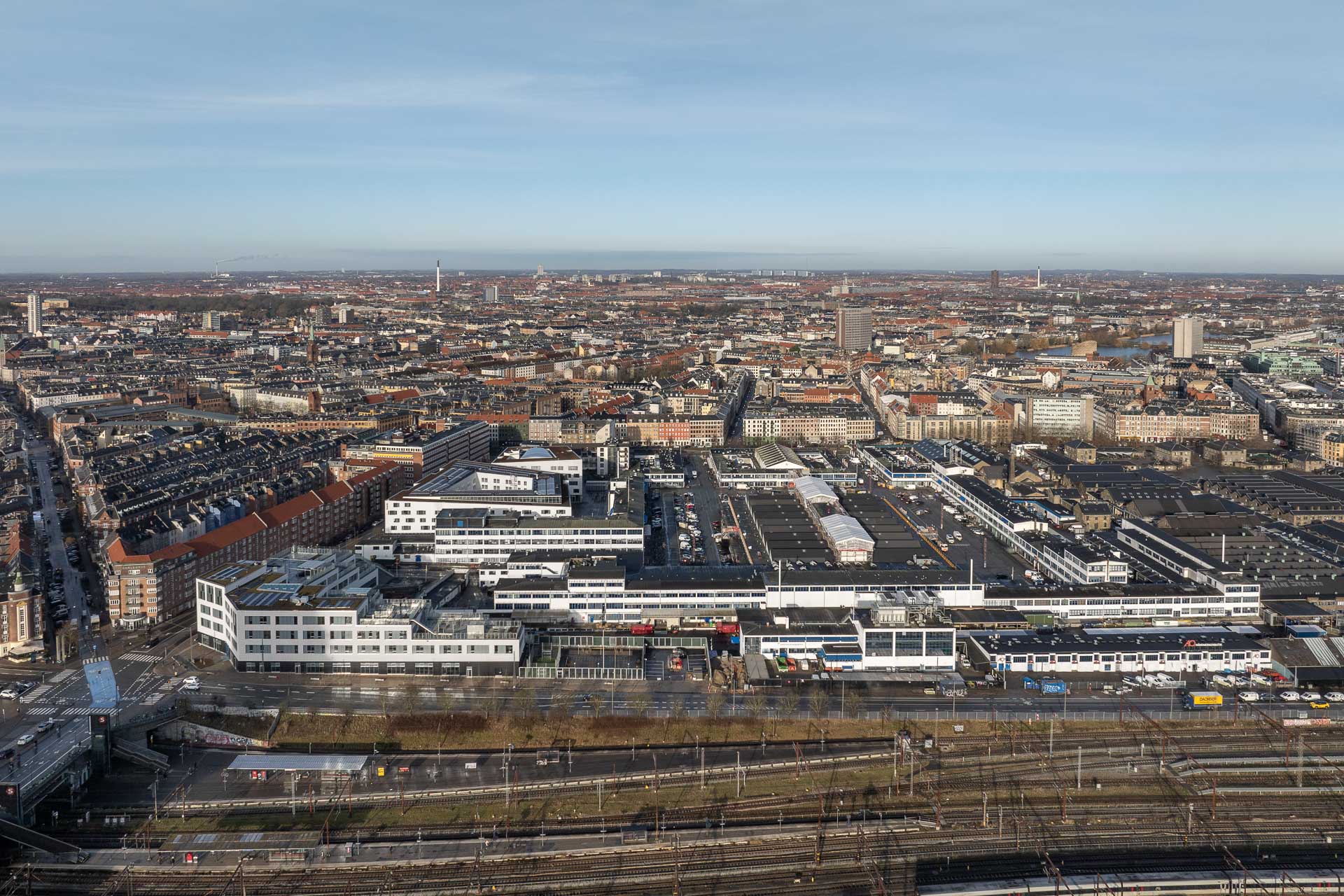
The aerial view clearly shows how seamlessly the new school building blends into Copenhagen's slaughterhouse district. © Adam Mørk
Roof terraces instead of a schoolyard
There was just enough space around the building for an open terrace in front of the canteen and a running track for athletics lessons. The planning team therefore divided most of the school playground into three roof terraces at different heights. These are connected by staircases to form a continuous circular route. The roofs feature climbing frames, sandpits, trampolines, and a somewhat cramped running track for aspiring track-and-field athletes, as well as a greenhouse and several roof gardens with plant beds for growing vegetables.
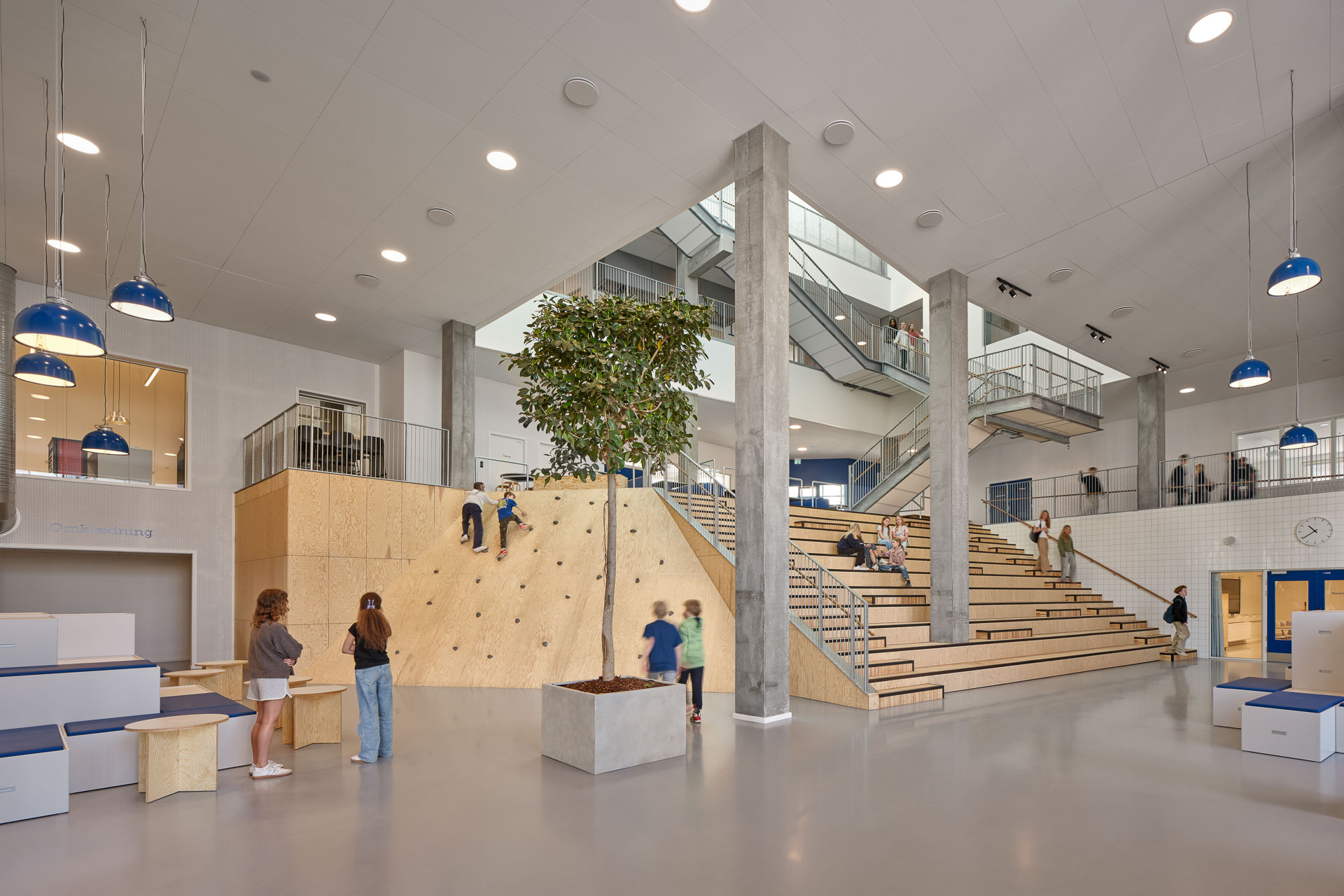
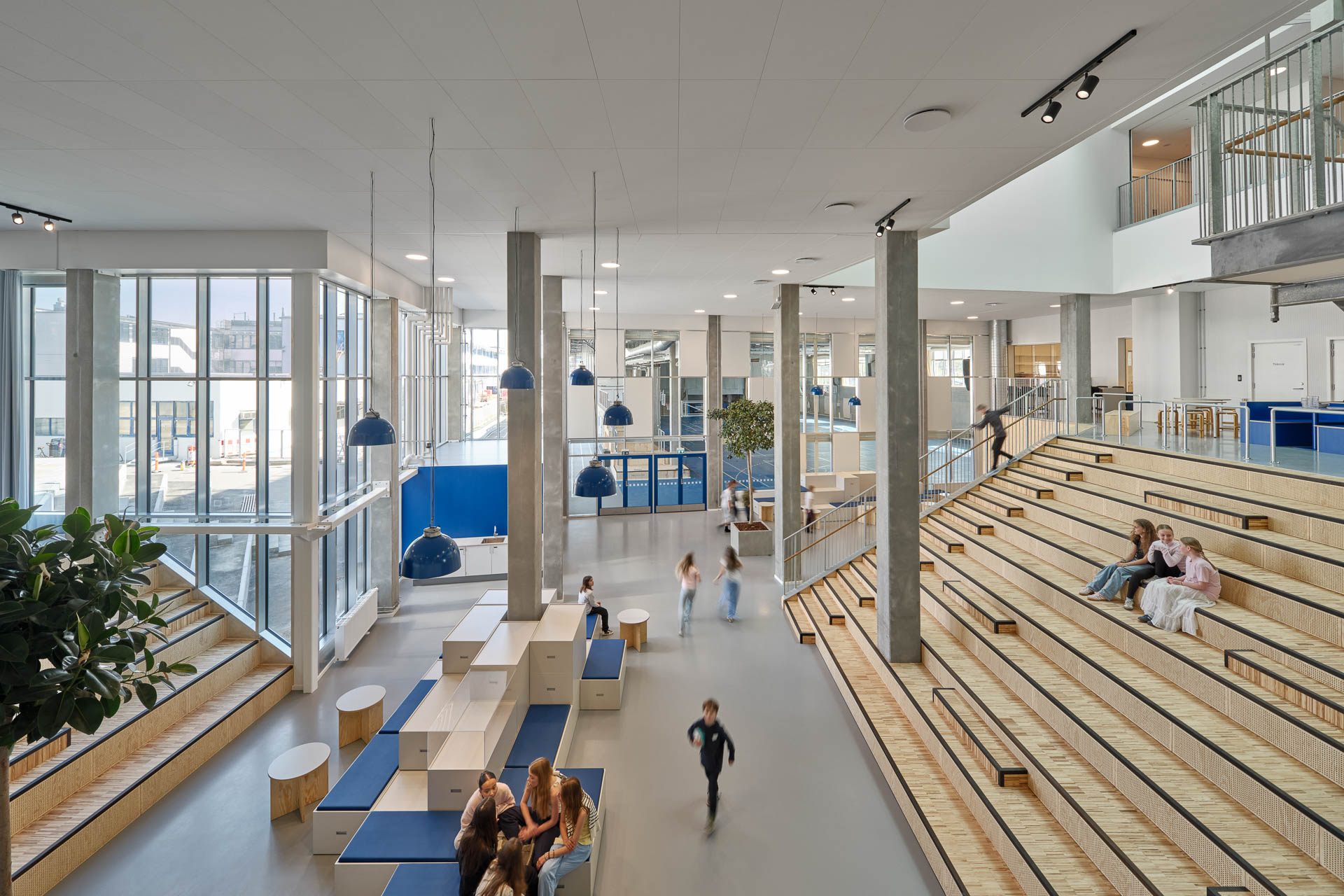
From the atrium at the intersection of the two wings of the building, varied staircases lead to the upper floors. © Adam Mørk
Nutrition and exercise in harmony
This combination of facilities hints at a distinctive aspect of the school's curriculum: here, sport and nutrition are given equal importance – the latter probably due to the location. The two subjects converge in the atrium, where the two L-shapes of the building intersect. From the main entrance, wide steps lead down to the level of the inner courtyard. To the right is the large, three-court sports hall and to the left, slightly elevated, is the canteen. Adjacent to this are two kitchens. In one of these, professional chefs prepare lunch, while in the other, children can help out – and learn that food does not simply come out of the freezer.
Only a glass wall separates the atrium from the triple-court sports hall. After school hours, this is also available to city clubs. © Adam Mørk
The planning team also ensured there was plenty of spatial variety on the upper floors, which are connected by stairs, slides and ramps. At the very top is a separate play and exercise room for the youngest pupils.
Discover another school building in our database Detail Inspiration: Islands Brygge Middle School in Copenhagen combines open learning environments and communal spaces.
Architecture: NORD Architects, BBP Architects
Client: City Copenhagen
Location: Skelbækgade/Ingerslevsgade, 1717 Copenhagen (DK)
Structural engineering, TGA-Planung: Norconsult
Landscape architecture: BOGL landscape architects
Contractor: BAM Danmark
Gallery


