
Honourable mention DETAIL structure 2016: Elytra Filament Pavilion, London, United Kingdom – Achim Menges with Moritz Dörstelmann, Jan Knippers and Thomas Auer
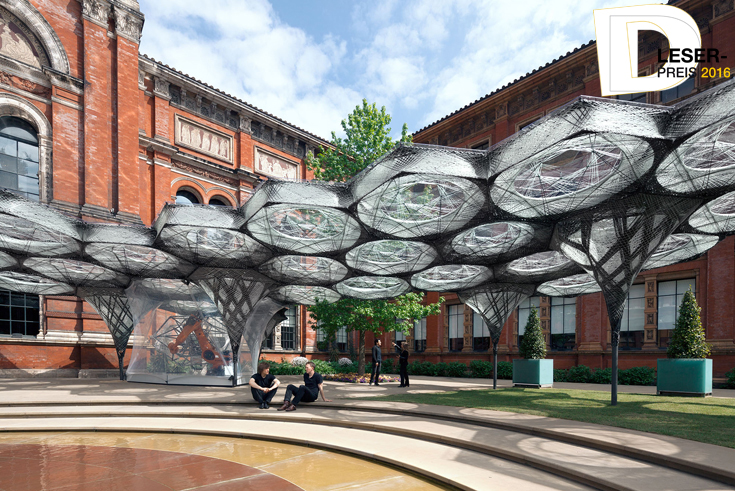
Elytra Filament Pavilion, Victoria and Albert Museum London 2016
The project group of Achim Menges and Jan Knippers writes about its project:
The Elytra Filament Pavilion is the outcome of four years of research on the integration of architecture, engineering and biomimetic principles. It explores how biological fibre systems can be transferred to architecture. The 200 sqm pavilion structure is inspired by lightweight construction principles found in nature – the fibrous structures of the forewing shells of flying beetles known as elytra.
The pavilion constitutes a dynamic space and an evolving structure. The cellular canopy grows from an onsite fabrication nucleus, and it does so in response to patterns of inhabitation of the garden over time, driven by real time sensing data. The pavilion’s capacity to be locally produced, to expand and to contract over time provides a vision of future inner city green areas with responsive semi-outdoor spaces that enable a broader spectrum of public activities, and thus extend the use of the scarce resource of public urban ground.
The fibrous composite structure of the installation only consists of two basic cells, the canopy cells and the column cells that interface between the inhabitable ground and the canopy, which is also equipped with transparent roof panels. Both cells are made from the same load-bearing fibre material: transparent glass fibres and black carbon fibres. Each canopy cell is adapted to its specific loading condition through a differentiation of its fibre arrangement, density and orientation, resulting in a very material efficient and light structure, which weighs just 9 kg/sqm.
The pavilion constitutes a dynamic space and an evolving structure. The cellular canopy grows from an onsite fabrication nucleus, and it does so in response to patterns of inhabitation of the garden over time, driven by real time sensing data. The pavilion’s capacity to be locally produced, to expand and to contract over time provides a vision of future inner city green areas with responsive semi-outdoor spaces that enable a broader spectrum of public activities, and thus extend the use of the scarce resource of public urban ground.
The fibrous composite structure of the installation only consists of two basic cells, the canopy cells and the column cells that interface between the inhabitable ground and the canopy, which is also equipped with transparent roof panels. Both cells are made from the same load-bearing fibre material: transparent glass fibres and black carbon fibres. Each canopy cell is adapted to its specific loading condition through a differentiation of its fibre arrangement, density and orientation, resulting in a very material efficient and light structure, which weighs just 9 kg/sqm.
Further information
Employees:
Marshall Prado, Valentin Koslowski, James Solly, Aikaterini Papadimitriou, Niccolo Dambrosio, Dylan Wood
Partners/Planners:
Institute of Building Structures and Structural Design, University of Stuttgart / Transsolar Klima Engineering
Photographers:
Roland Halbe, Stuttgart
NAARO, London
Employees:
Marshall Prado, Valentin Koslowski, James Solly, Aikaterini Papadimitriou, Niccolo Dambrosio, Dylan Wood
Partners/Planners:
Institute of Building Structures and Structural Design, University of Stuttgart / Transsolar Klima Engineering
Photographers:
Roland Halbe, Stuttgart
NAARO, London
Gallery
