
Hotel and Tourism Institute in Montréal
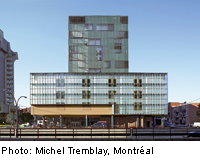
Built in 1970, and comprising 21,000 m2, the building complex accommodating the Quebec Tourism and Hotel Institute (abbreviated ITHQ) sets an accent within Montreal’s urban fabric as block-filling, four-storey podium topped by a seven-storey tower. With a subway station integrated in the ground floor, the internationally acclaimed education facility for tourism, hotel studies and gastronomy thereby accommodates public infrastructure as well. In order to convey the institute’s significance and contents to the public in a contemporary fashion, the building’s interiors were completely overhauled. The existing facade was fitted with thermal insulation and new cladding; a second skin of glass draped over the original one bestows the building with transparency and depth. The building massing is now articulated by the glass elements with their varying colours and sizes, as well as by the different functions it houses. The amenities on the ground floor which are accessible to the public, such as restaurant, entrance and lobby areas, are glazed on all sides and are clearly visible around the clock from the outdoors. Colossal lettering imprinted on the podium’s smooth, wrap-around glass ribbon communicate the building’s functions visually to the surrounding city.
The longitudinal facades of the tower – visible from many points in the metropolitan area – were designed to achieve plasticity, in particular by introducing protruding balcony elements on the hotel and administrative levels. And depending upon the viewer’s standpoint, the alternation between clear and green-coloured glass on the shingled facade to Rue Saint-Denis produces a wide range of colour effects.
The double-skin facade, paired with the newly insulated inner facade, optimizes the building’s energy-efficiency. In winter the air within the double-skin facade is warmed by solar energy and fed into the energy system on the services floor. In summer, stale air is discharged, via the up-current of warm air, through openings in the facade at the parapet zone.
Gallery