
“We just wanted to have fun”
Illa Glóries in Barcelona by Cierto Estudio
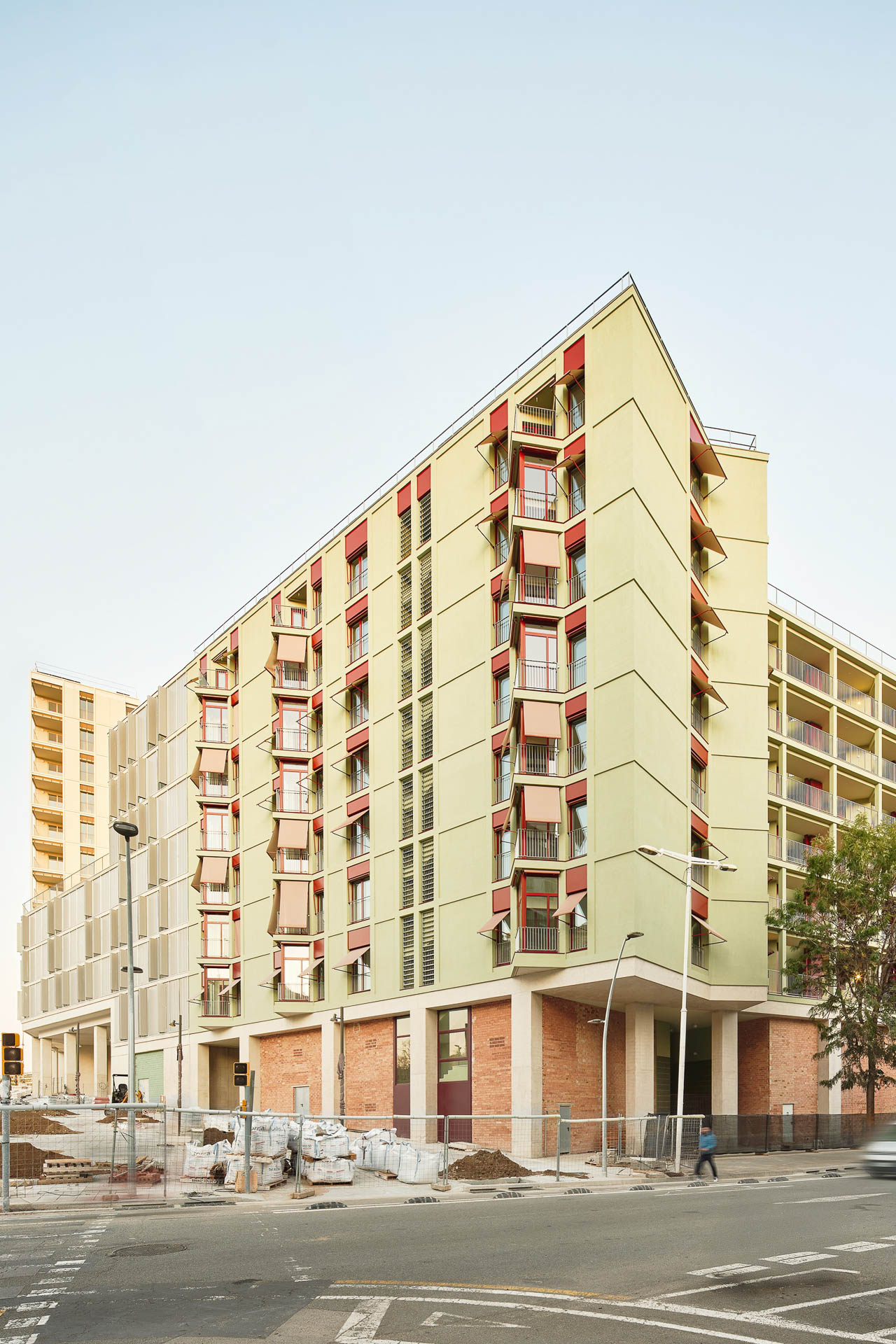
Seven colorfully designed residential floors rise above the tall concrete and brick base of the building. © José Hevia
Plaça de les Glòries Catalanes is the largest transportation hub in eastern Barcelona. Three of the city’s main thoroughfares converge at the square, which was once home to a roundabout that was impassable for pedestrians. In recent years, the city has dismantled this monument to car-centric planning and transformed it into a park. It is flanked to the north by Jean Nouvel’s 144-meter-tall Torre Glòries (formerly Torre Agbar), and to the southeast, MBM Arquitectos built the Disseny Hub design museum in 2013.
Collaborative effort in support of housing construction
The plot at the western end of the square had previously been undeveloped; most recently, it served as a nursery for the newly created city park. In 2017, the young architecture firm Cierto Estudio, led by six women, won the competition for a new residential complex. The client and competition organizer was the municipal housing company IMHAB. The plan was to build 238 residential units between Avenida Diagonal and the roof of the Mercat dels Encants. Together with the winners of the second, third, and fourth prizes, Cierto Estudio was commissioned to carry out the project.
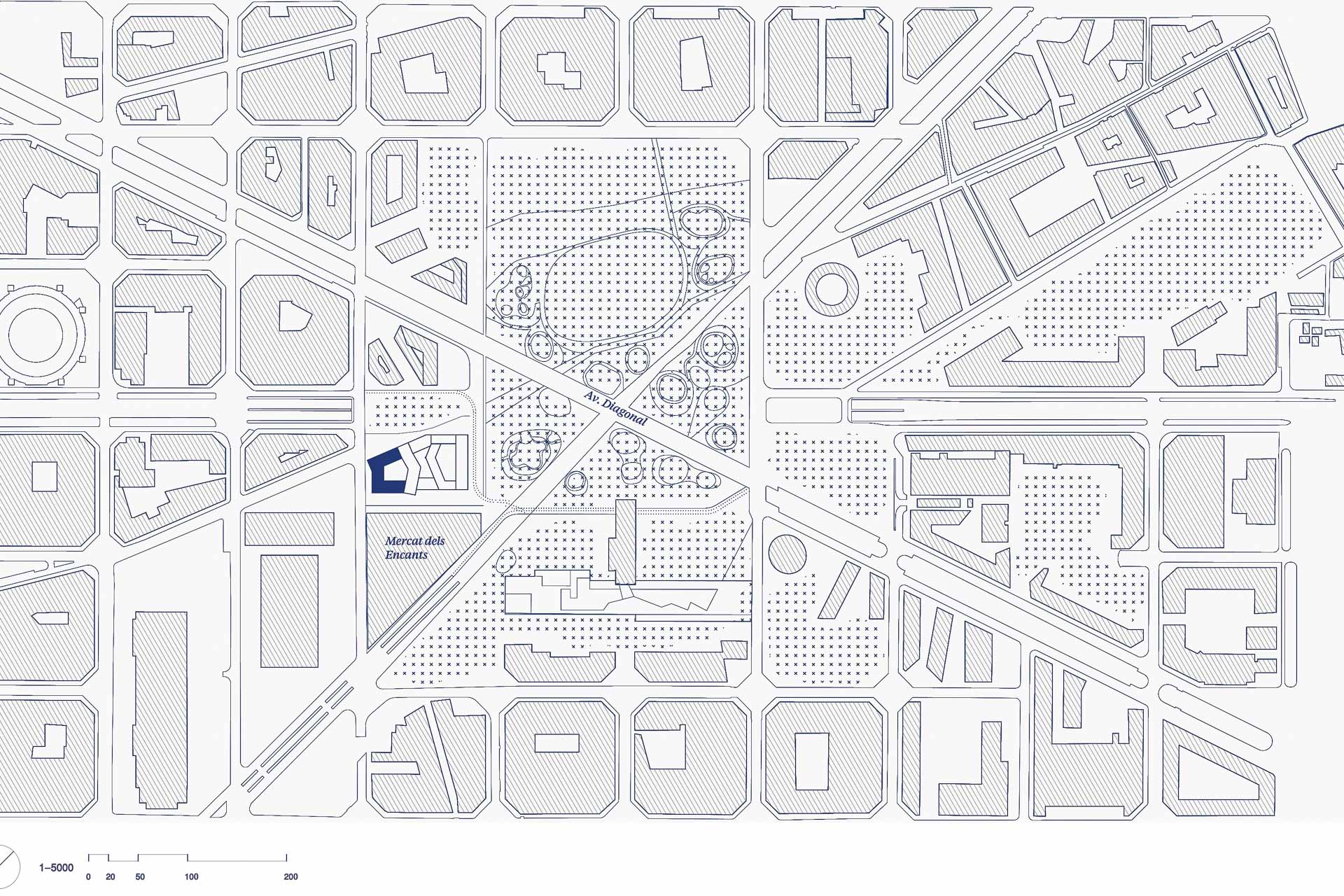
Situation plan of Illa Glóries, graphic © Cierto Estudio
Fun meets beauty: Wooden architecture with a colorful exterior
The new building responds to its diverse surroundings with a strikingly colorful design. Across the seven residential floors, Cierto Estudio combined green-plastered facades with red shutters, awnings, and exterior columns. “The site’s prime location and proximity to the new Parc de les Glories called for an iconic design. That’s why we allowed ourselves to have some fun and take a slightly more unconventional approach to the facade design,” the architects describe their concept. They continue: “This proposal is also a statement that reflects our values. Beauty is part of our work; it lends the project dignity and quality of life. That’s important to us, regardless of the program or budget.”
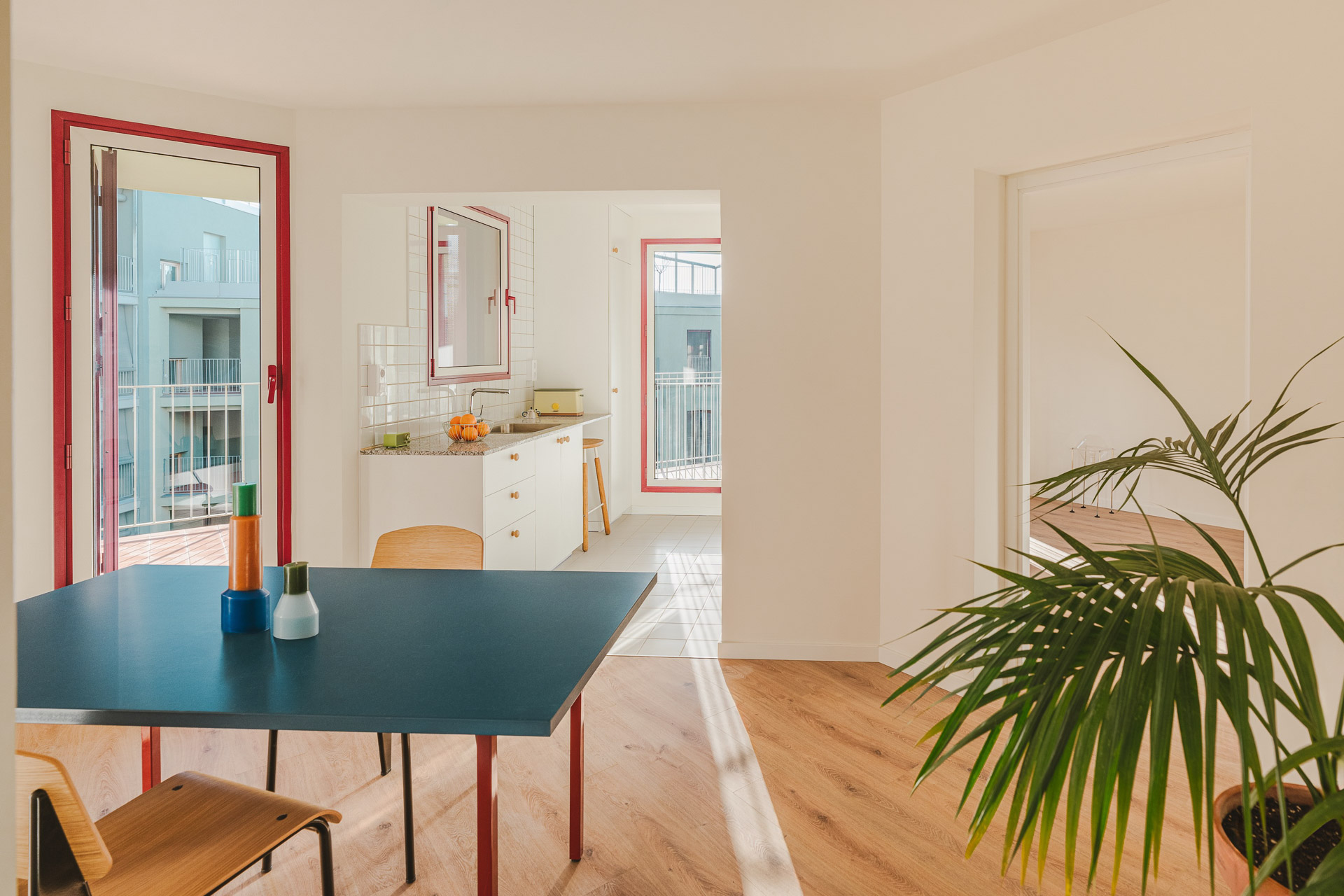
The red window frames add a splash of color to the interior of the apartment as well. Because the kitchens are arranged at an angle to the central axis, the view extends outward in two directions. © José Hevia
Behind the building envelope lies a timber structure with load-bearing walls and ceilings made of cross-laminated timber. However, due to fire safety regulations, the material is not visible anywhere. The ground floor, which houses the (as yet unrented) stores, consists of a concrete skeleton clad with exposed brick.
Arched walkways as places for gathering
When designing the residential complex, the architects prioritized gender equality and the protection of residents – many of whom are single parents – from assault. A few steps lead up to a semi-private courtyard accessible only to residents. The apartments are accessed via open arcades. These are always located on the south side, facing partly toward the courtyard and partly toward the street. “The question isn’t whether the pergola faces inward or outward. We wanted to ensure that it’s sunny and offers a pleasant place to spend time,” explains Cierto Estudio.
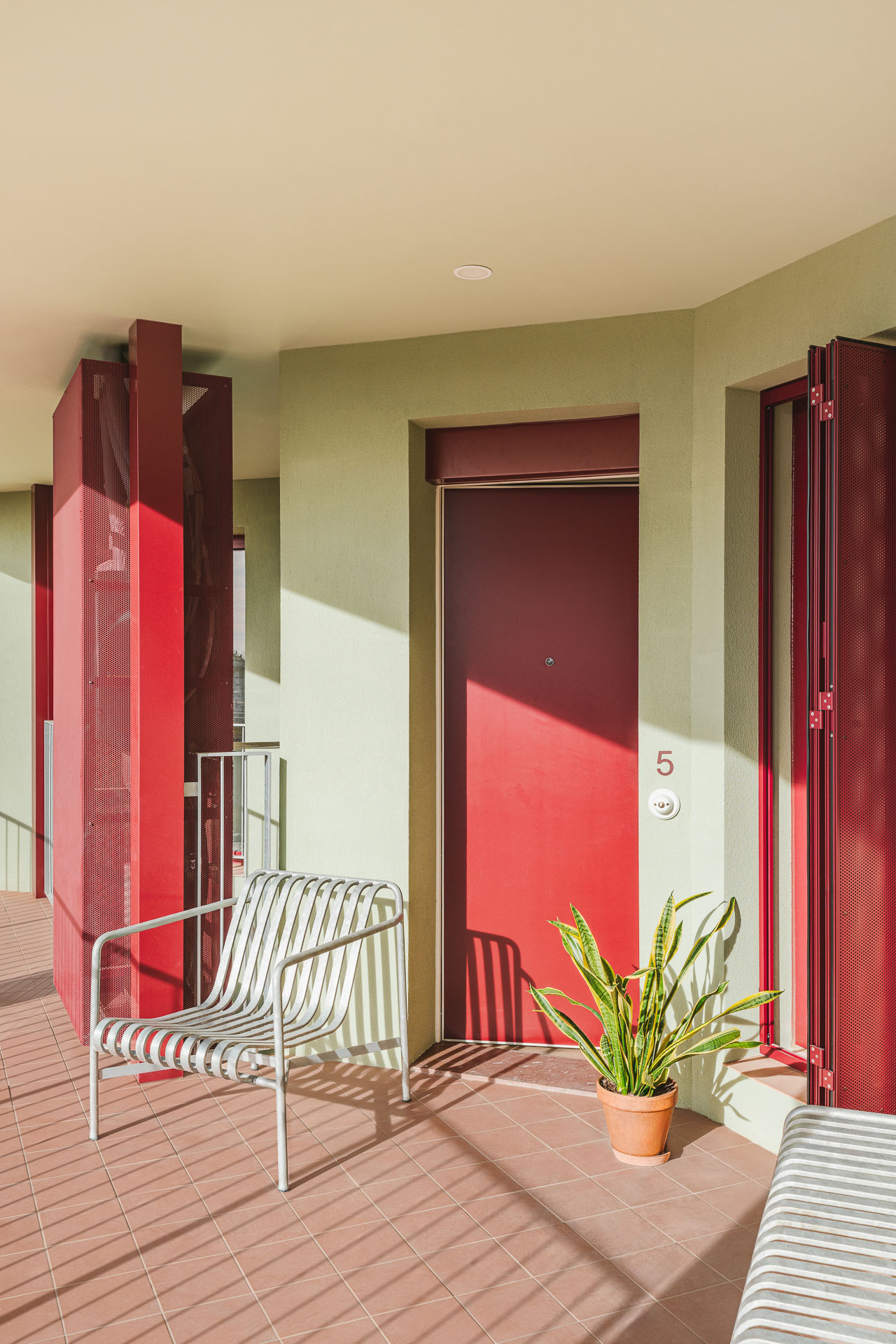
Sheltered niches, protected from the wind and prying eyes, have been created in front of the apartment entrances, where residents can meet.© José Hevia
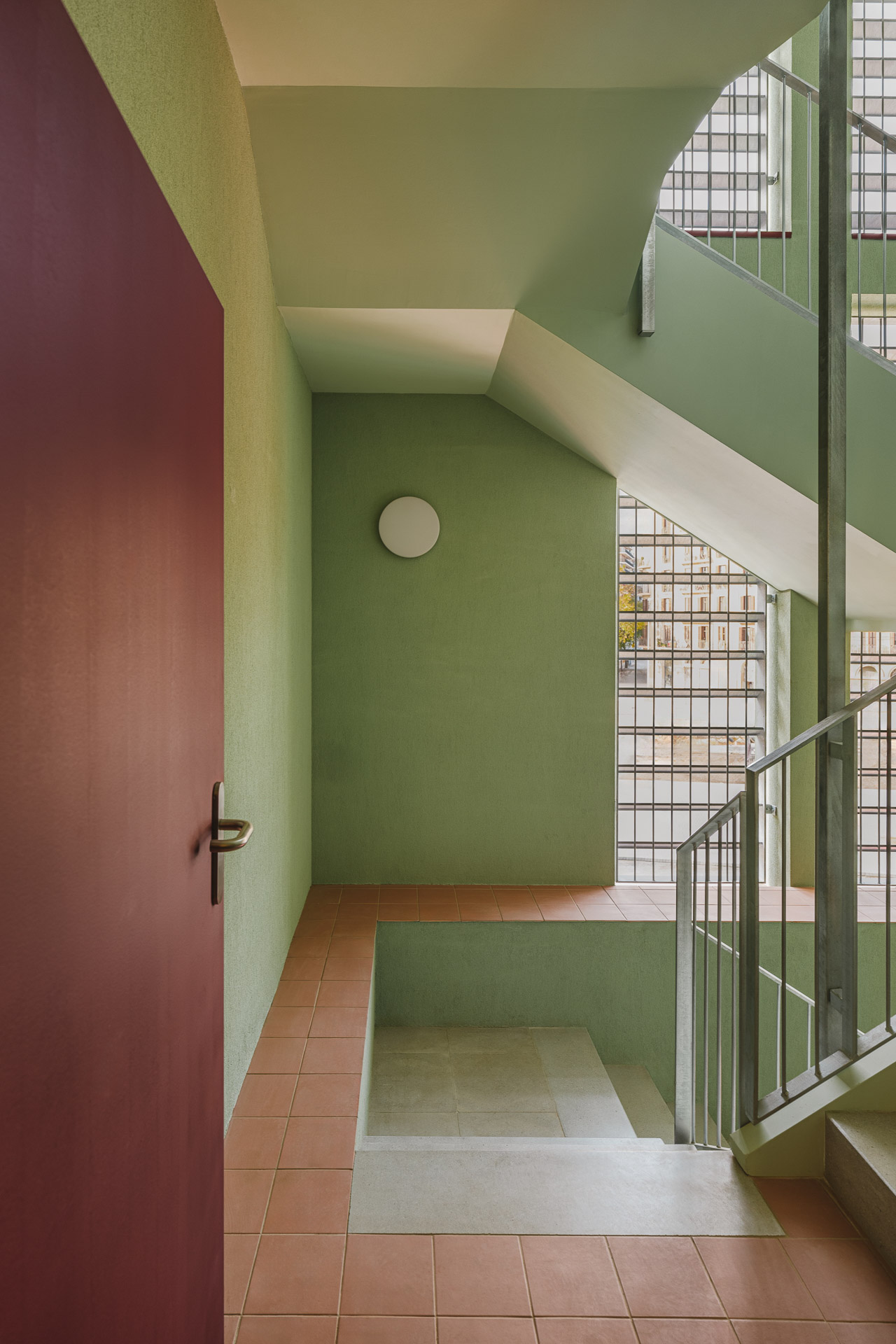
The primary colors red and green also dominate the stairwells. © José Hevia
A large part of community life is intended to take place on the covered walkways – at least during the summer. This is where laundry hangs to dry, and where residents meet for coffee or a chat. In addition, each apartment has one or two private balconies facing north. Like the bathroom and kitchen, they are rotated 45 degrees off-axis.
The trick with the bend: Apartment floor plans that break the mold
With this design approach, the architects aim to achieve benefits for both the interior and the exterior design. The facades and arcades are divided into manageable sections by the projecting balconies and kitchens. Inside, the central bathroom serves as the focal point of each apartment. The surrounding rooms are flexible in use and are based on a grid dimension of between 3.60 and 3.75 m. None of them are exactly rectangular –depending on their location within the apartment, they have one to three angled corners. The room immediately adjacent to the kitchen is designed as a dining room and is nearly oval in shape.
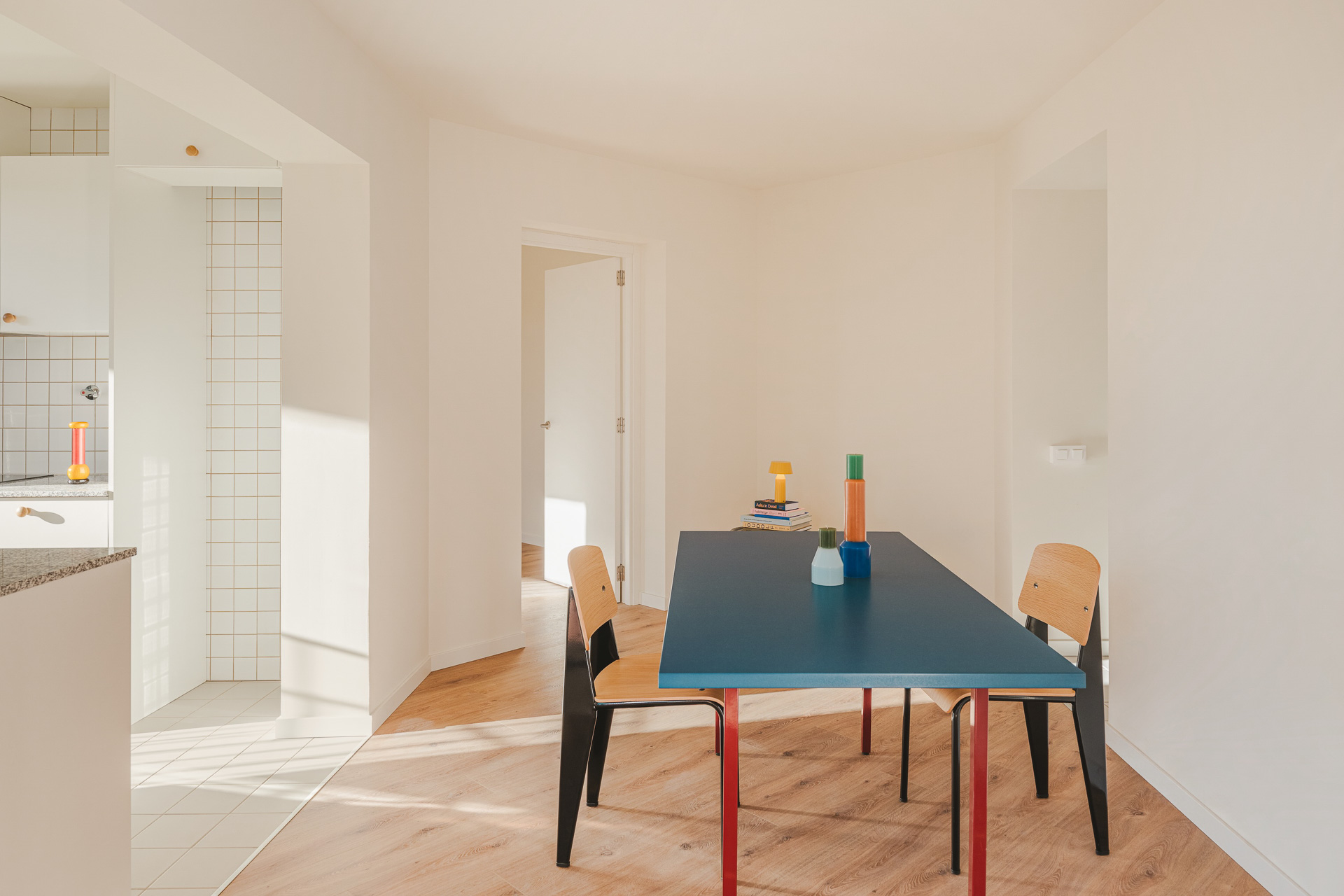
With the exception of the kitchen, all interior rooms have more than four corners. © José Hevia
With the exception of a few accessible apartments, Cierto Estudio has designed four apartment layouts ranging from three to five rooms and 60 to 97 m² of gross floor area. However, the unconventional layout makes the apartments appear larger than they actually are. In many units, the view extends diagonally across the entire apartment, from the kitchen at the entrance to the private balcony on the north side.
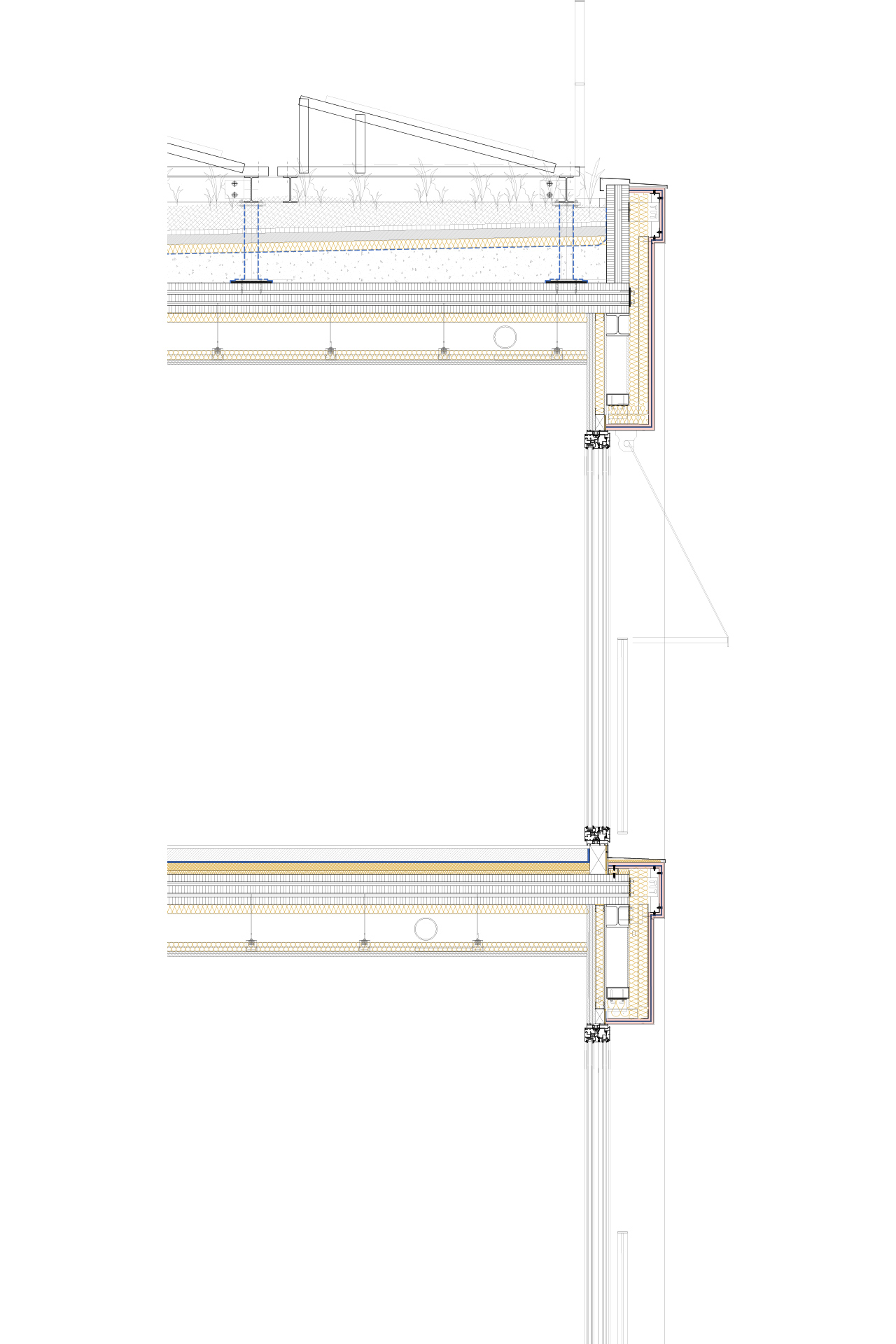
Vertical section of the exterior facade, graphic © Cierto Estudio
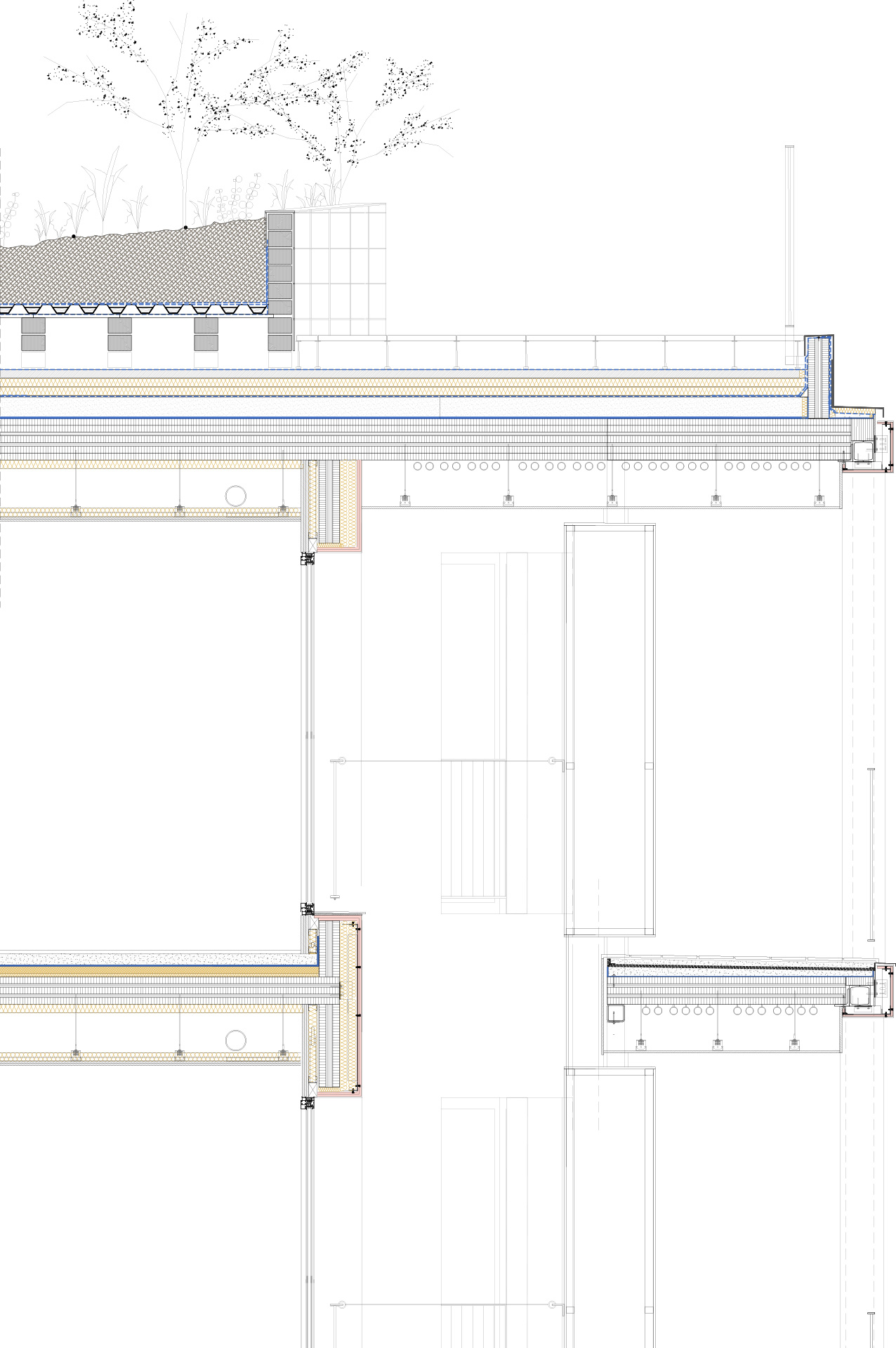
Vertical section of the pergola area, graphic © Cierto Estudio
Easy renovation despite solid walls
The exterior walls, the interior partition walls, and the walls of the central bathroom core are made of 120 mm thick cross-laminated timber. All other interior walls consist of lightweight stud framing with gypsum board cladding and can be reconfigured with relative flexibility. For the floor slabs and balcony slabs, the architects used 160 mm thick cross-laminated timber. In the area of the pergolas, they are supported by a steel frame. A shared terrace on the roof is available to all residents.
Living in Barcelona – discover more articles in our Detail Inspiration database.
Architecture: Cierto Estudio, Franc Llonch
Client: Institut Municipal de l’Habitatge i Rehabilitació de Barcelona (IMHAB)
Location: Plaça de las Glorias, Gran Via de les Corts Catalanes, Barcelona (ES)
Structural engineering: Bernuz-Fernández Arquitectes
Landscape architecture: Beatriz Borque + Miquel Mariné
Building services engineering: Eletresjota Tecnics Associats
Environmental Consulting: Societat Orgànica +10 SCCL
Site management: Ángel Gil
Gallery


