
Structure and finish as one
Moabiter Kinderhof in Berlin by Kersten Kopp Architects
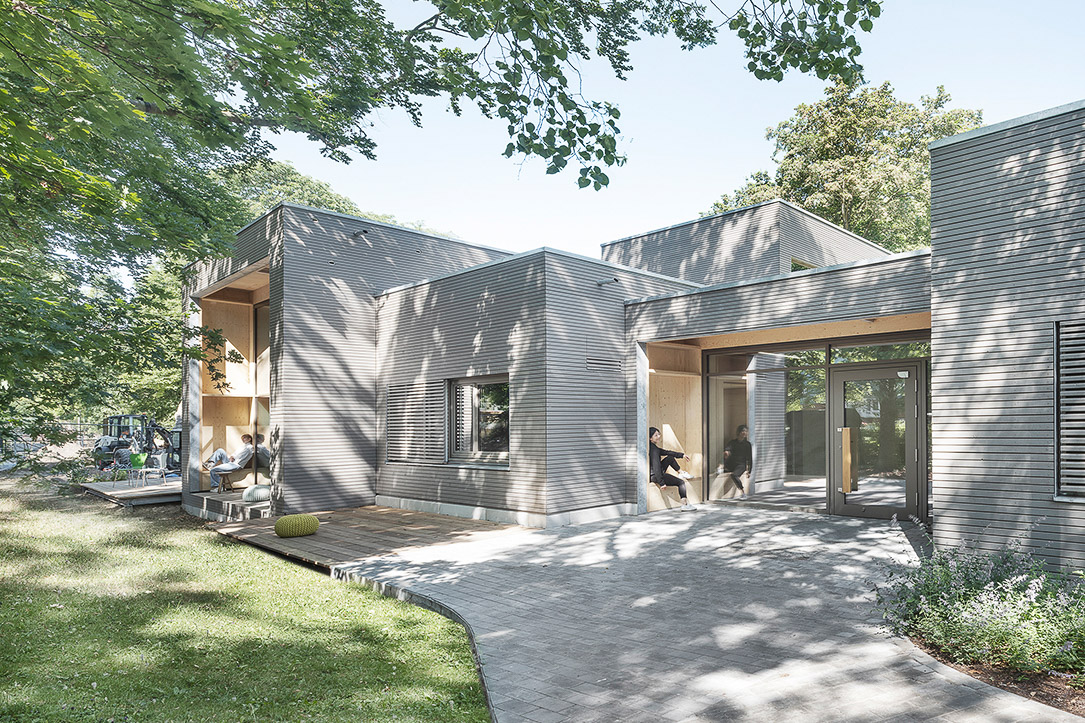
Large window areas break through the grey facade cladding of the Kinderhof. © Werner Huthmacher
Since the mid-1990s, the Moabiter Kinderhof has provided afternoon care for children aged seven to 13 in Berlin's former working-class district of Moabit. Run by a charity, it operates on the principle that play and learning are equally important for children’s development. Volunteer carers help the children with their homework and offer a variety of leisure activities, including music, crafts, and sports. The City of Berlin has also recognised the importance of the facility for social interaction in the neighbourhood. In 2016, the city purchased a park-like plot of land very close to the main station and made it available to the sponsoring association as an adventure and building playground.
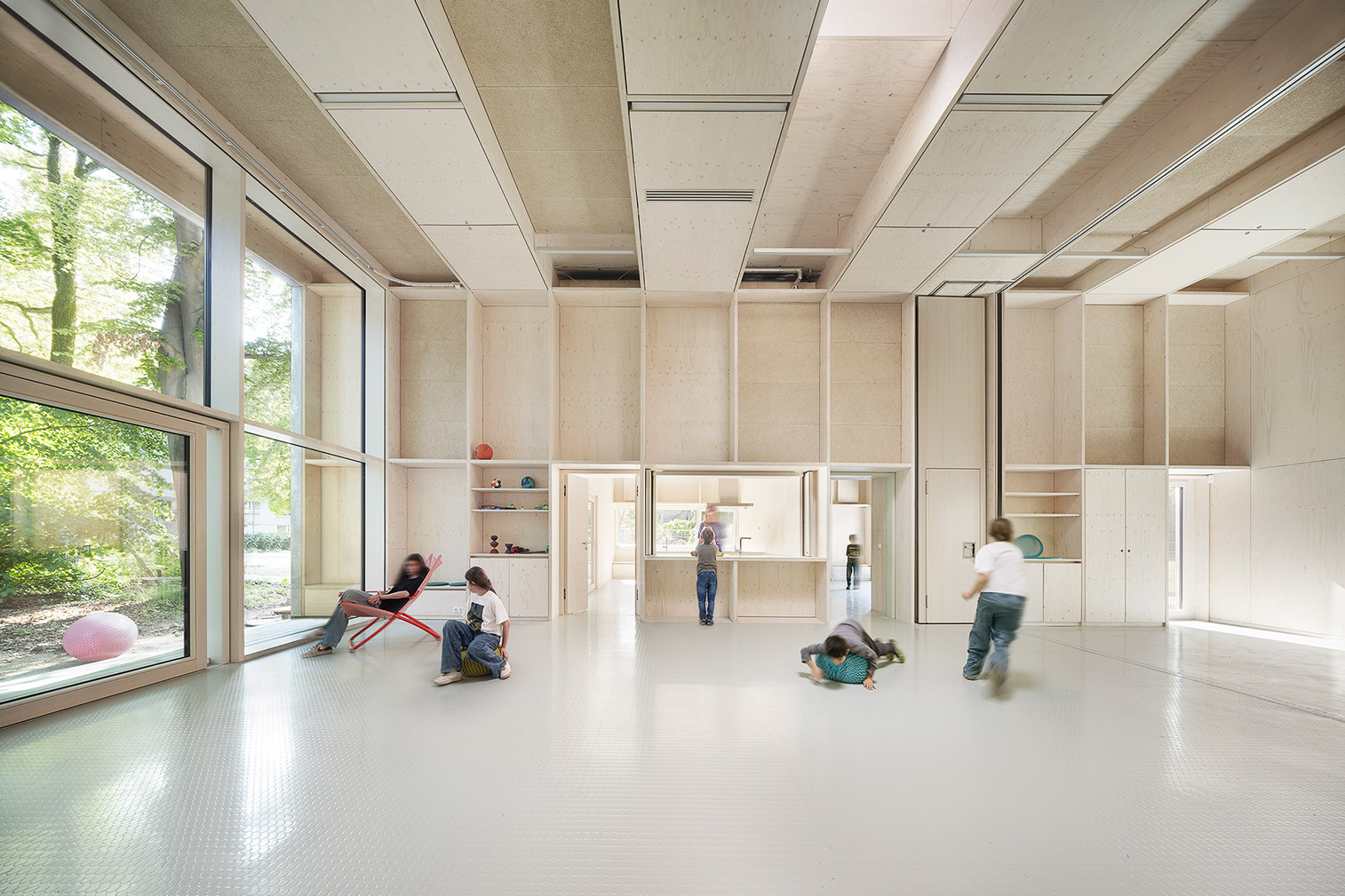
An open serving hatch connects the large hall with the kitchen next door. © Werner Huthmacher
Leaving the site hut
At first, the children and carers had only a single-storey hut and two electrically heated site huts at their disposal. Three years later, Kersten Kopp Architects won the tender for a permanent home for the Kinderhof. The new building, measuring around 340 m², was to result in as few trees as possible being felled. The architects therefore designed an ensemble of six cubic structures of varying heights, which skilfully avoid the old chestnut, beech and oak trees and their root systems.
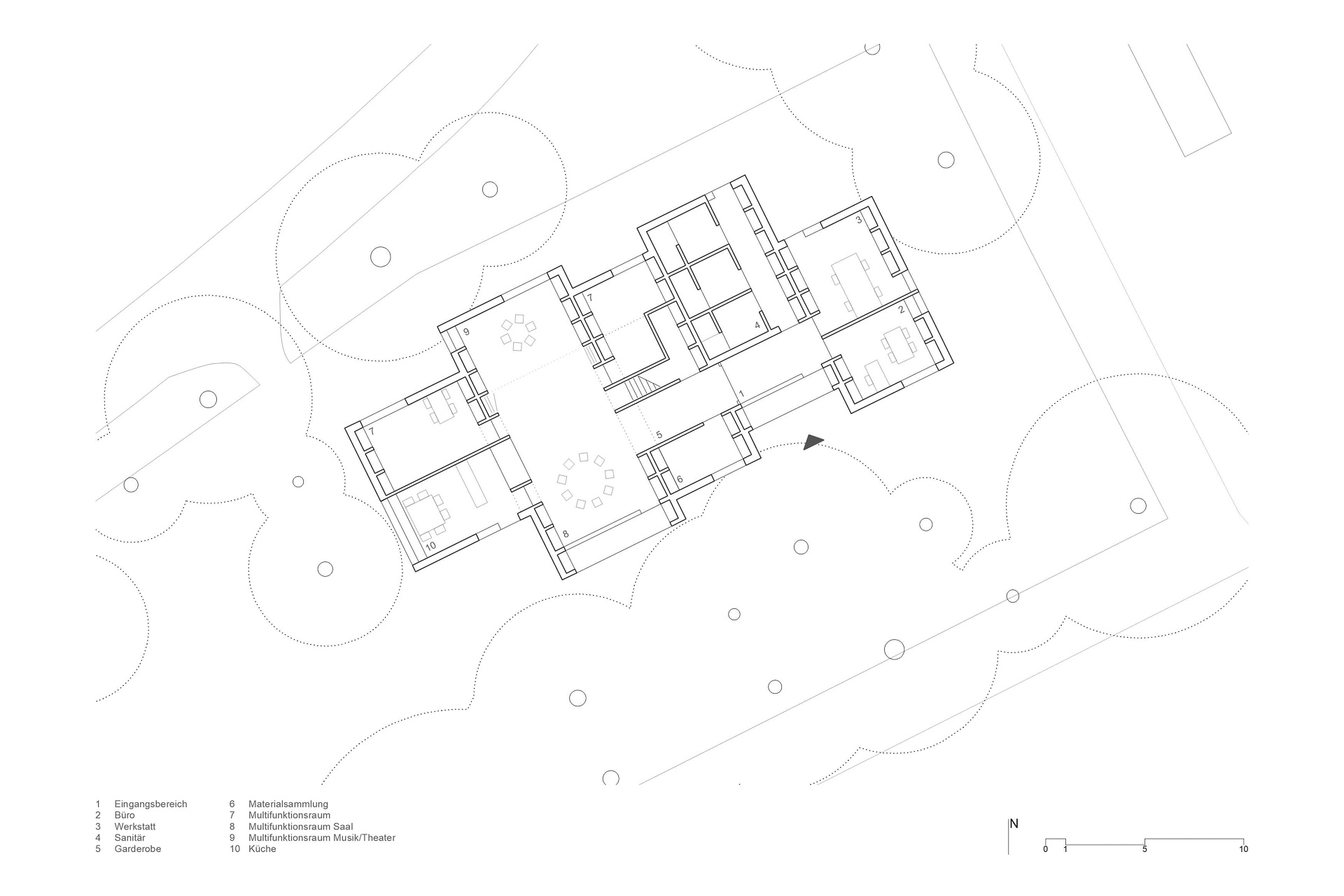
Ground floor plan, graphic © Kersten Kopp Architekten
Walking on stilts and a chill-out corner
Kersten Kopp Architects explain the varying heights of the cubes by reference to the sponsoring association's consistently grassroots democratic approach. The children had expressed a wish to be able to walk around on stilts in at least one part of the building. This is now possible in the large multi-purpose hall, flanked to the east and west by two smaller rooms for music, sports, and theatre. The hall itself can also be divided into two distinct halves using a movable partition. Like a living room, it connects to the adjacent kitchen via an open serving hatch. Opposite this is a staircase that leads up to a “platoon” covered with mats – a retreat and chill-out corner for the children that is difficult for the carers to see into. Together with the multi-purpose room below, the area receives daylight through a large, flat-roofed window. A corridor next to the staircase leads to the eastern part of the building, which houses the staff offices and toilets.
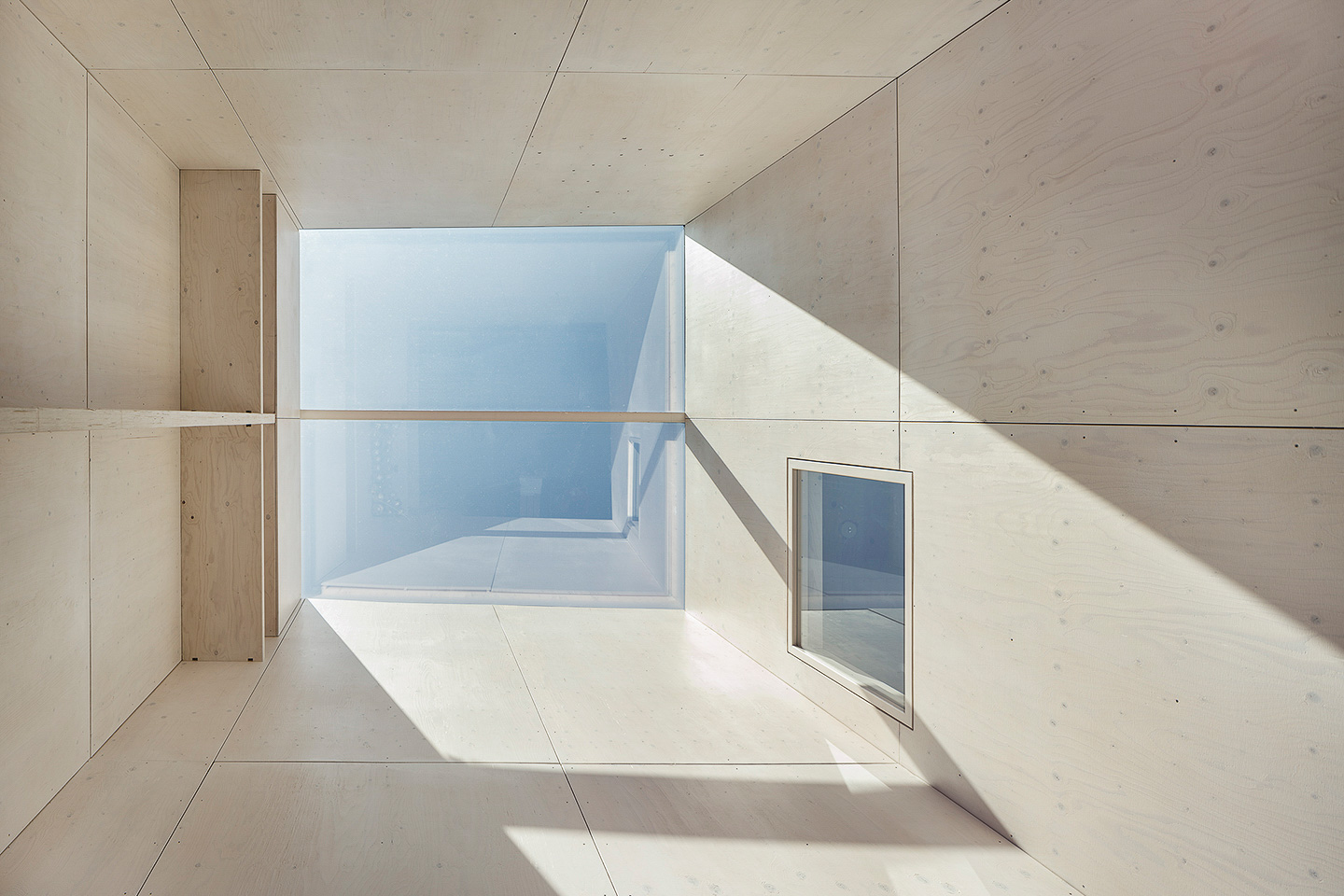
A large skylight brings sunlight all the way down to the ground floor and into the retreat area above. © Werner Huthmacher
Prefabricated shelving structure for walls and ceilings
The most unusual aspect of the new children’s centre is undoubtedly its construction method. Kersten Kopp Architects predominantly used laminated timber panels for the structural shell and interior fit-out. Reinforcing panels, which are 51 mm thick and 400 mm deep, have been attached to the 27 mm thick roof and wall elements. Depending on their position, these panels serve as roof beams, supports, shelving or table tops. The wall and ceiling elements, which resemble shelving, were delivered to the site as prefabricated components. They remain visible even after installation, enabling the children to understand the building’s structural logic.
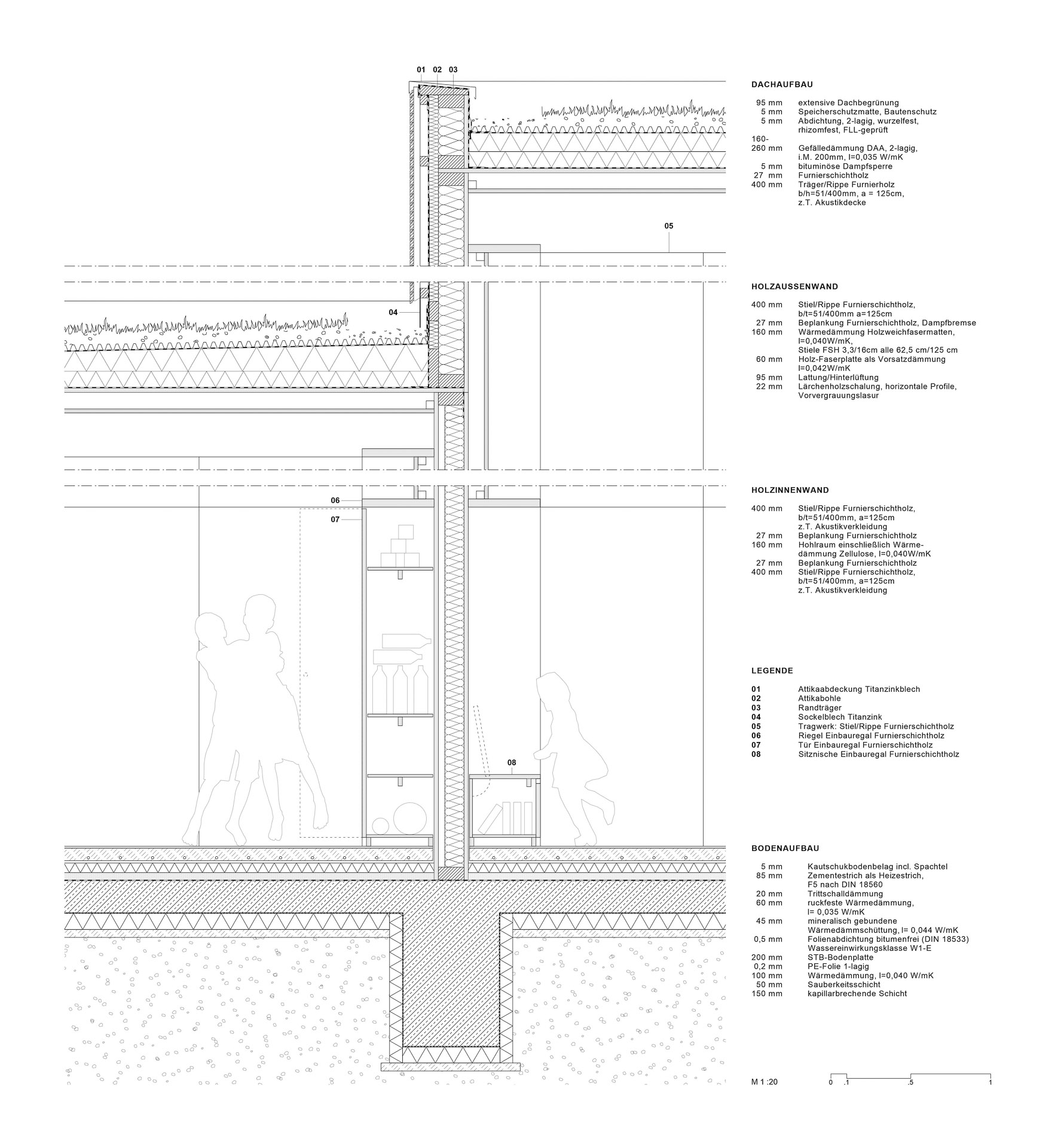
Vertical section through the interior wall. Graphic © Kersten Kopp Architekten
The other elements in the material palette also contribute to the space's harmonious appearance: the floor is covered in subtle, light green, rubber studded flooring, while the facades are clad in rough-sawn, pre-weathered larch boards.
Read more about the daycare centers designed by Kersten Kopp Architects in our database Detail Inspiration: Modular Daycare Centers in Berlin.
Architecture: Kersten Kopp Architekten
Client: Bezirksamt Mitte, Berlin (DE)
Location: Seydlitzstraße 12, 10557 Berlin (DE)
Structural engineering: Pichler Ingenieure
Landscape architecture: Henningsen Landschaftsarchitekten
Building services engineering: DELTA-i
Fire prevention consulting: brandschutz plus
Building physics: IB Kaiser
Timber construction: Arche Naturhaus
Gallery


