
Behind the scenes
V&A East Storehouse by Diller Scofidio + Renfro
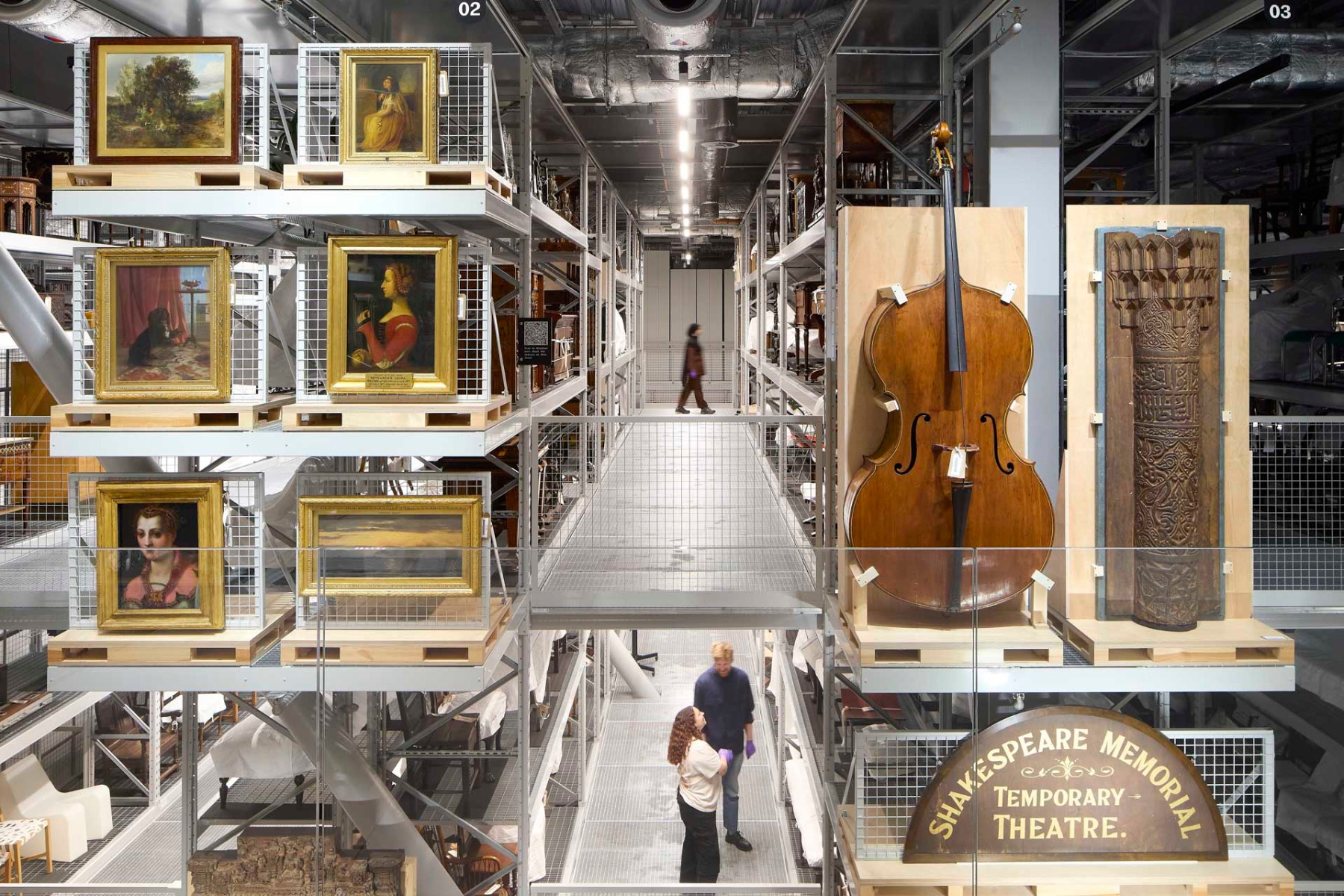
At the ends of the shelving units, Diller Scofidio + Renfro integrated display bays designed for the flexible rotation of exhibited objects. © Hufton + Crow
The new V&A East Storehouse is a striking, experimental blend of storage facility and museum. Occupying over a third of the former London 2012 Olympics Media and Broadcast Centre, this 16 000 m² new cultural destination is accessed through an intentionally unassuming set of doors. “It’s not a typical bombastic museum entrance”, agrees project architect Bryce Suite, a senior associate at Diller Scofidio + Renfro, the practice behind the design. “We wanted people to wonder: ‘Am I allowed to be here?’”
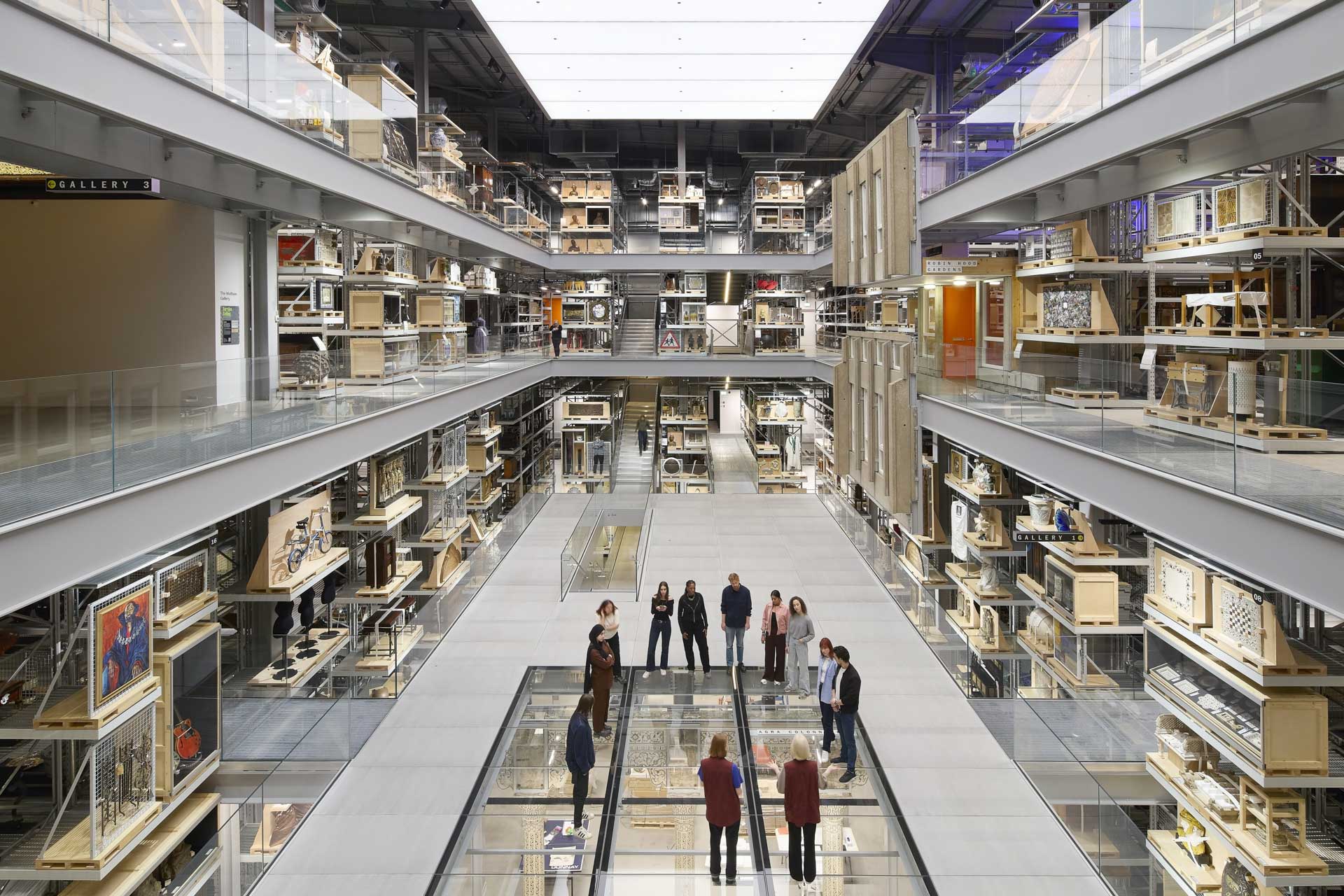
The 20-meter-high Weston Collections Hall, © Hufton + Crow
A theatrical experience
The same behind-the-scenes and almost casual concept has been applied to the lobby and café, which is more living room-meetsworkspace than formal museum foyer. From here a staircase (or lift) leads you into a brief airlock, then through a compressed tunnel-like walkway – past rows of busts and statuary belted into wooden pallets – and directly into a spectacular 20 m-high Collections Hall. It’s from this cathedral-like vantage point, with its glazed floor section offering unexpected aerial views of the 17th century Agra Colonnade on the ground floor below, that you get an idea of the scale of the enterprise and can see some of the 250 000-plus artefacts and objects displayed and stored over four levels.
“Creating the Collections Hall was a bit like the process of mineral extraction and removing a core sample,” explains Suite. “In this case we extracted the central space to create an inner piazza.” By slicing through the floor and pallet racking, the architects created a series of cantilevered shelves and display crates at the ends and sides of the aisles. In some places, the museum has wrapped these shelves in glass; for the most part, however, the cacophony of objects installed therein – which range from musical instruments, chairs, and prints to shoes, paintings, and ceramic urns – are within touching distance. Larger objects, such as the 1930s Kaufmann Office by Frank Lloyd Wright or an intricately restored ornate ceiling from a 15th century palace in Toledo, Spain, are displayed for the first time in decades, with the latter pleasingly visible from below and above.
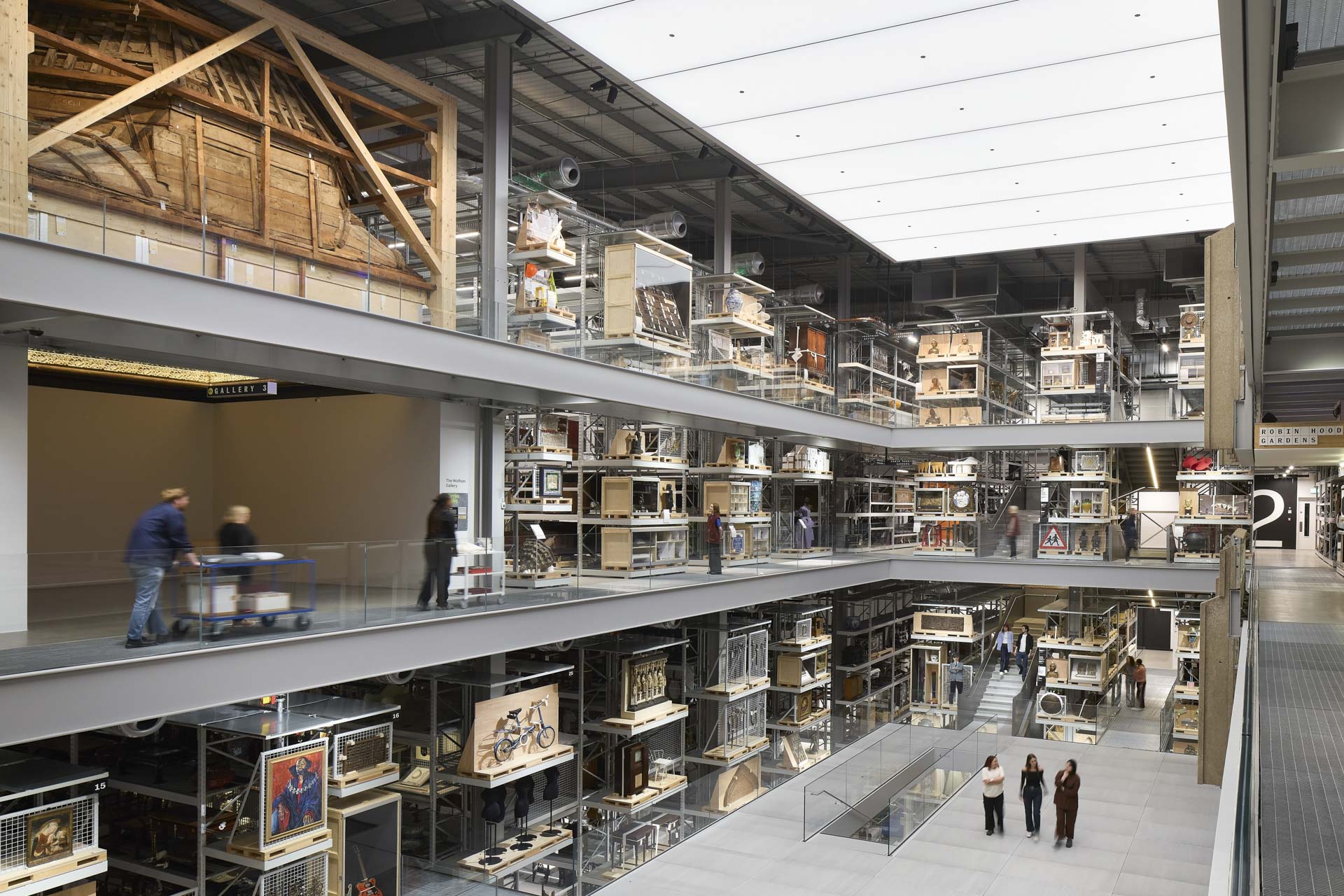
At the top left of the image is a carved and gilded wooden ceiling from the now lost Torrijos Palace near Toledo in Spain. Measuring 6.5 m x 6.5 m x 5.6 m, it is the largest object in the V&A East Storehouse by cubic volume. © Hufton + Crow
Antithesis of conventional museum architecture
The architects used the building’s existing loading and structural capacity – an 8 × 8 m grid of steel columns and a solid ground floor – to plug in four floors of adjustable pallet racking and metal grate walkways with glass railings. The organising principle behind how the objects are conserved, displayed, and moved around in this hermetically sealed space, is down to size, shape, and weight, explains Suite – not, as is the case in conventional museums, by conservation studios has a glass balcony so the public can see down into it; a screen and microphone allow the public to ask questions in real time.
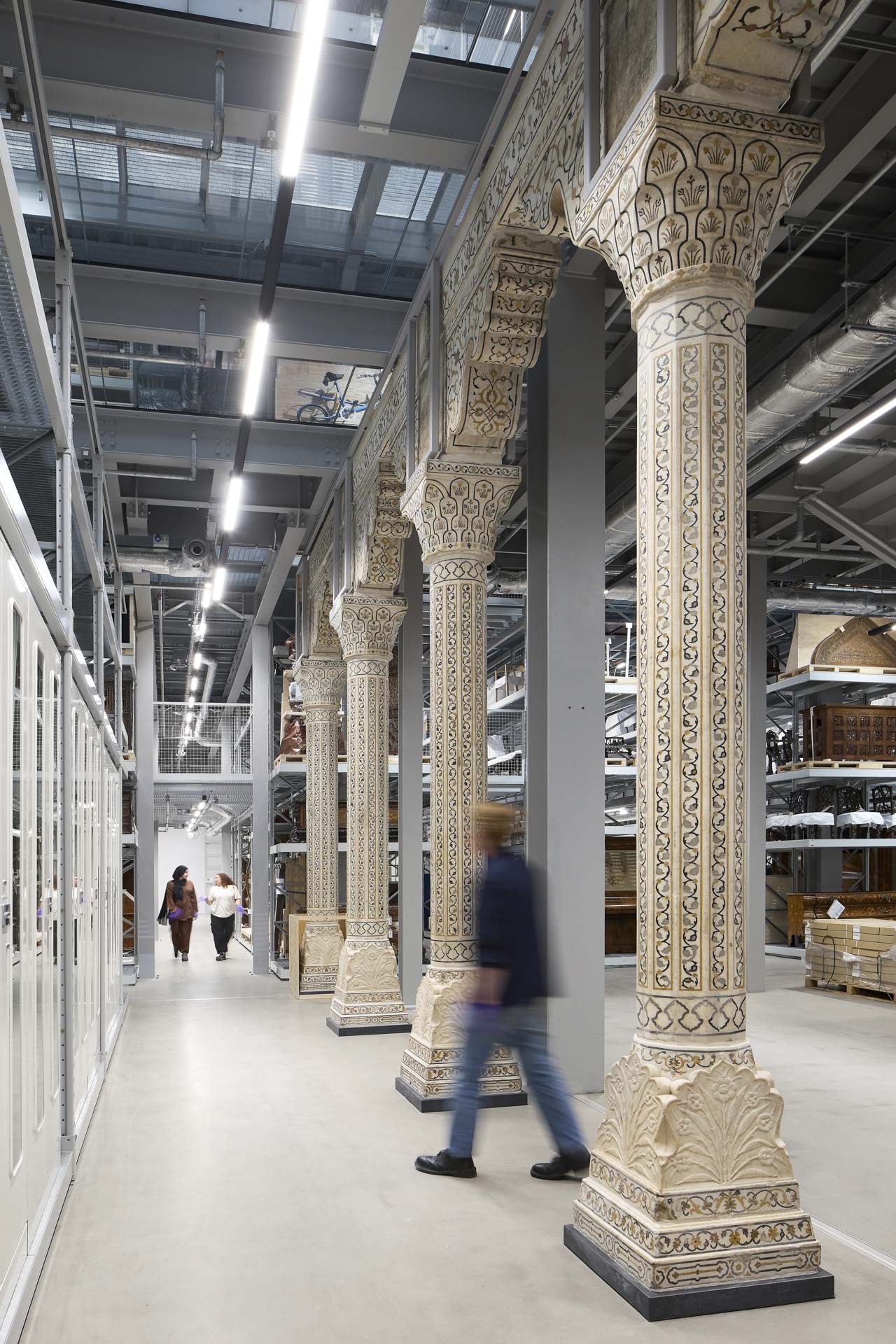
The Agra Colonnade is the heaviest of all objects in the collection, weighing in at 18 t. © Hufton + Crow
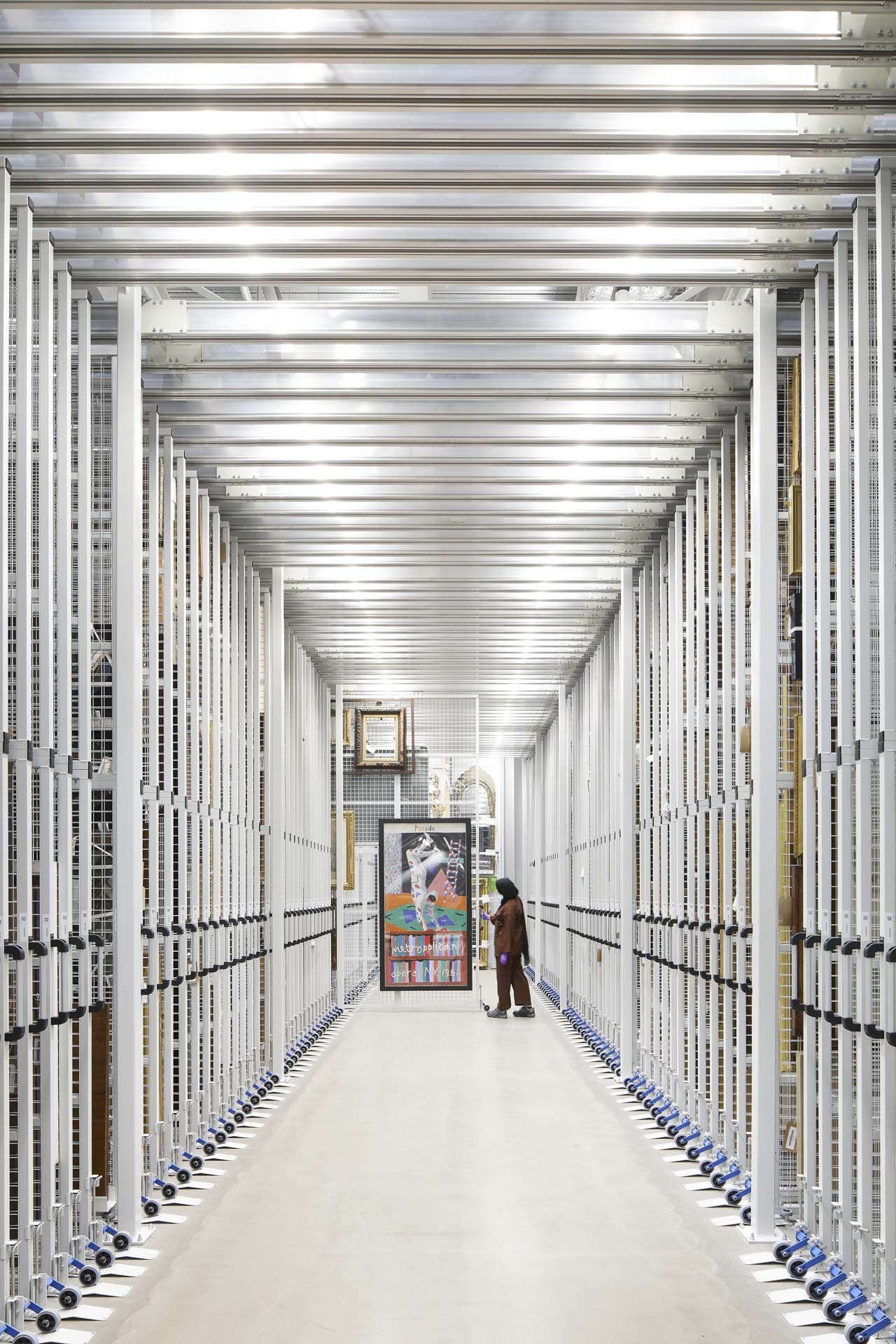
The Collection Hall is divided into concentric levels of accessibility: the middle level is a more traditional archive. © Hufton + Crow
Between daily work and exhibition
As a working storage facility and museum, the design is focused on making processes agile and efficient. Objects can be moved on and off hooks and shelves with ease, and captions printed in-house and clipped into existing metal stands. This means exhibits can be changed in a matter of days and respond to timely issues. “Curators don’t need to spend time thinking how they can fund an exhibition or how to design the displays either,” says Suite. “This frees them up to experiment and even make mistakes.” It’s hard to imagine that being possible in a traditional museum.
Read more in Detail 7/8.2025 and in our Detail Inspiration database.
Architecture: Diller Scofidio + Renfro
Client: The Victoria and Albert Museum
Location: Queen Elizabeth Olympic Park, London (GB)
Structural engineering: Arup
Gallery


