
Interview with Ralf Pasel
“Radical Simplification Really Does Work”
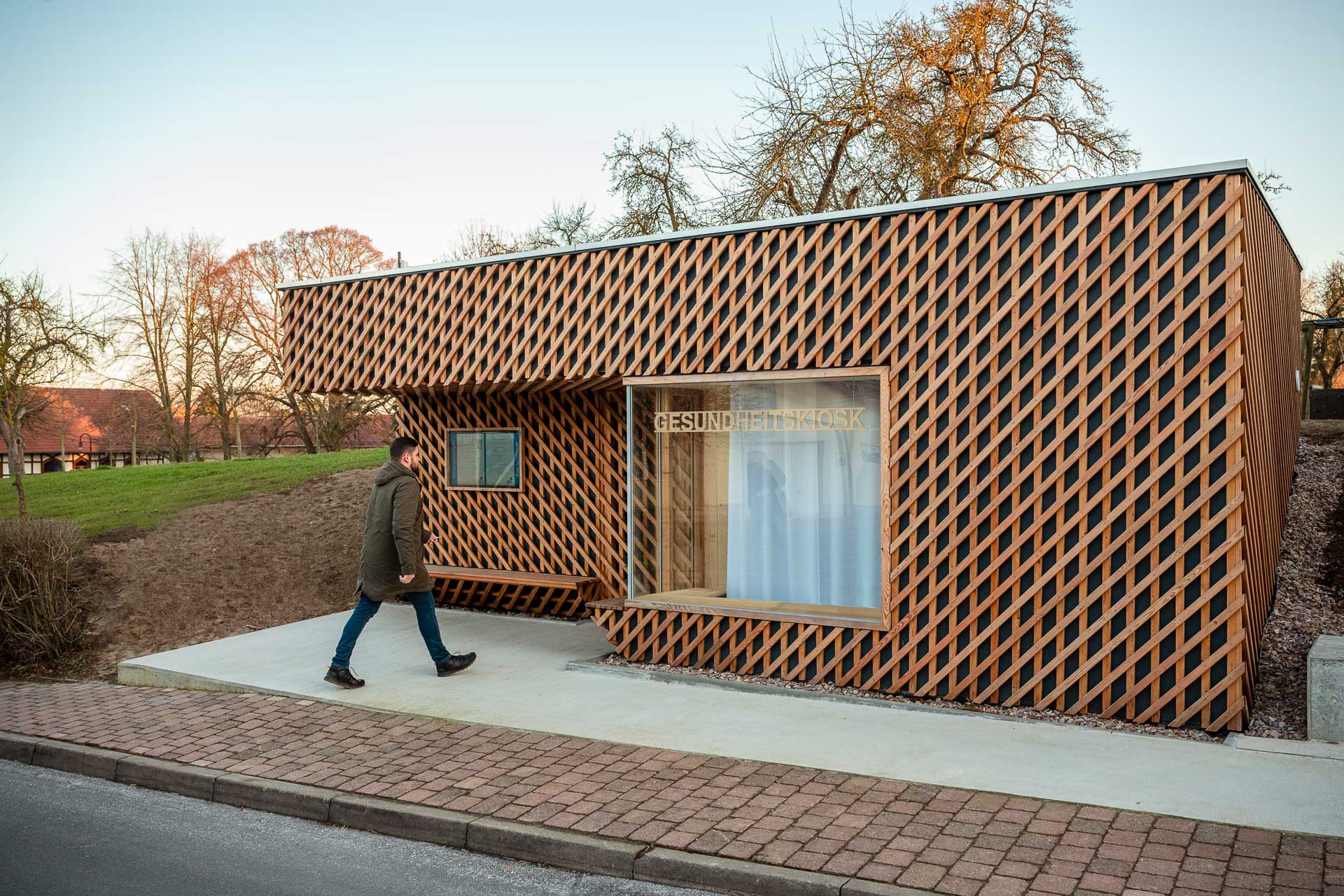
The first health kiosk in Urleben was realised in collaboration with local tradespeople. © Thomas Müller
For the Seltenrain region, Pasel-K Architekten designed a multifunctional building that combines medical care, social counselling, and infrastructure facilities within a minimal footprint. Four of these kiosks were newly constructed as simple, cost-effective timber-frame buildings in the neighbouring municipalities of Urleben, Bruchstedt, Blankenburg and Kirchheilingen. Each health kiosk is designed for flexible, needs-based use. They can be booked as treatment rooms, counselling centres or meeting places. The design of the kiosks varies from village to village. Each one responds specifically to its location, topography, or the availability of materials. In this interview, practice founder Ralf Pasel explains how structural characteristics and high levels of acceptance are mutually dependent.
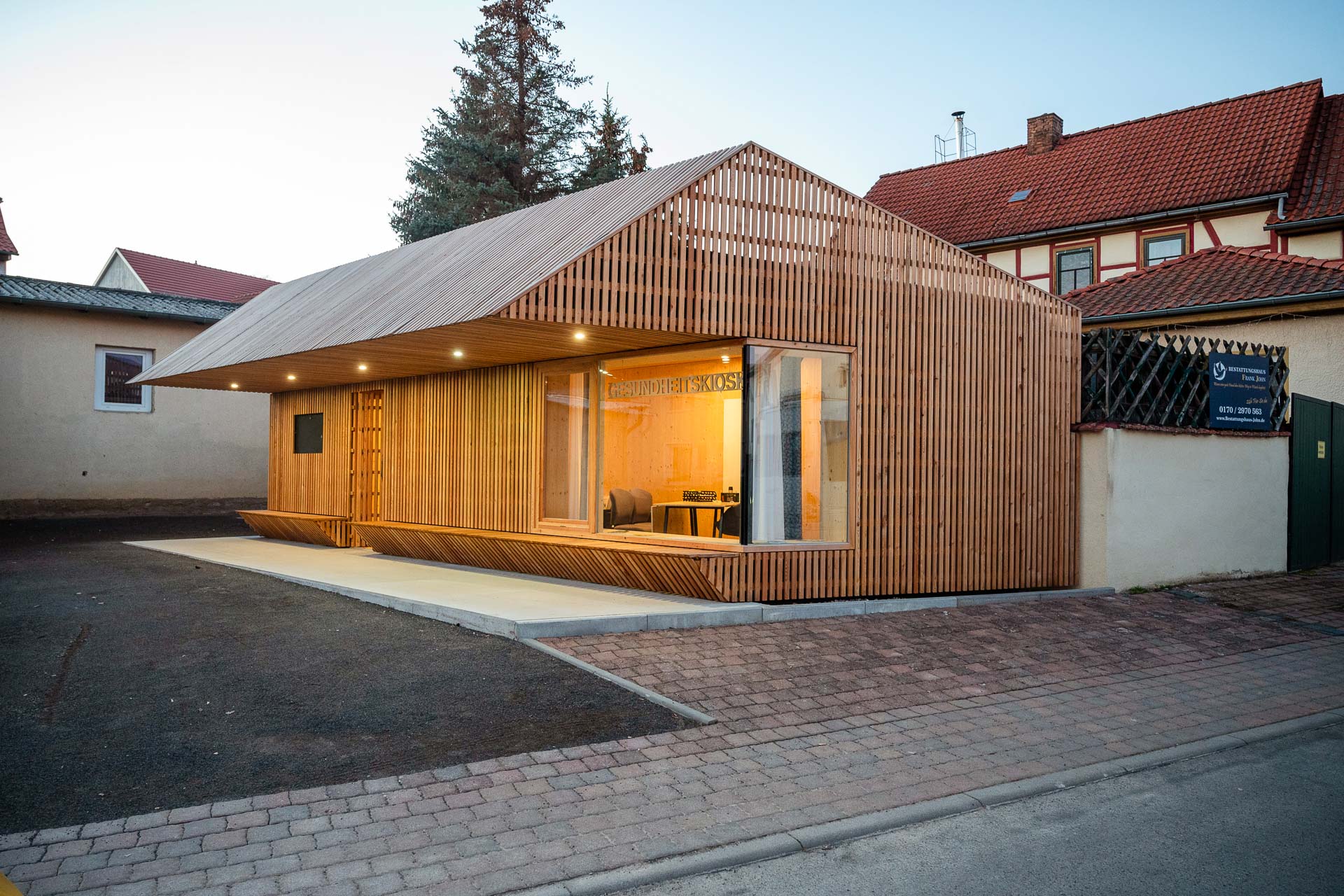
The kiosk in Kirchheilingen is backed up against a wall. © Thomas Müller
You describe the four kiosks as forming a family, sharing genetic characteristics. How does this manifest itself in the design?
The original idea was to design the kiosks to look very different from each other. However, this could not be implemented for cost reasons. Nevertheless, the basic idea remained: to create a new building in each village that shared a “gene pool”. As there had been no new public buildings in this region since reunification, the project was also intended to send a positive signal. All the pavilions have the same basic layout and similar functions. They are centrally located in each village and are strongly integrated into the local area. At the same time, we were dealing with a variety of different conditions, including listed buildings, sloping sites and properties on the outskirts of villages. Consequently, no single solution could be applied across the board.
How did you respond to these conditions?
We created a detailed catalogue of shared key design elements. While the basic configuration of the kiosks remains the same — classic timber-framed structures — their form is unique. Some have pitched roofs and others have flat roofs. All feature a bench and a timber-framed facade, though this is executed differently in each village.
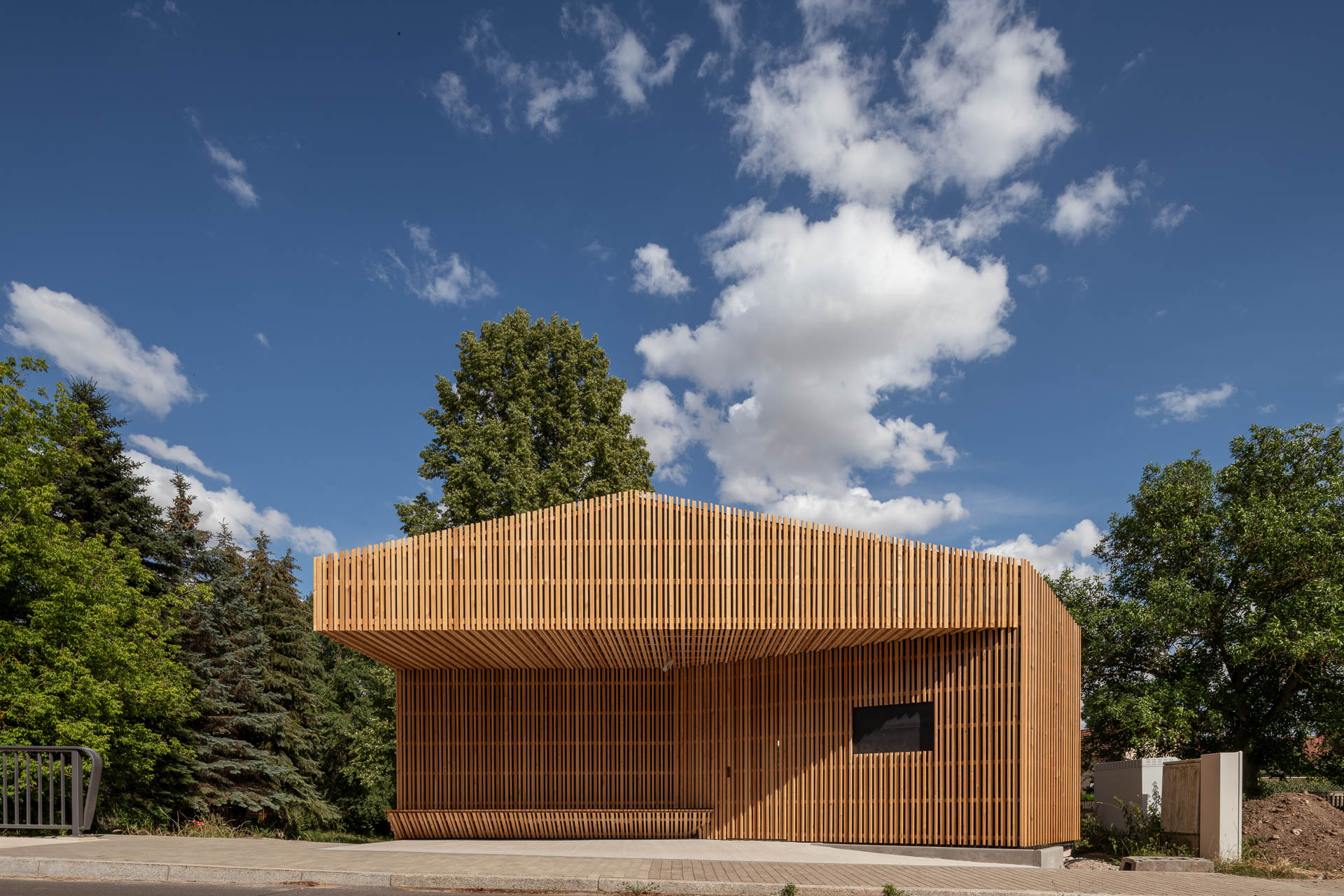
In Bruchstedt, the timber frame is clad with reused timber panels that shimmer through the battens. © Thomas Müller
In what ways do the kiosks differ?
In the listed environment of Blankenburg, for example, we opted for diagonal bracing inspired by the half-timbered structure. The timber facade was installed by the villagers and a carpenter together. In Bruchstedt, the timber frame is clad with reused timber panels, and in Kirchheilingen, the kiosk is built next to an existing boundary wall. The first kiosk in Urleben was technically the most challenging. It was realised in 2021/22 as a pilot project in collaboration with local tradespeople. There, the details were developed to scale and their ease of implementation was tested under significant cost pressure. It was only after a workable solution had been found that it was applied to the other locations. Although the kiosks are all different, they remain clearly recognisable as part of the same family thanks to their shared key design features.
The publicly accessible outdoor infrastructure certainly contributes to this as well.
Absolutely. All the kiosks are public spaces featuring outdoor areas, seating, a digital noticeboard, a defibrillator, charging stations for e-bikes and electric cars, and a bus stop. These elements are arranged around an area of broom-finished concrete.
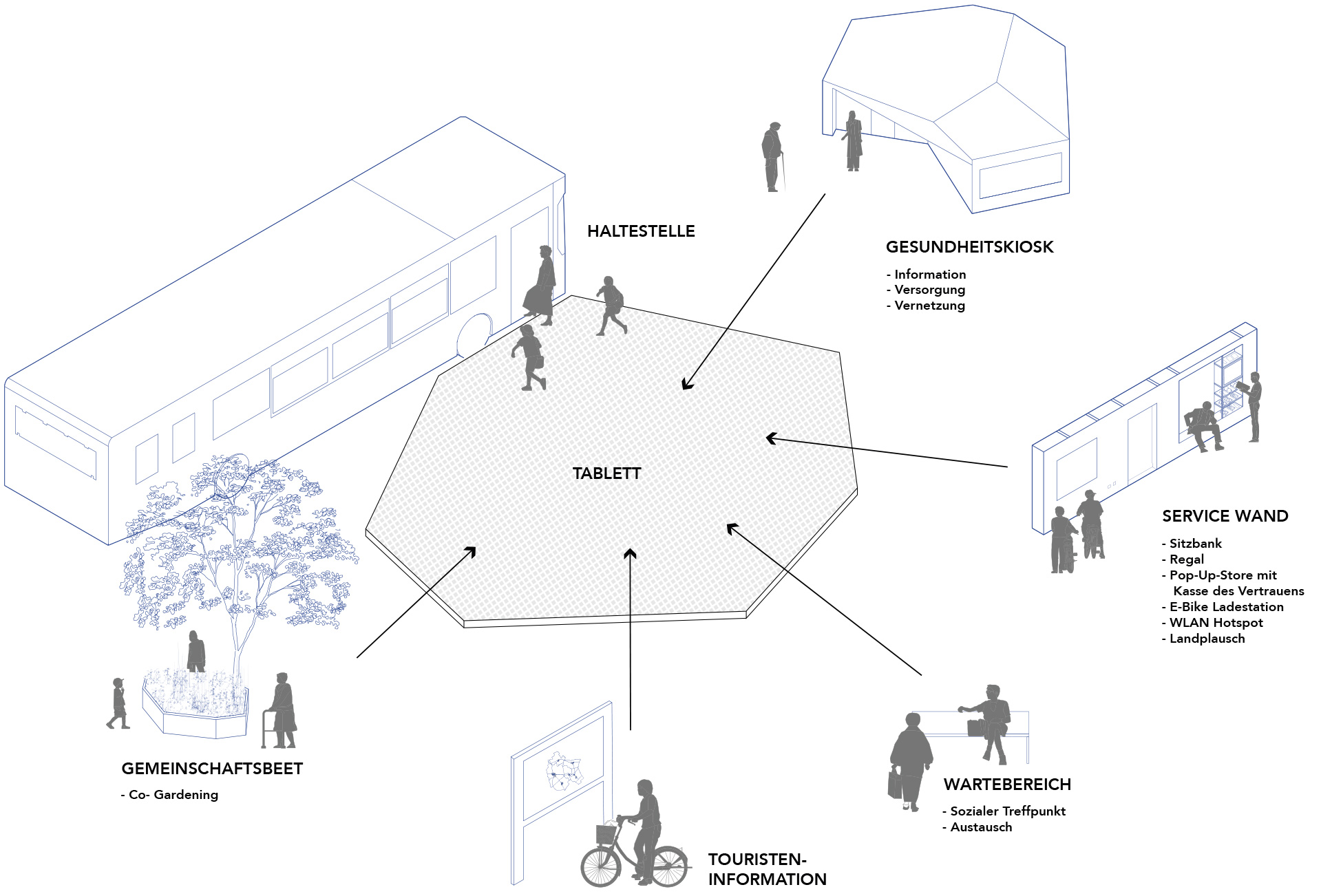
Graphic outdoor space, © Pasel-K Architects
Are people making use of the facilities?
The kiosk is clearly a popular place to meet, whether just for a brief visit, to check the screen or to sit on the bench. Even if you only have five minutes until the bus arrives, it creates an almost homely atmosphere. You often see people chatting.
What advantages does the shared key catalogue offer over a modular solution?
The major advantage is that highly individual kiosks can be created that are nevertheless designed as part of a series and can be replicated. Tradespeople can move around in teams. While one person is working here, another is busy there. This is entirely scalable in rural areas, which is an exciting aspect. Ultimately, the goal was to develop something unique in every village.
Was this also discussed during the evening talks with the villagers?
Yes. We started with the question, “What is really missing?”, and tried to identify the basic needs together. These discussions had an enormous impact: everyone feels they have contributed something. Consequently, the buildings are being looked after. It’s truly amazing – there's no graffiti or damage. This is very remarkable in this context.
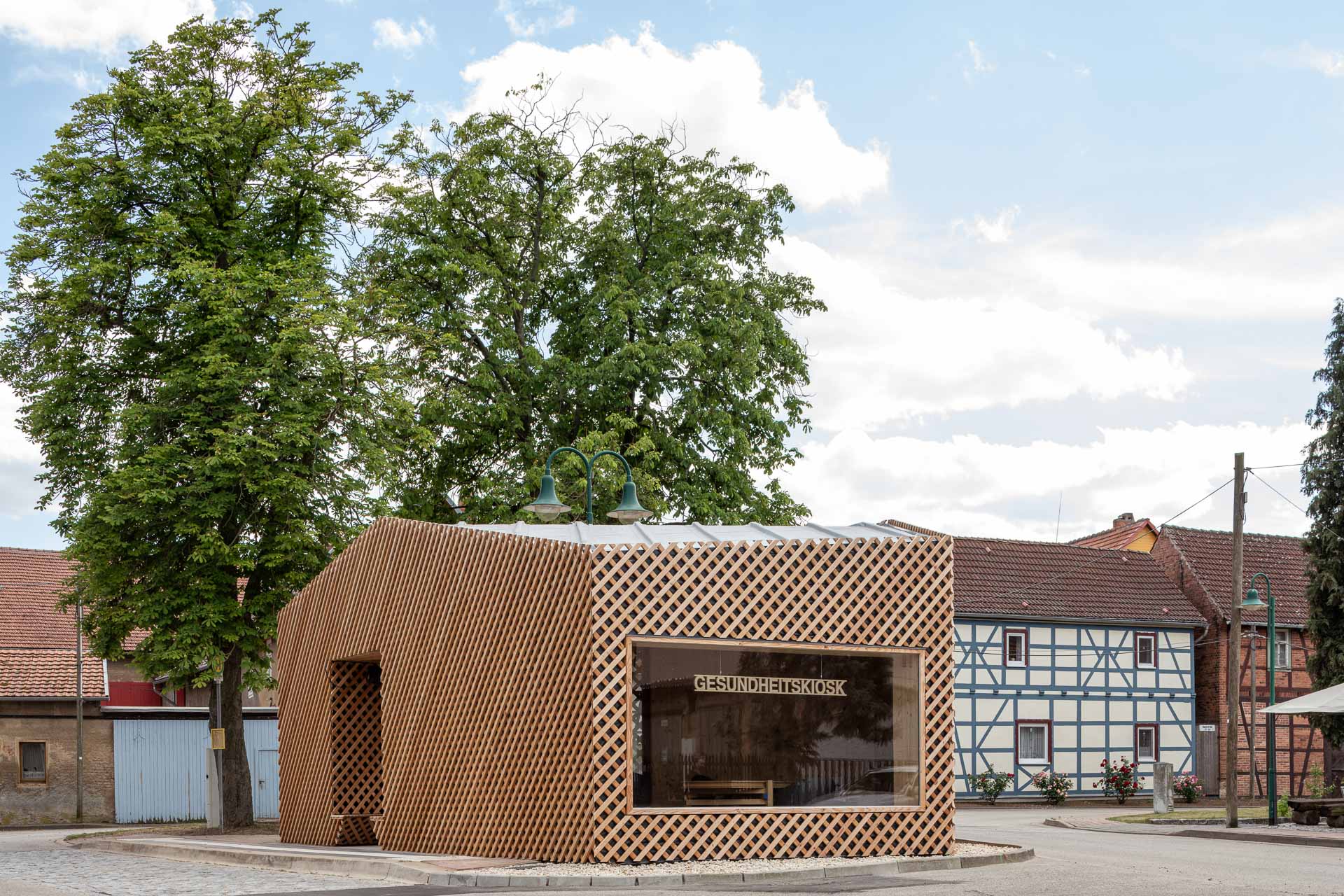
The health kiosk in Blankenburg responds to its listed surroundings with diagonal facade battens. © Thomas Müller
The budget was extremely tight. Where did you have to make the biggest cutbacks?
Mainly on the fittings. Construction costs of around 80,000 to 85,000 euros were originally planned. However, due to the sharp rise in timber prices, the final cost per kiosk was around 115,000 euros – still an extremely low figure. The structural work had to be perfect as there was no budget for subsequent finishes. The structural work is the finishing touch.
Were there any positive surprises?
Yes, such as the large windows. I was really pleased that we were able to install them. And, of course, there were the savings achieved through voluntary work: many tradespeople, students and villagers did more than could have been expected of them. Looking back, I’m amazed that nothing is missing. At the same time, the tight budget meant that we had to build using existing materials. Over the years, the villages have developed a mindset where nothing is thrown away, because it might be needed later. Materials are now collected, sorted and reused at the building yard.
What were your key insights from the project?
Even on the tightest budget, it is possible to question and deviate from standards, norms and notions of comfort without the building suffering as a result, if everyone pulls together. The common goal must be clear to everyone. This requires intensive communication and, sometimes, a prototype to encourage experimentation, as was the case in Urleben. The most surprising realisation is that radical reduction actually works. This makes me wonder whether experimental building should be promoted much more strongly, particularly in rural areas. These projects would never have come about under standard regulations.
Read more in Detail 4.2026 and in our Detail Inspiration database.
Architecture: Pasel-K Architects
Client: Landengel e.V., Thüringen
Location: Urleben, Kirchheilingen, Blankenburg, Bruchstedt (DE)
Project architects: Ralf Pasel, Mareike Krautheim
Team: Thalia Buddin, Marie Deilmann, Charlotte Perschmann, Lara Jessen
Structural engineering: Planergruppe, Bad Langensalza
Contractor: Stiemer Bau
Timber construction: Holzbau Krieghoff
Cabinetry work: Tischlerei Lindner, St. Gobain
Insulation: Bauder
Gallery


