
A beacon for modern timber construction
Sawa Residential Building in Rotterdam by Mei Architects + Planners
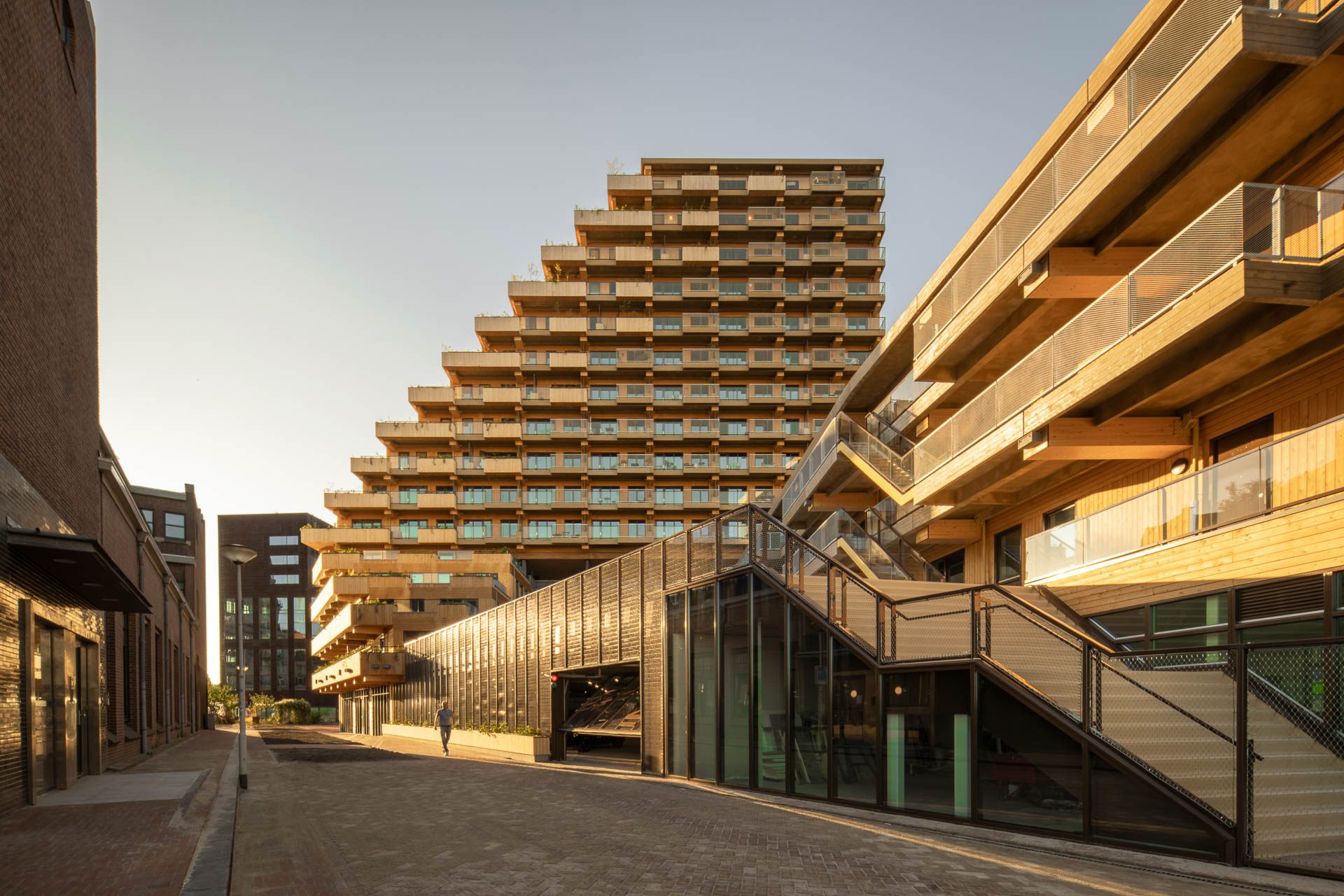
Sawa seen from the banks of the Maas. The residential building, which is up to 16 stories high, frames an inner courtyard on the first floor, below which are parking spaces and shops. © Aiste Rakauskaite
In the past, the Lloydkwartier in the west of Rotterdam’s inner city was the most important transfer site for freight and passengers on the way to Southeast Asia. In the late 1990s its successive transformation into an office and residential district began. This process took more than 25 years, with an interruption during the global financial crisis. In 2019 Mei architects and planners approached the municipality of Rotterdam together with the project developer Nice – a recently founded spin-off of the architecture office. The aim was to create an ambitious residential building on one of the few remaining properties in the city: 55 m tall, supported by a structure comprised nearly exclusively of timber, permitting flexible use, and covered with lush green. More than 600 planters and 140 nest boxes are supposed to contribute to biodiversity in Europe’s largest port city.
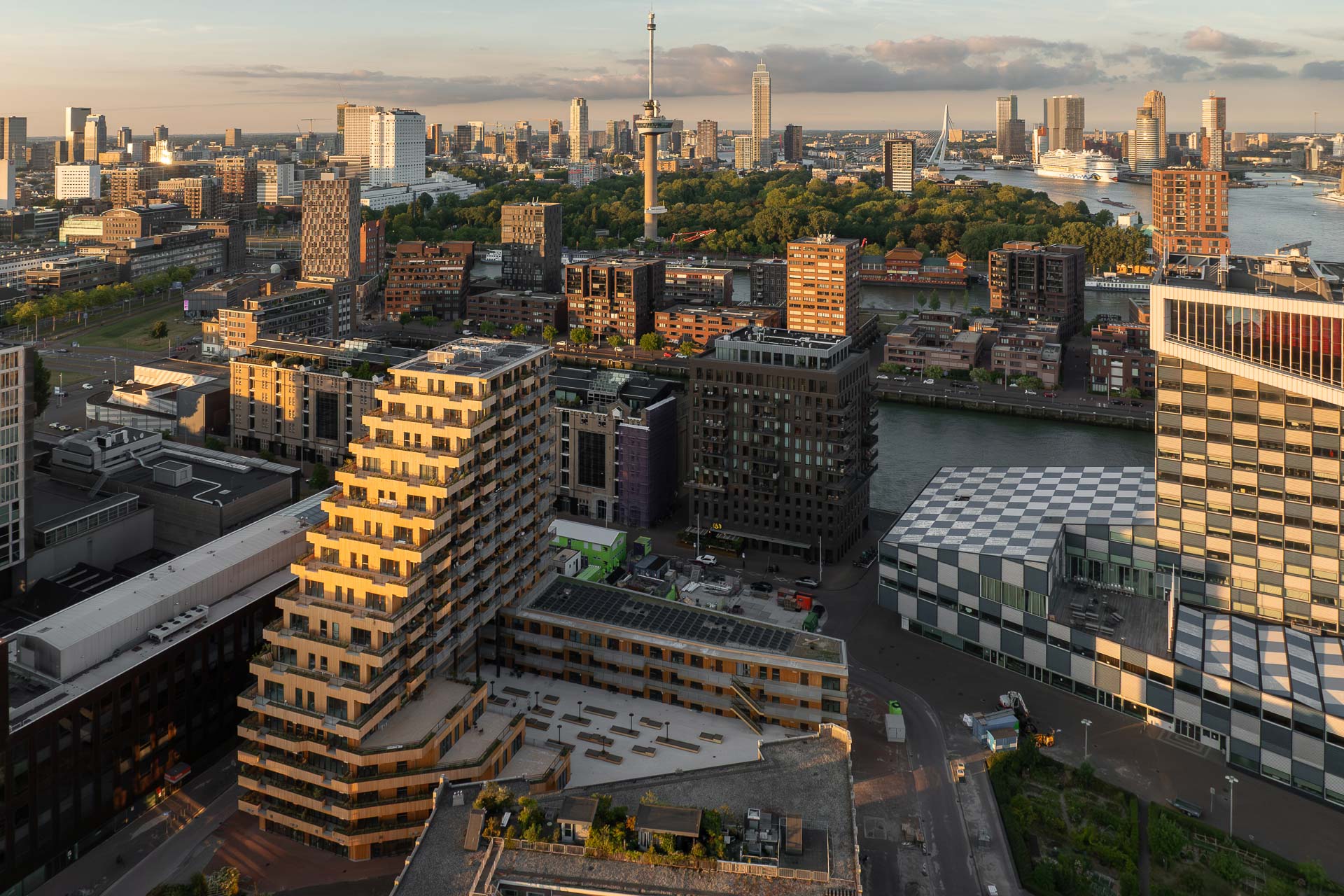
The residential construction is the final building block of the Lloydkwartier, whose conversion began 25 years ago. © Aiste Rakauskaite
The rice terraces of Rotterdam
The development plan in its original form permitted a 16-storey slab facing northward and two four-storey residential slabs in the west and the east as bookends of a parking garage with a rooftop garden. Mei architects and planners opted for a staggered arrangement of setback floors oriented westward that would afford the neighbouring buildings more daylight. The project name Sawa is an outcome of this approach. It recalls the rice fields of Indonesia with their typical terraced arrangement.
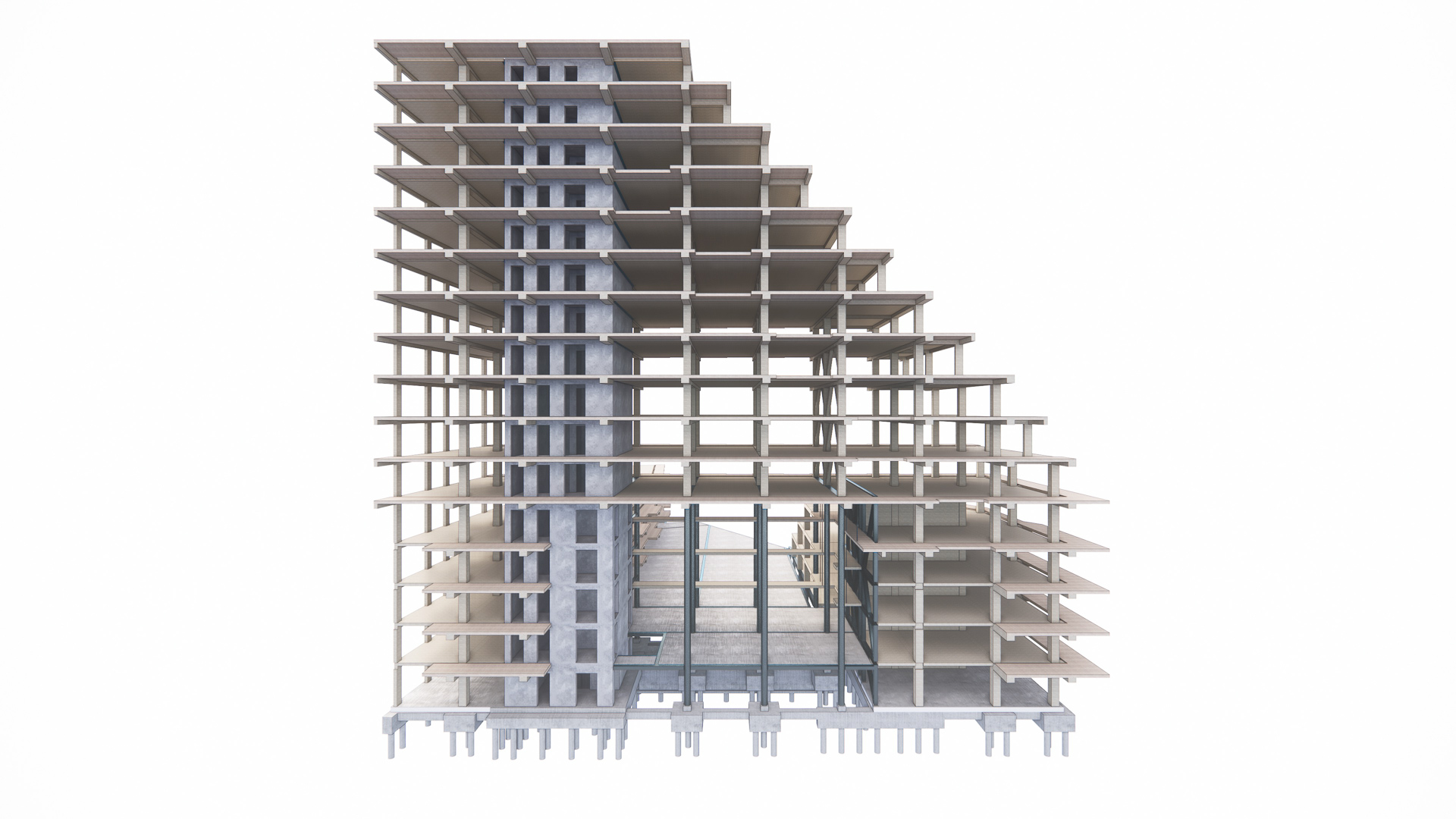
Structural diagram of the residential building, viewed from the north. © Mei architects and planners
Mighty wooden supports in a flexible grid
https://inspiration.detail.de/en/article/sawa-residential-building-in-rotterdam-12735?utm_source=website&utm_medium=referral&utm_campaign=AFF0116According to the architectural office, the primary loadbearing structure consists of wood to more than 75 %. Omitting a basement contributes to this figure. Only the ground floor slab and the parking garage were built from reinforced concrete, in addition to the access core and the multi-storey columns in the passageway on the northern side of the building. Altogether, the timber contractor Derix used about 3300 m2 of wood, sourced from forests in the west of Germany to a major degree. This includes the glued laminated timber columns with 60 × 60 cm cross sections and arranged according to a 6 × 7 m column grid. This further comprises the downstand beams supporting the 24 cm thick cross laminated timber ceilings. In the interiors, the loadbearing frame and the ceiling undersides mostly remain exposed. The non-loadbearing interior elements such as the inner lining of the facade and the partitions either display gypsum board or tiled.
Read more in Detail 3.2026 or in our Detail Inspiration database.
Architecture: Mei architects and planners
Client: Nice Developers, ERA Contour
Location: Lloydstraat, Rotterdam (NL)
Structural engineering: Pieters Delft, Pirmin Jung
Landscape architecture: Copijn
Building services engineering, building physics, acoustics: DGMR
Gallery


