
Strengthening the community
Rammed Earth Tennis in Ghana
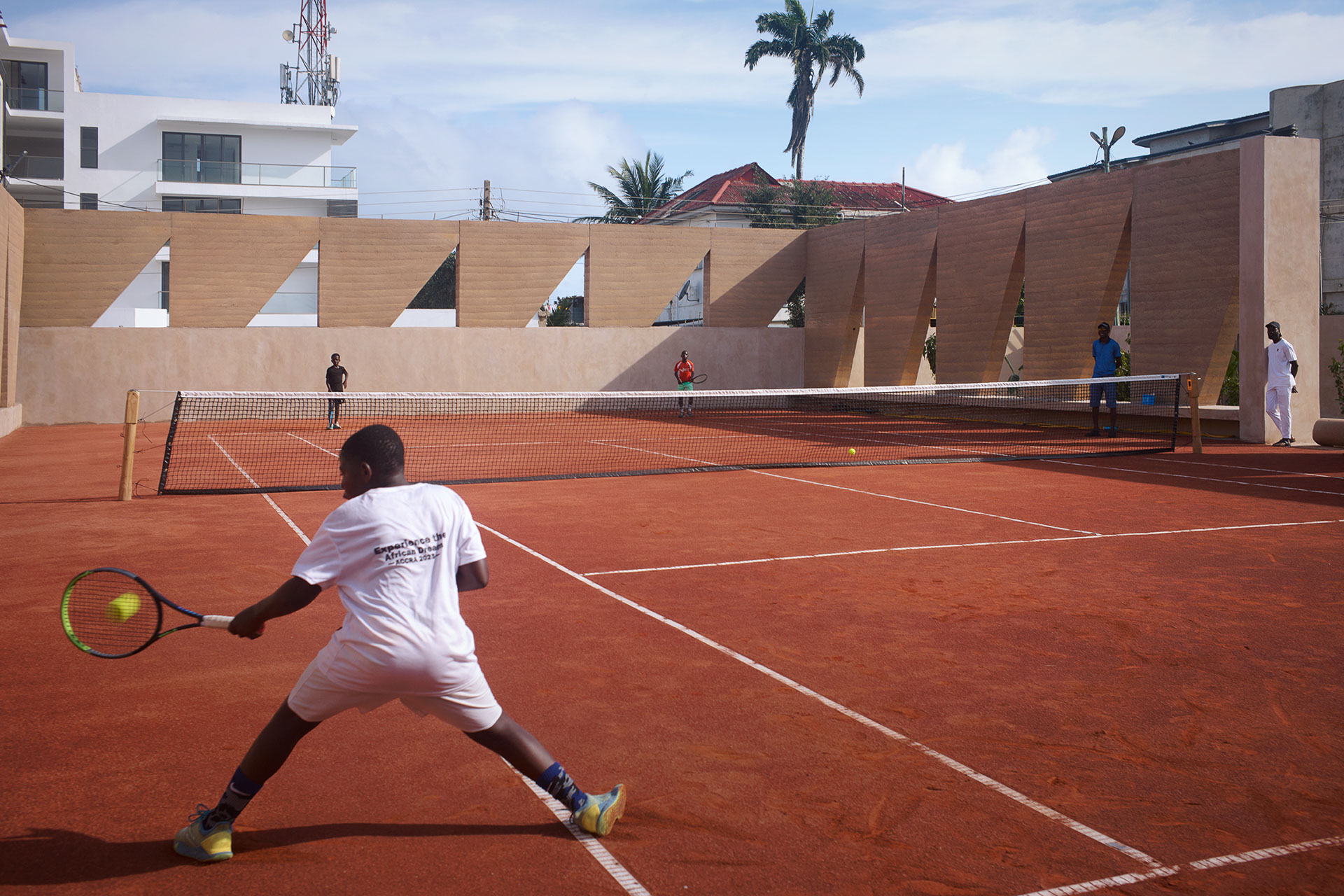
Backyard Community Club in Accra, © Julien Lanoo
Anyone who has played tennis properly after years of intensive training knows that this sport encapsulates life in all its kinetic beauty, with moments of happiness as well as setbacks. This is one reason why tennis is so addictive. While the four Grand Slam tournaments – the Australian Open, the French Open/Roland Garros, Wimbledon and the US Open – take place on three continents, Asia, Latin America and Africa are largely excluded from this world-class competition. Tennis generates enthusiasm all over the world, but lacks a lobby. Currently, players such as Ons Jabeur from Tunisia and Zheng Qinwen from China, as well as legends like former top-ten player Gabriela Sabatini from Argentina, represent nations outside the world elite.
Local heroes
This makes the current report by US tennis magazine Racquet on the Backyard Community Club in Accra, Ghana, all the more significant. In Accra's Osu district, architect Glenn DeRoche and his team at DeRoche Projects have created a subtle icon made of rammed earth, skilfully combining architecture and tennis. The double-curved roof of the training halls for Wimbledon, designed by Hopkins Architects, remains rather exceptional in tennis, as architectural firms are rarely commissioned for such functional buildings. So how did this special project come about?
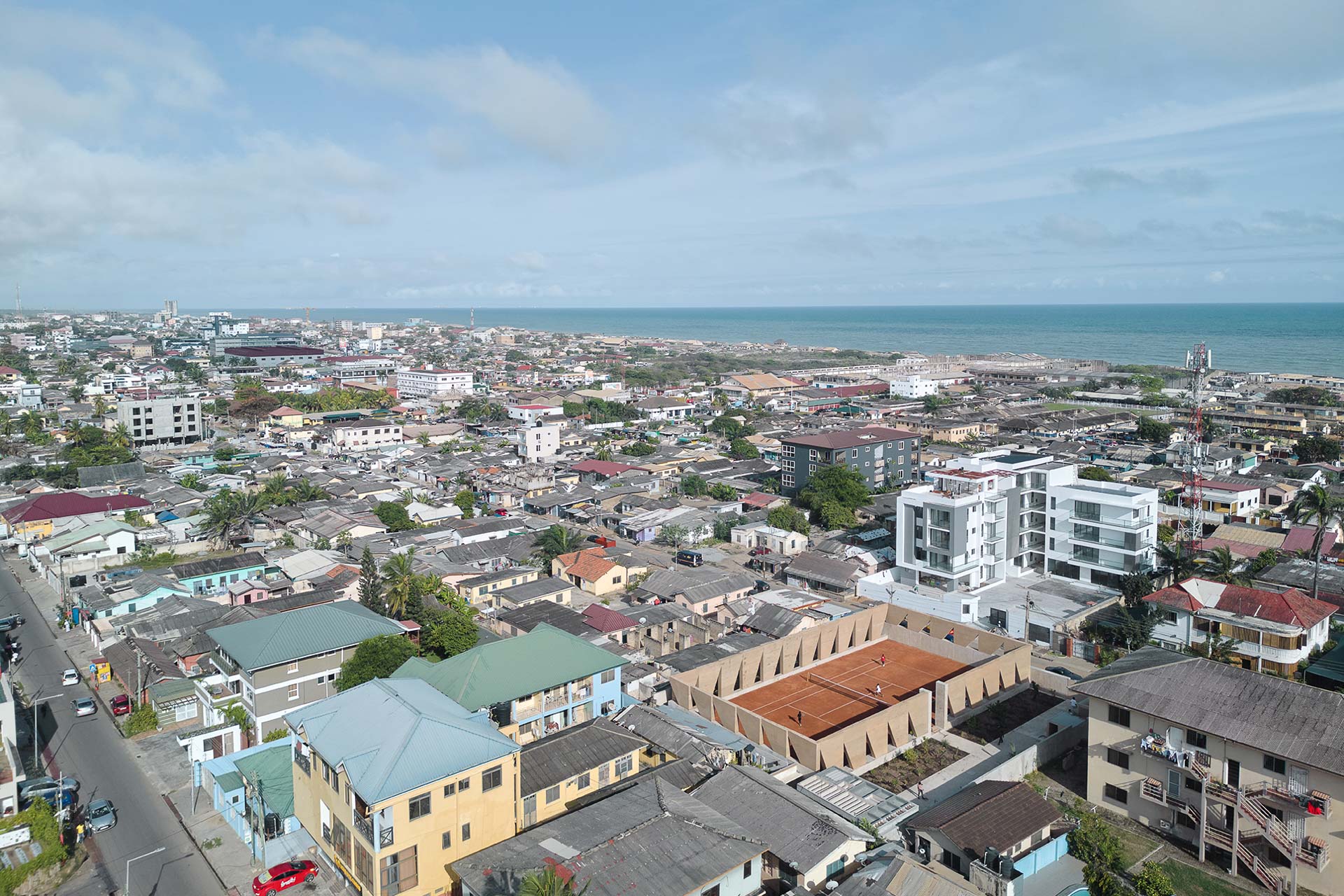
The Backyard Community Club in Accra is promoting a new model for community living. © Julien Lanoo
Tennis for all
The client and initiator of the Backyard Community Club project is Ghanaian artist Amoako Boafo. His goal is to promote a new model for community living in Accra, where public leisure spaces and green areas are scarce. The communal sports facility, with a tennis court at its centre, demonstrates how good design can create environments that are ecological, climate-friendly, inclusive, and socially transformative. Collaborating with DeRoche Projects was a perfect match. The studio takes a long-term view of its projects, mainly focusing on public buildings and community centres. In 2023, Glenn DeRoche and his team caused an international stir with SurfGhana Busua Collective, and in 2024 with Dot.Ateliers – Ogbojo Residency in Accra. When Amoako Boafo asked DeRoche to build a tennis facility in the poor Osu neighbourhood, he immediately accepted the commission. The architect started playing tennis as a child, but had to give up the sport due to financial constraints, only taking it up again as an adult in London. “I haven't put my racket down since,” he said in a Racquet interview. “When I came to Accra, I realised how few public tennis facilities there are. There are a few established facilities, but they all charge a fee. So, if you don't have money, you don't have access.”
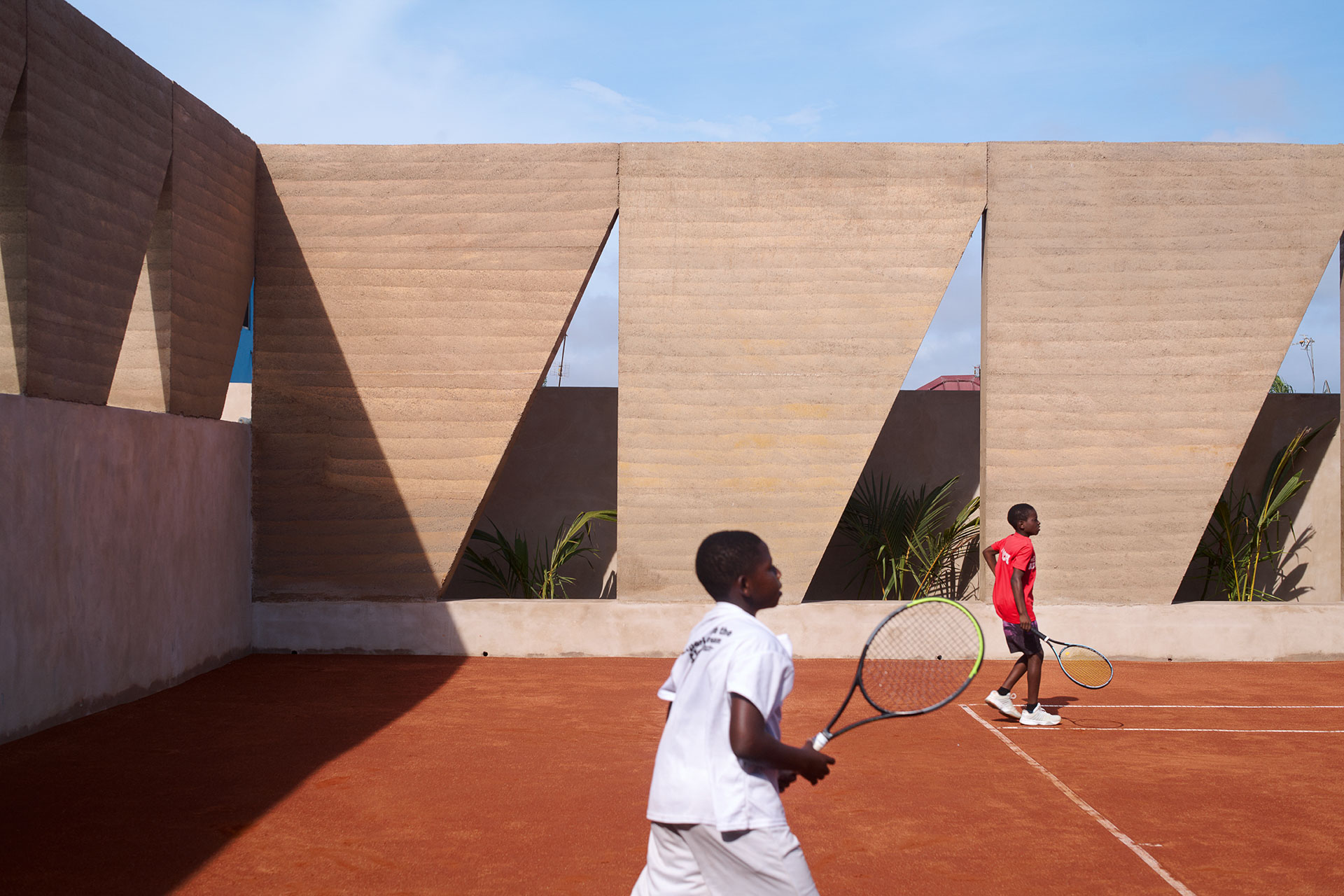
Inside the tennis court, the rammed earth slabs were constructed flat. © Julien Lanoo
Baseline play
Light and shadow define the small tennis facility at the Backyard Community Club. Built on a compact plot of land in the densely populated district of Osu, the club is a prime example of how to make the most of a small space. The design was informed by the need for a boundary that would open up the court to its surroundings while also protecting it. The architecture studio sought an alternative to the usual unappealing chain-link fence that would also have to be imported. DeRoche Projects' solution is an experiment. A 4-m-high rammed earth wall surrounds the court, creating a subtle rhythm of closed surfaces that protect against crosswinds, with geometric incisions allowing views in and out. This adds a striking element of beauty and sculpture to a sport that otherwise takes place behind wire fences and colourful advertising banners.
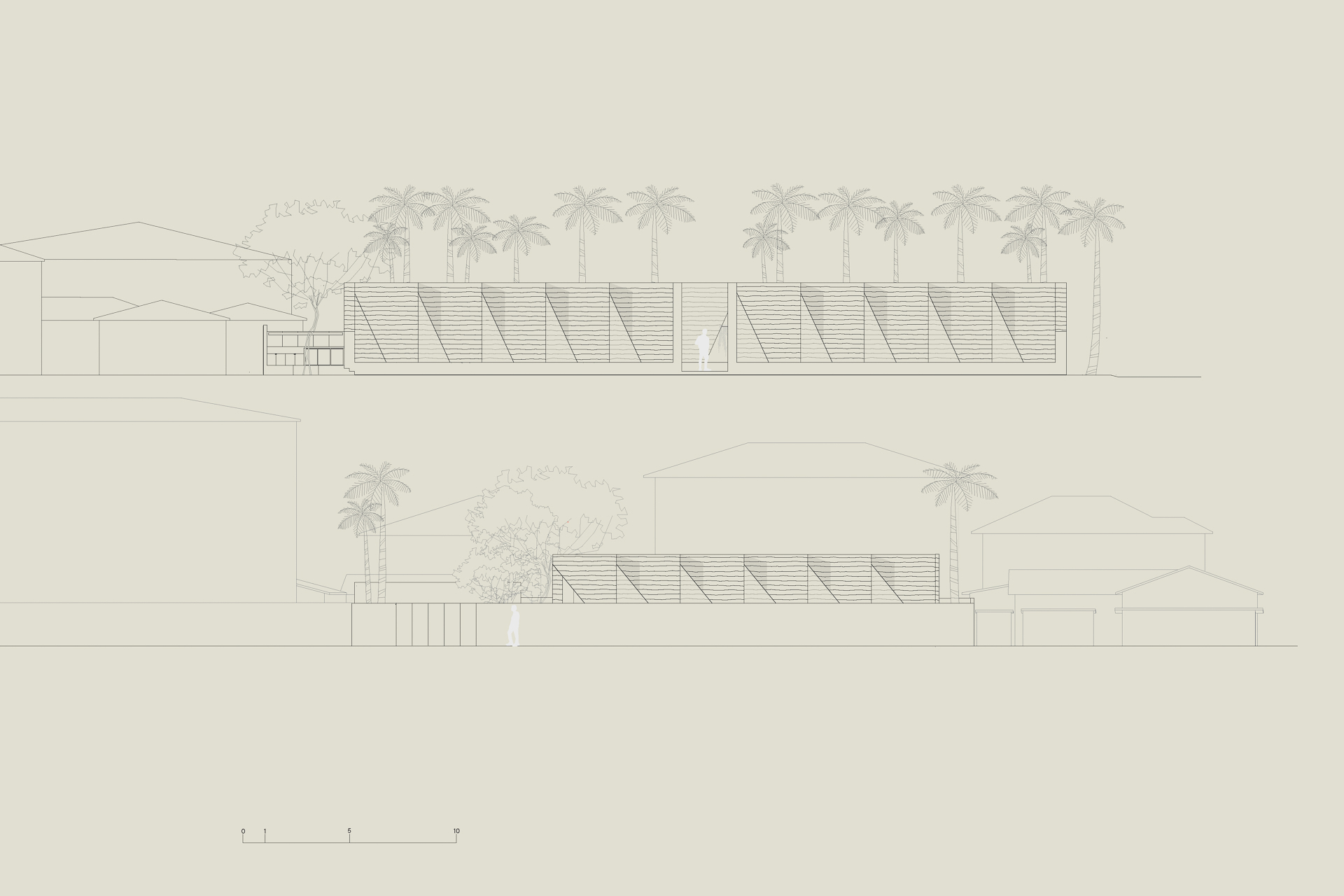
Elevation, Graphic © DeRoche Projects
One detail that is not immediately apparent is that the prefabricated rammed earth panels move in two directions. While they taper in one plane, they slope in another. Additionally, the clay panels inside the court are completely flat to enable ball boys and girls to predict where the balls will bounce during a match.
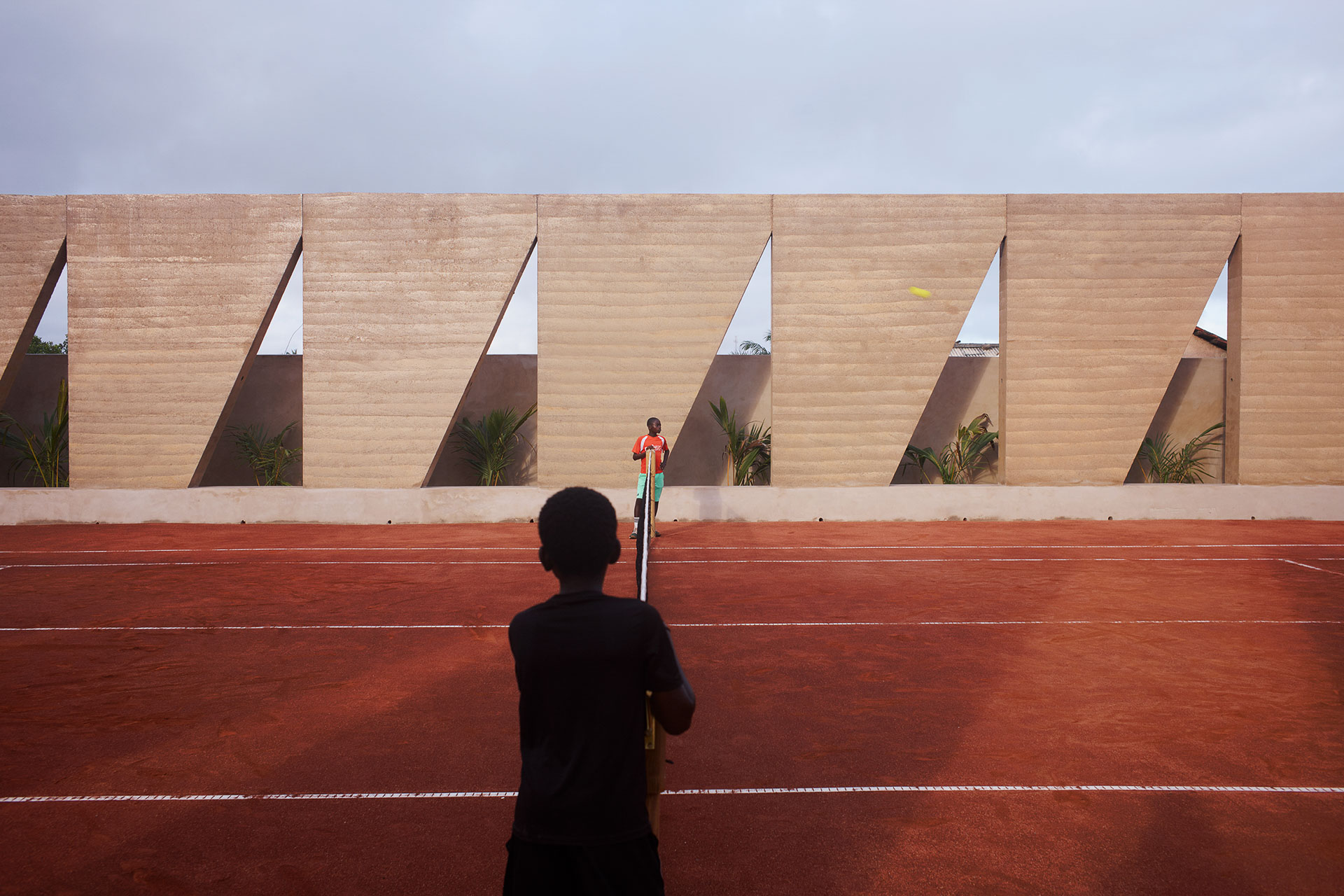
Light and shadow define the small tennis facility at the Backyard Community Club. © Julien Lanoo
Prototype rammed earth system
Glenn DeRoche developed a prototype rammed earth system that was modular, climate-resistant and reproducible, and tailored to local transport conditions, the local workforce and the Ghanaian climate. “Traditional rammed earth construction is slow, labour-intensive and weather-dependent, which has long limited its use in commercial or municipal projects,” explains the architect. “Our system circumvents these limitations by manufacturing off-site. It can be delivered quickly, generates less waste, and has only a fraction of the CO₂ emissions of concrete.” DeRoche describes it as a new concept for building from the ground up using the soil itself.
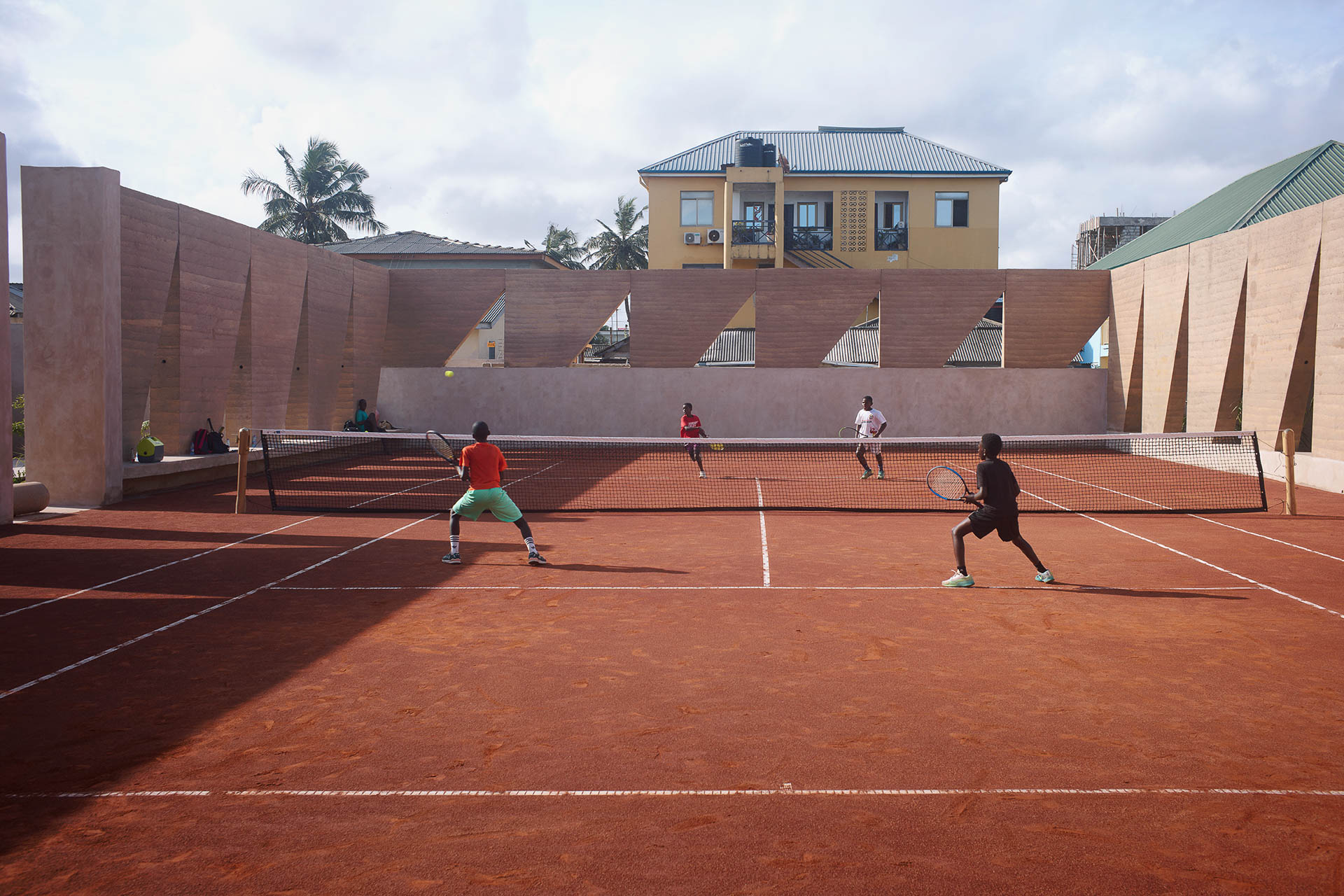
A 4-m-high rammed earth wall surrounds the court, creating a subtle rhythm of closed surfaces and geometric incisions. © Julien Lanoo
As clay courts require a lot of water, a borehole system and diverted rainwater are used to irrigate the tennis courts and green spaces. This promotes resilient, drought-tolerant planting that is as independent as possible from the municipal water system. According to the architectural firm, the court's surface is made of real clay, produced from crushed, fired bricks of various grain sizes that have been carefully layered. “It is the only imported material in this project, but it is indispensable. In combination with the drainage system, the court dries much faster than typical Ghanaian laterite surfaces,” says DeRoche. After rain, tennis can resume six to twelve hours later, which is a definite advantage. The only disadvantage is that there is only one tennis court.
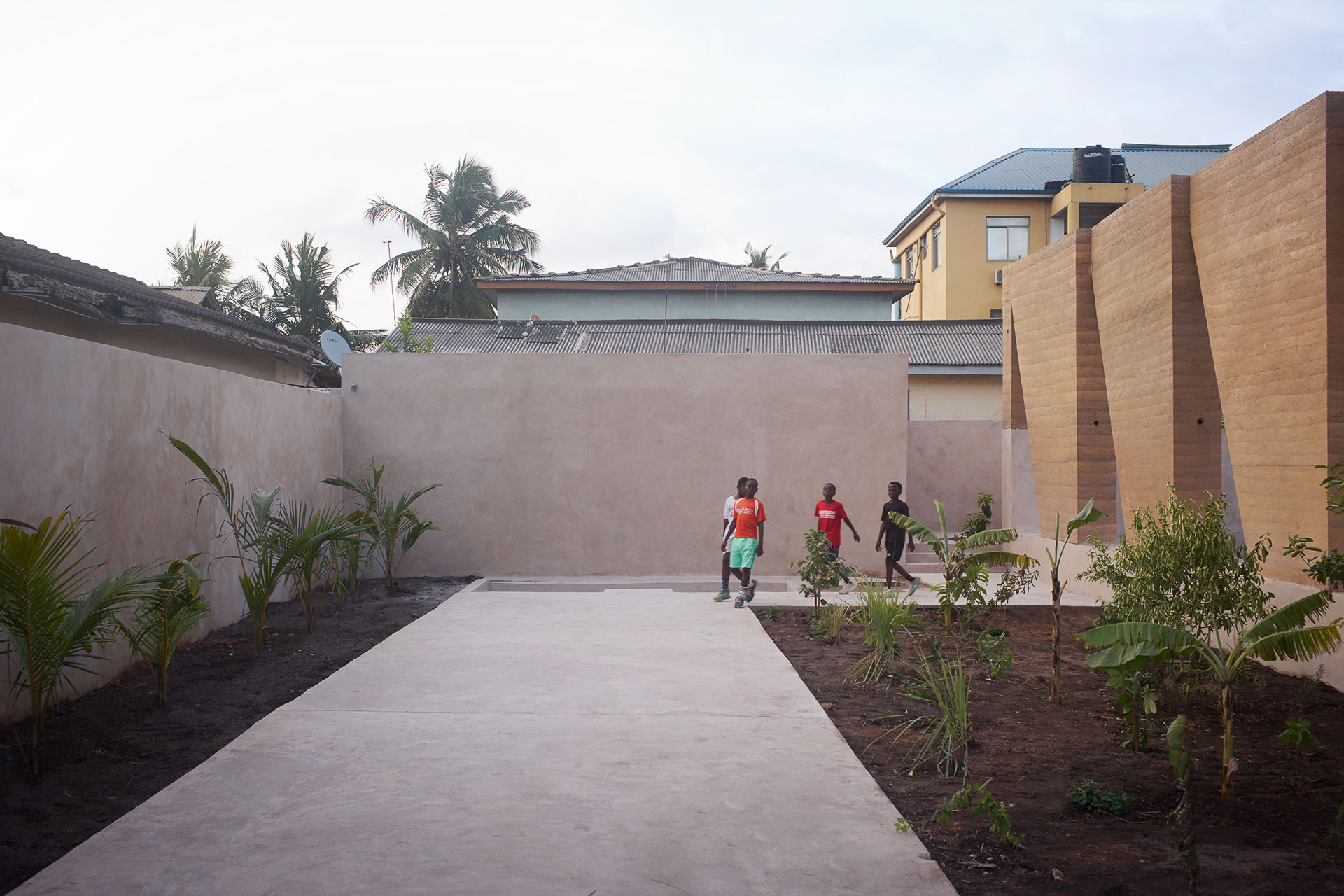
Adjacent to the tennis court is a kitchen garden containing over 20 species of edible and medicinal plants. © Julien Lanoo
Will tennis remain an elite sport?
“Backyard is about more than just tennis. It's about creating a platform for young people, mentoring, and community engagement,” Glenn DeRoche emphasises. The tennis court is complemented by a 230 m² kitchen garden containing over 20 types of edible and medicinal plants. Discreetly integrated into the complex are ancillary rooms such as changing rooms, showers, shaded seating areas, outdoor preparation tables and a barbecue area. Tennis remains competitive in Ghana: The Backyard Community Club's current programme supports nine West African tennis champions, all under 18. Amoako Boafo hopes that they will not have to travel to North Africa for training, to countries such as Algeria, Morocco or Tunisia. They can now continue their training in Ghana, where the next tournaments and places in the world rankings await them.
Architecture: DeRoche Projects
Client: Private
Location: Osu, Accra (GH)
Structural engineering: Richard Ofori Addo
Construction industry: Elorm Benjamin Nyornator
Consulting for rammed earth construction: Earth Structures
Rammed earth construction company: Brazz Construction
Construction company: Kasa Konsult
Mechanical engineering and plumbing: Synergy Mep Ltd.
Electrical planning: Carllyn
Gallery


