
Building in hot climates
Women's Mosque in Doha by Diller Scofidio + Renfro
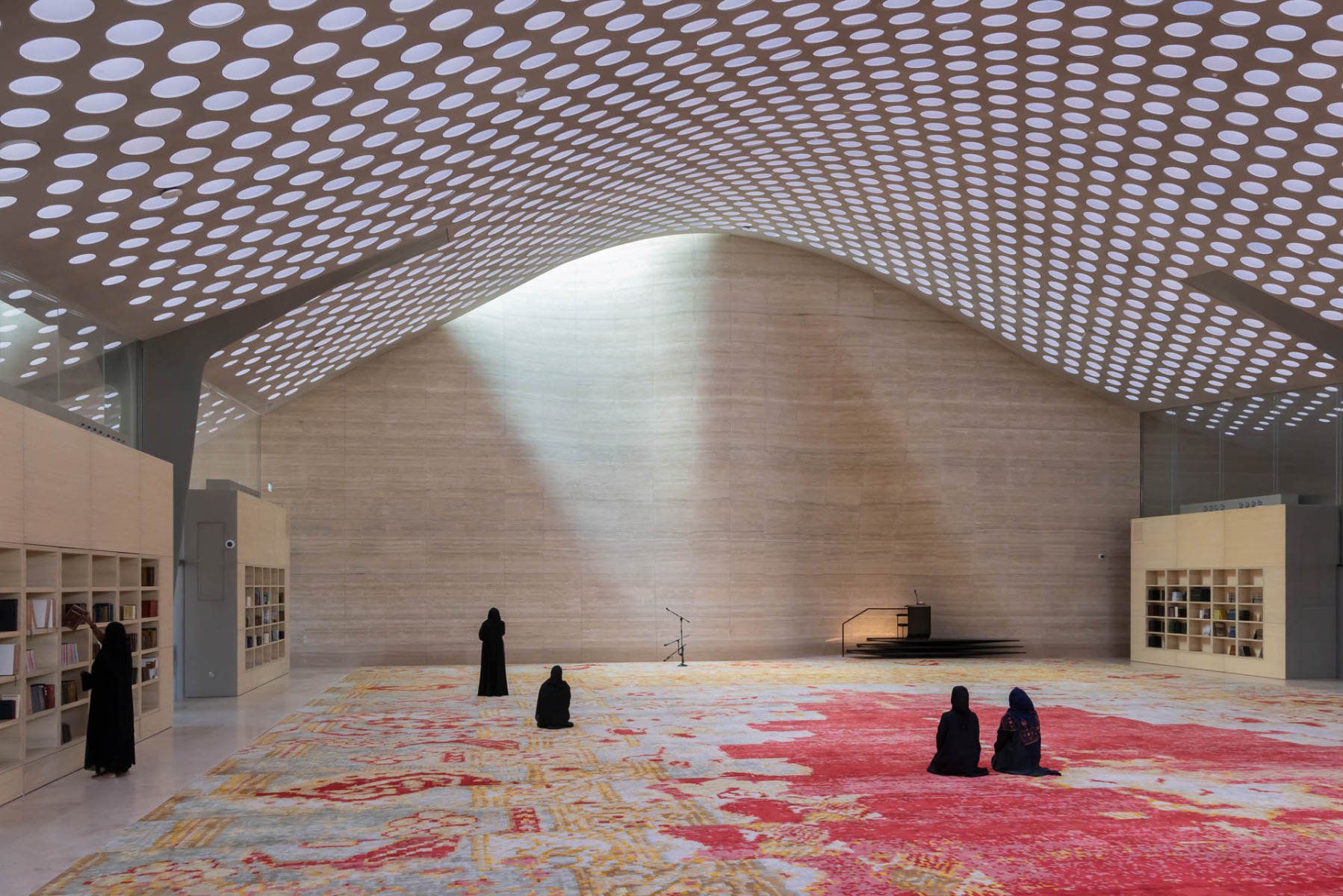
This is a view of the women's mosque in the Al Mujadilah Centre educational complex in Doha: The Qibla wall, facing Mecca and clad in travertine, curves outwards at its highest point in the centre of the room to form a Mihrab prayer niche. © Iwan Baan
The construction of new mosques has experienced a renaissance in recent years in Europe and around the world. In 2018, Paul Böhm's monumental DITIB Central Mosque in Cologne caused an international sensation with its 35 m high concrete shell dome. In 2022, Bevk Perović Architects in Ljubljana opened the Islamic Religious and Cultural Centre (IRCC) with Slovenia's first mosque: a white, translucent steel cube measuring 32 m on each side. Marina Tabassum's Bait Ur Rouf Jame Mosque in Dhaka was much more modest in scale, but still had a high spiritual quality. Opened in 2012, this simple sacred building made of traditional brickwork on the outskirts of the Bangladeshi capital was the result of an initiative by the architect's mother. In Qatar, the first mosque exclusively for women in the Islamic world has now been built. The initiator here is also a woman: the chairwoman of the Qatar Foundation, Her Highness Sheikha Moza bint Nasser. The new Al Mujadilah Centre in Doha is named after the 58th surah of the Quran, entitled Al Mujadilah, which deals with women's rights.
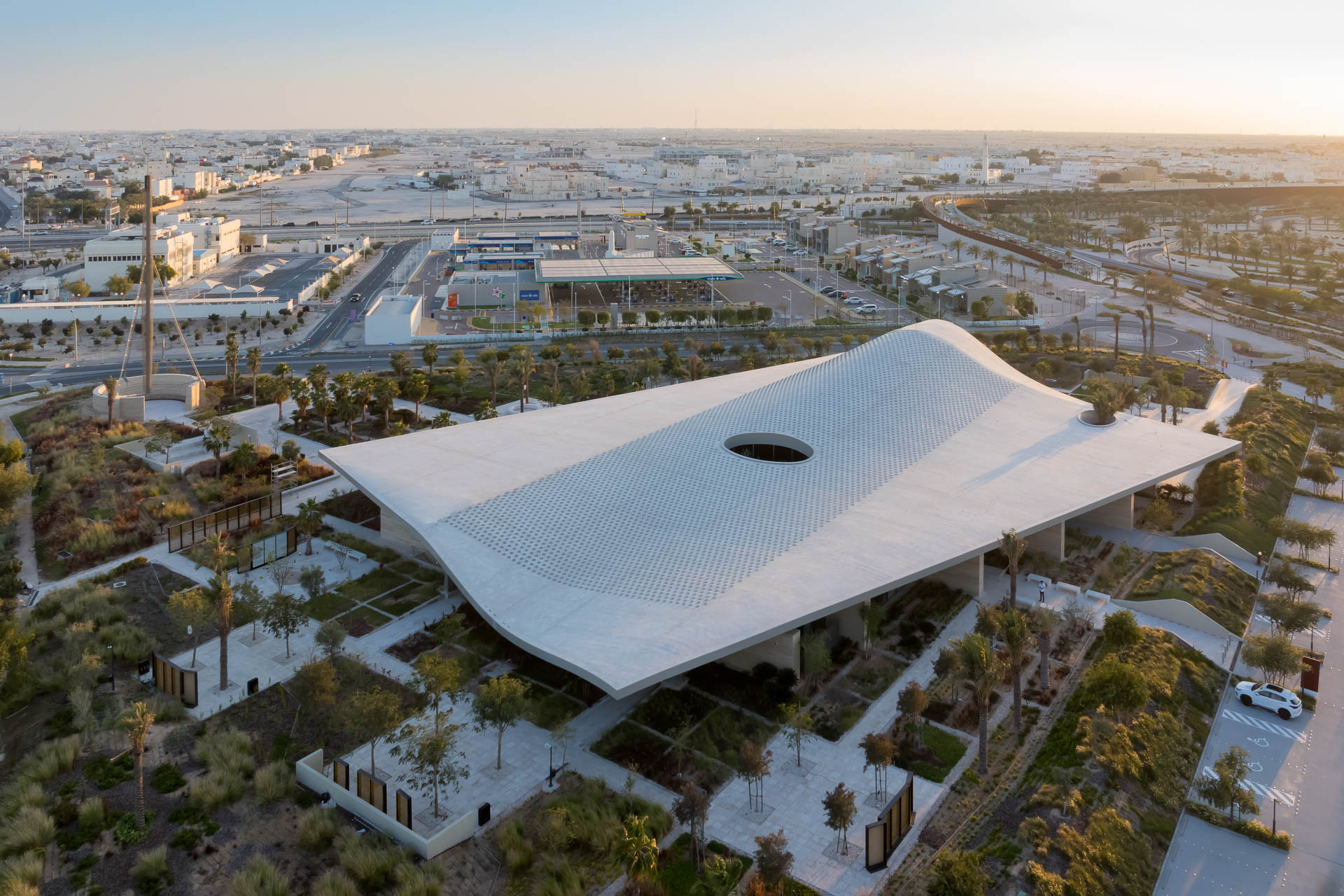
The new building by Diller Scofidio + Renfro has a perforated roof panel that is curved like a sand dune and aligned precisely in a north-south direction. © Iwan Baan
Wave instead of dome
The new building by Diller Scofidio + Renfro is a world first in terms of its typology. The 62 x 89 m perforated roof panel is corrugated like a sand dune and precisely aligned in a north-south direction. A field of 5,488 cylindrical skylights, rotated by 17 degrees in the direction of Mecca, sits beneath it. The roof rises from 3.15 m to 12.90 m along its central axis, while the roof edges form a continuous horizon at 5.50 m all around. Eight main steel girders, each with a span of 25 m and individual camber, form the primary supporting structure. Secondary beams made of 40 cm-high steel profiles support the C-profiles to which the insulated sandwich panels are screwed. The roof surface consists of 2 cm thick, individually cut panels of Omani marble laid in a supporting layer of reinforced screed. The architects and structural engineers achieved the feat of designing the steel structure in such a way that the immense number of 25 cm diameter skylights create a homogeneous field of light with equal spacing when viewed from above and below.
Wave as Mihrab
The qibla wall, which faces Mecca and is clad in travertine, curves outwards at its highest point in the centre of the room. This forms a mihrab prayer niche that is bathed in streaks of diffuse light from a lens-shaped skylight. The minimalist minbar, a pulpit made of thin steel sheets, is located by a counter-vibration of the natural stone wall. Another defining feature is the 20 x 35 m prayer carpet, woven as a single piece and laid flush with the floor. Its design is based on a traditional carpet pattern that Diller Scofidio + Renfro pixelated and abstracted using a graphics programme. Along the prayer hall are a shoe storage area and rooms for ritual washing, as well as a lounge and seminar rooms for Her Highness.
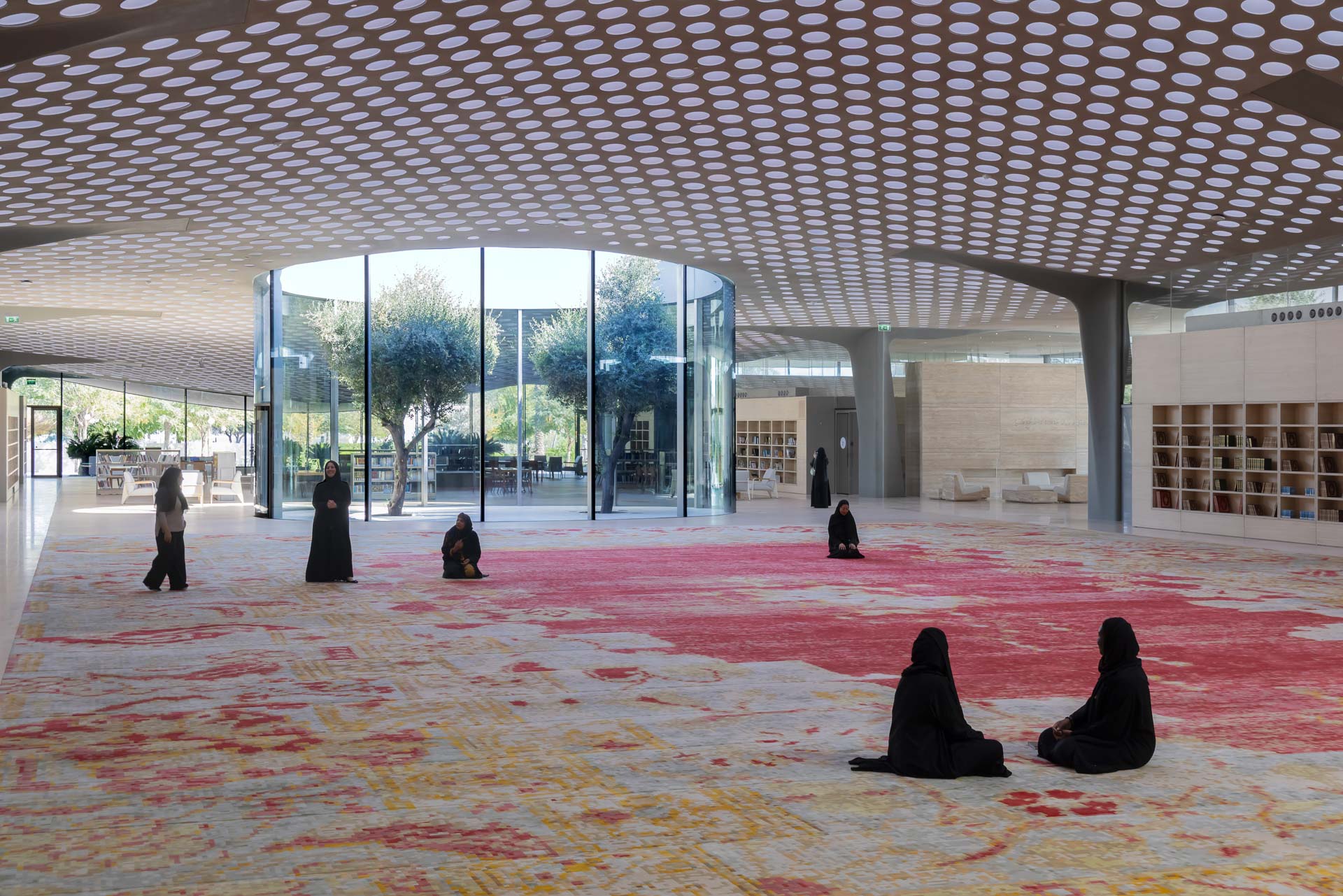
The 20 x 35 m prayer carpet has been woven as a single piece and lies flush with the floor. © Iwan Baan
Courtyard with olive trees
An oval courtyard with olive trees in the centre of the building separates the prayer hall from the multi-purpose room, which can be used for various events. During Ramadan, an additional large prayer carpet is laid out here, enabling a total of 1,300 Muslim women to pray in the building. A library offers women the opportunity to study Islamic literature. Various workspaces with plenty of daylight enable a variety of learning formats: These can be used in the courtyard, the seminar rooms or the multi-purpose room. A café completes the room layout. Vegetation also plays a decisive role in the immediate surroundings of the education centre. A chessboard-like park surrounds the transparent rooms, offering attractive shaded outdoor areas amidst the hot desert climate.
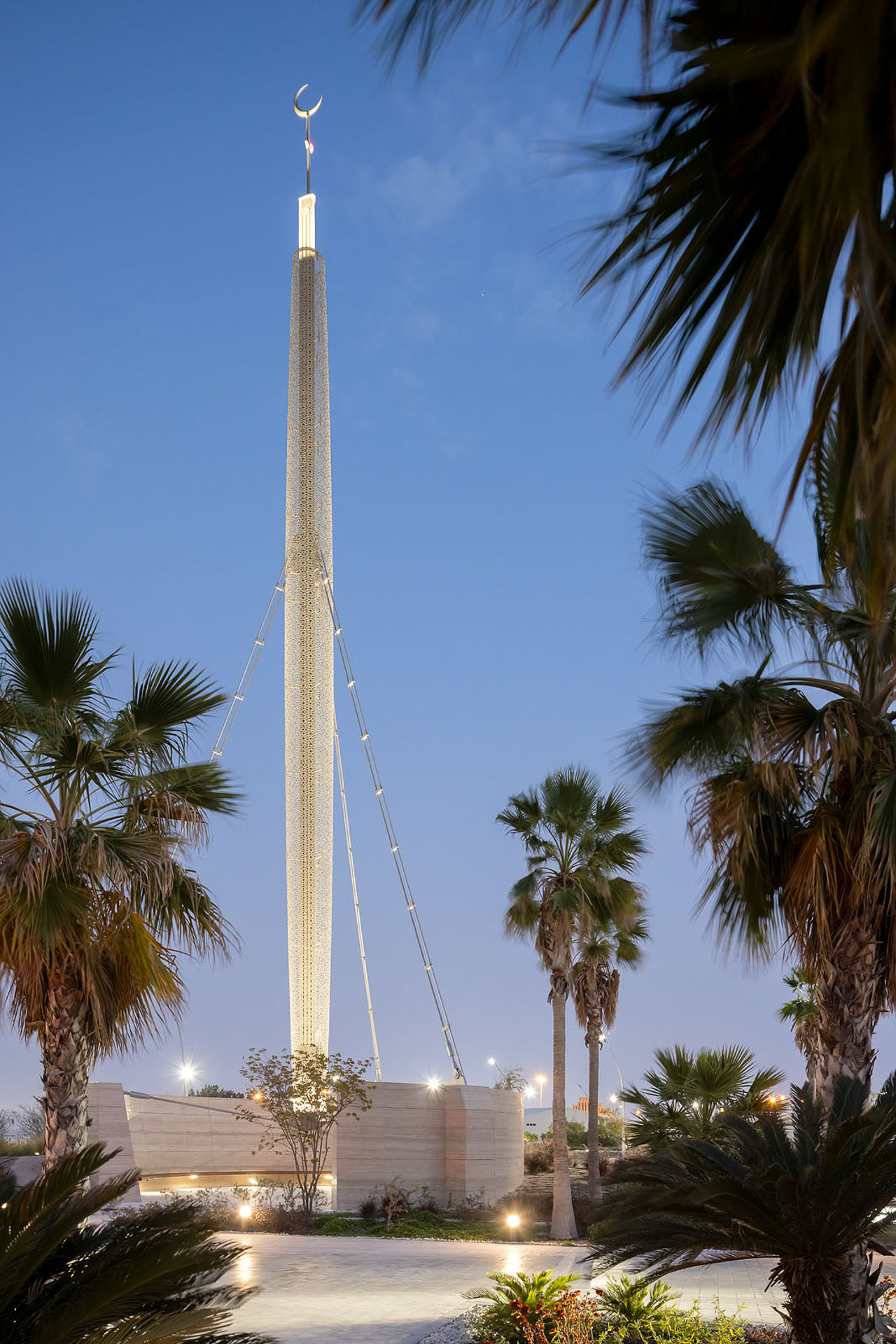
The 39 m high steel minaret needle floats 2 m above the floor as a tensegrity structure. © Iwan Baan
The minaret as an art installation
The Al-Mujadilah Centre, which includes a women's mosque, marks the western entrance to Education City, a 12 km² area developed by the Qatar Foundation. Complementing the cluster of eight international universities and 13 schools with a total of 11,000 students centred around the National Library by OMA, the minaret is associated not only with the mosque, but also serves as a landmark for the entire educational campus. The 39 m high steel needle appears to float two metres above the ground as a tensegrity structure. At night, the translucent shell of perforated ornamental metal sheets is backlit. Five times a day, three loudspeakers on three sides of the shell are raised automatically to announce the call to prayer.
You can find out more in Detail 10.2025 and in our Detail Inspiration database.
Architecture: Diller Scofidio + Renfro, Elisabeth Diller, Evan Tribus
Client: The Private Office of Her Highness Sheika Moza Bint Nasser
Location: Zone 52, Street 2748, Building 66
Doha (QA)
Structural engineering: Werner Sobek, New York with Halcrow, Doha
Landscape architecture: Atelier Miething, Paris
Lighting design: Buro Happold, New York
Roof covering: Nassar Stone
Gallery


