
News from Architecture & Design
Issue 3.2026
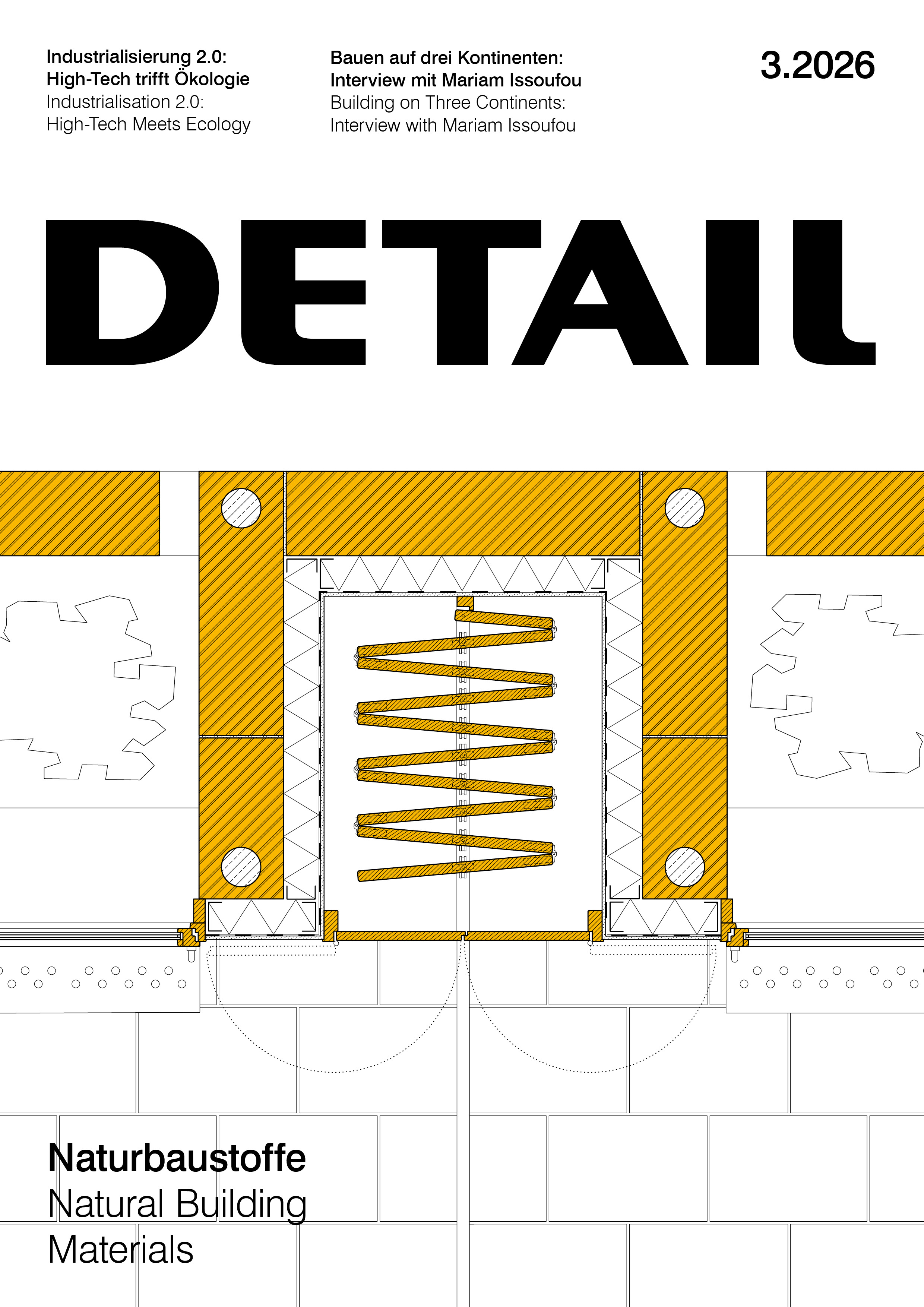
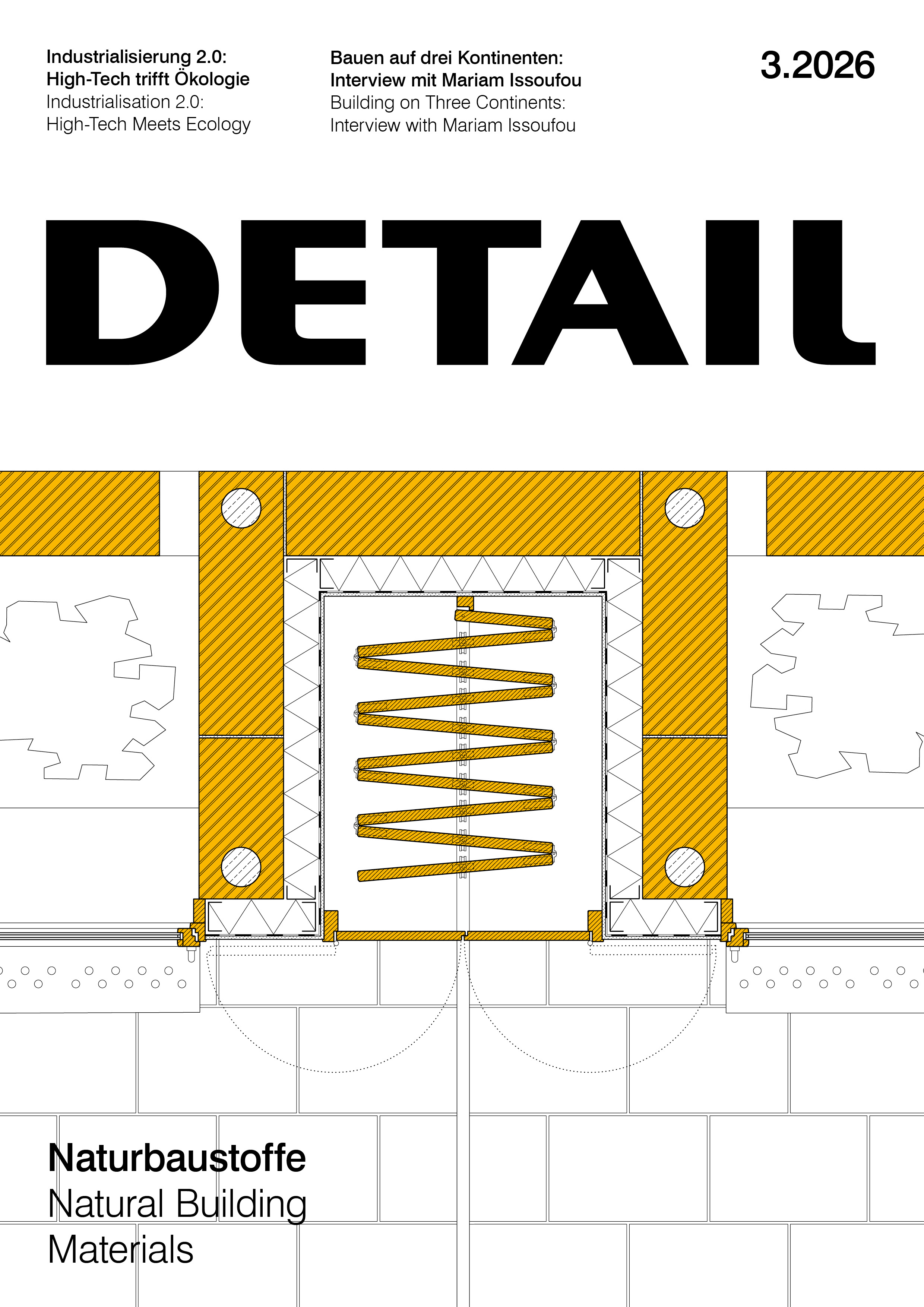
Natural Building Materials
Nature knows best. In nature, circularity is not some unfamiliar process, but the self-evident basis of all existence. Just as nothing is left behind in nature, energy is never wasted. Which means that every end contains a new beginning.
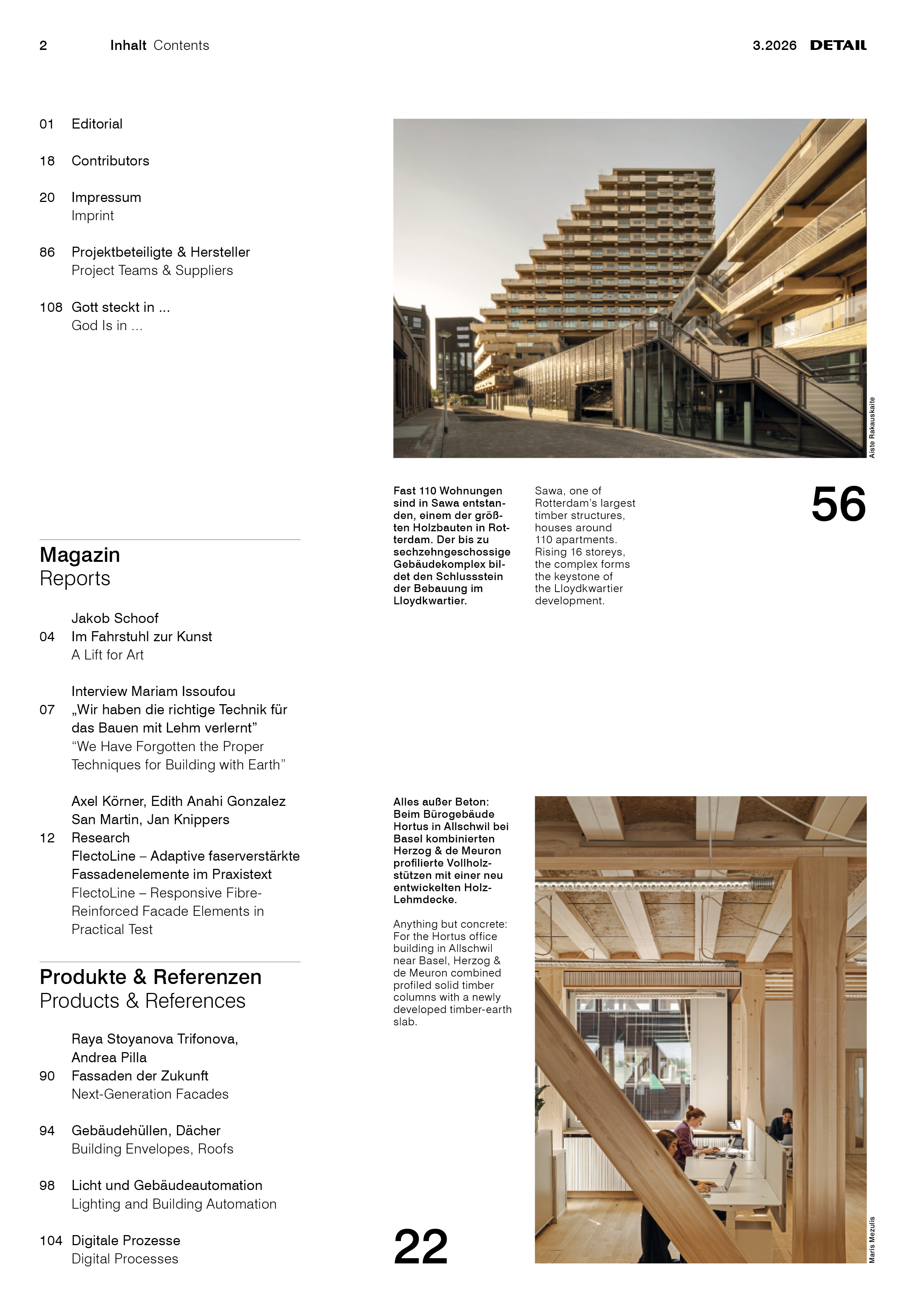
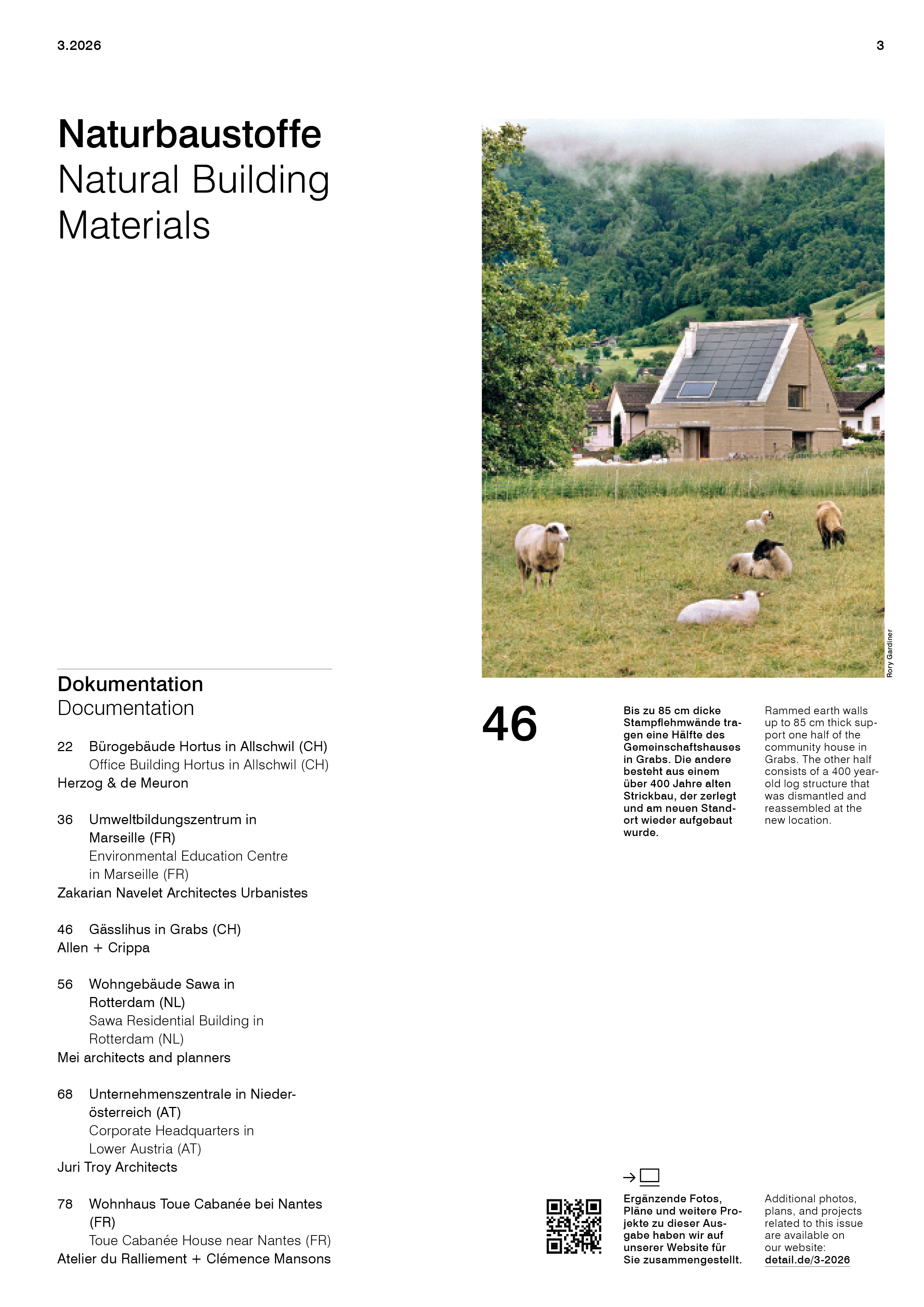
Today, natural building materials are driven less by ideology than by pragmatic choices and a pursuit of longevity. The synthesis of high-tech and “eco” has long been aesthetically convincing too. In this issue, we showcase the beauty and potential of natural stone, hemp bricks, and hempcrete; visit a reconstructed “Strickbau” (traditional timber-log construction) that upends the very definition of “immovable property”; look behind the facades of a 16-storey timber housing block; and examine the timber-earth slabs at Hortus, a key project by Herzog & de Meuron. For Alexander Franz, Project Director & Associate Architect, certifications for building components are decisive. At Hortus, the earth in the ceilings serves as part of the fire safety strategy. This game-changer is already fire-safety certified for Switzerland; it isn’t restricted to insiders and, as in nature, imitation is encouraged. Jeanette Kunsmann
Projects in this Issue
-

Enveloped in willow mats
The Toue Cabanée Residential Building Located Near Nantes
The small residential building by Atelier du Ralliement sits enthroned on a rocky plateau above a floodplain in the Loire river landscape. Simple willow mats from the hardware store cover the wooden structure.
-

Rammed earth meets wood
Windkraft Simonsfeld by Juri Troy Architects
The new building in Ernstbrunn, Lower Austria, will extend the company's existing headquarters from 2014 – and boasts a comprehensive sustainability concept in line with industry standards.
Newsletter
Produkt + Praxis | Advertorial

Publisher's offer
More projects, images and detailed drawings on our knowledge platform DETAIL Inspiration.

Further Contributions on the Topic
-

Danish architectural tradition
Heatherhill Beach House by Norm Architects
The Heatherhill Beach House combines Danish tradition with modern design, featuring clean lines, natural materials, and deliberate perspectives that open up spaces to the landscape, creating an understated elegance.
-

Strengthening the community
Rammed Earth Tennis in Ghana
DeRoche Projects' Backyard Community Club in Accra is a pioneer in the use of prefabricated rammed earth systems for construction. It is also helping to develop a tennis culture beyond the elite.
-

Protective shell made of stamped concrete
Espalion Nursery School in South-West France
The four-group nursery school in Espalion in south-west France has two radically different faces: on the outside, metre-high tamped concrete walls protect the open spaces and interior rooms. Inside, however, floor-to-ceiling glazing dominates the impression of space.
-

Redensification beneath the castle ruins
Residential Buildings on Baden's Schlossberg Hill near Zurich
Menzi Bürgler Kuithan Architects have renovated a stately 1923 villa in Baden, near Zurich, and added two slender detached houses made of wood and hemp lime.
-

When algorithms garden
The Avanade Intelligent Garden by Studio Weave
Studio Weave has teamed up with landscape architect Tom Massey and furniture designer Sebastian Cox to create an intelligent garden. This experimental urban garden uses artificial intelligence to extend the life of city trees.
-

Plant-based guest room
Rooted Potential near Copenhagen by Sara Martinsen
The pavilion “Rooted Potential” by Danish designer and materials researcher Sara Martinsen is a research project that explores the architectural potential of ten native plants from the Copenhagen area.
Previous Issues
-

Simply Well Built 1/2.2026
How can architecture deliver on its promises when budgets are tight, tasks are pressing, and resources are limited? In this issue, we hear from architects who have embraced the discipline of doing more with less.
-

Transparency Translucency 12.2025
What forms of transparency remain desirable amid social uncertainty and urban densification? Do transparent or translucent envelopes still make sense when contemporary energy concepts are applied? The examples in this issue provide numerous positive arguments.
-

Building in Existing Contexts 11.2025
Building in existing fabric conserves resources, saves energy, and reduces carbon emissions – good reasons to choose conversion over new build. The projects in this issue cast a special light on this theme.
-

Roofs 10.2025
Can architectural firms keep reinventing the roof? Since 2019, we know the answer is yes! In our new issue, we present various projects with different types of use.
-

Building for Children 9.2025
No phase of life is more formative than childhood, and the buildings children experience leave lasting impressions. In this issue we profile child-focused environments realised both as new builds and through adaptive reuse.
-

Regional Building Culture 7/8.2025
Traditional building forms have undergone repeated revivals and rejections throughout architectural history. In the current issue, we take a look at various projects.
-

Circular Construction 6.2025
The cradle-to-cradle principle envisions buildings returning to the natural cycle after use. Find out how different the approaches and hurdles are in DETAIL 6.2025.
-

Facades 5.2025
The facade is a building’s most outward-facing element. The projects featured in this issue reveal the diverse ways architecture firms approach the art of cladding
-

Solid Construction 4.2025
Around 75 % of residential buildings in Germany are made of masonry. This enduring preference reflects growing confidence in solid construction and provides the impetus for dedicating this issue of Detail to the topic.
-

Urban Housing 3.2025
Building plots are becoming scarce, housing costs are soaring, and apartments in new developments are shrinking. The model has shifted from suburban houses to urban living. But what does that mean?
-

Digital and Sustainable 1-2.2025
What lies ahead for architecture in the digital age? To gain insight, we surveyed architects from around the globe on the role of artificial intelligence. The result is a fascinating snapshot of their perspectives.
-

Masonry 12.2024
In addition to the winning projects of the Detail Award, our December issue takes us to masonry buildings in France and southern England and to Danish brick construction.
-

Timber Construction + Prefabrication 11.2024
From residential estates and office complexes to an observation tower and an Olympic milestone in Paris, this issue showcases the versatility of timber construction through seven exemplary projects.
-

Building Envelopes 10.2024
While many new residential buildings are generic investor projects using cheap materials, Paris continues to lead with experimental milestones in the use of natural building materials. We present these building envelopes in this issue.
-

New Work 9.2024
New Work is a widely used term these days, but its meaning often remains unclear. In this concept edition of Detail, we let current projects illustrate these changes rather than providing rigid definitions.
-

Building in the Mountains 7/8.2024
From the metropolis to the solitude of the mountains: In our summer issue, we explore two highly contrasting subjects. The Olympic Games in Paris and Building in the Mountains.
-

Climate and Resources 6.2024
Sustainability encompasses various practices, all aimed at reducing carbon emissions. With this June issue, we spotlight six diverse projects that are taking steps towards a climate-neutral future in very different ways.
-

New Housing in Old Stock 5.2024
The focus should be on developing housing within existing buildings and settlementstructures – through conversions, additions, extensions, and densification. Our new issue illustrates how this can be achieved.
-

Balconies, Loggias, Terraces 4.2024
Out into the open! Our April issue delves into the construction and design of buildings with balconies, terraces, loggias, and arcades. We hope you enjoy exploring these features.
-

Schools 3.2024
Is it possible to reduce costs and guarantee quality simultaneously in construction? As we embark on the new year, we confront a pressing issue that will accompany us for some time to come.
-

Simple + Cost-Efficient 1/2.2024
Is it possible to reduce costs and guarantee quality simultaneously in construction? As we embark on the new year, we confront a pressing issue that will accompany us for some time to come.
-

Increasing Density 12.2023
This December issue is dedicated to urban density and the architectural solutions needed to achieve it. While we understand the necessity of densification, few are eager to sacrifice their own space.
-

Natural Building Materials 11.2023
In the last decade, timber construction has rapidly gained ground in the building industry. Our current issue documents multi-layered examples of the detailed application of natural building materials.
-

Windows and Facades 10.2023
Facades have always had many roles to play. They give buildings a face, protect them from the elements, and convey meaning. The examples presented in this issue highlight the merits of thoughtful facades.
-

Mixed Use 9.2023
We selected exciting projects for our September issue, focussing on mixed use concepts. They include residential and office spaces, sports halls and gastronomic functions and many more within their complex programs.
-

Saving Space 7/8.2023
Space is a type of resource we bring to light in this summer edition of Detail. Our Documentation section features innovative structures that make clever use of limited space.
-

Architecture and Climate Protection 6.2023
Anyone asking the inevitable question about climate protection in architecture today will receive not one but many answers.
-

-

Truth to Materials 4.2023
Debates about building materials in architecture inevitably mention the term “truth to materials” (known in German as “Materialgerechtigkeit”).
-

Hotels, Hostels, Guesthouses 3.2023
Few sectors of the economy were so battered during the corona years as the hotel industry.
-

Taking Stock 1/2.2023
Not only in Germany and Europe but also worldwide, building in existing structures is currently gaining in acceptance and relevance.
-

Building Envelopes 12.2022
While compiling our personal favourites of the year in the Detail editorial office, I was surprised at the vast scope of projects my colleagues had experienced in 2022. For this issue’s review of the year, they describe their architectural observations in places like Jerusalem, Berlin, and Montagnana, Italy.
-

Circular Economy 11.2022
If the aim is net zero, demolition and landfill disposal must be avoided at all costs. Today, a progressive architecture is one that takes part in the circular economy and reuses building materials.
-

Lighting Interiors 10.2022
Our October issue is all about light and interiors. PPAG’s school in Vienna brings daylight into deep cluster spaces to foster daily well-being.
-

Cultural Buildings 9.2022
In 1997, the Guggenheim Museum opened in Bilbao, and Frank Gehry’s eccentric new building transformed the Basque city into an overnight hotspot for international tourism.
-

Urban Green 7/8.2022
Especially in big dense cities, roofs and facades are the only places left to make things greener.
-

Simple and Affordable 6.2022
“Doing away with everything superfluous creates the potential for an architectural quality all of its own,” says Florian Nagler about “simple building” in an interview with Frank Kaltenbach.
-

Prefabrication Modular Construction 5.2022
Naturstein und Hochlochziegel, Ortbeton und Stampflehm in vorproduzierten Elementen: Für die Massivbauweise kommen viele unterschiedliche Materialien in Frage, und oft ist ihre Anwendung regional motiviert.
-

Solid Construction 4.2022
Natural stone and perforated bricks, cast-in-place concrete, and rammed earth in prefabricated elements – these are just a few of the diverse materials used in solid construction, and their use is often regionally motivated.
-

Urban Housing 3.2022
“A villa in the countryside with a large terrace, in front of you the Baltic Sea, Friedrichstrasse behind you …”. Thus begins Kurt Tucholsky’s 1927 poem, “The Ideal”. While Tucholsky’s ideal of urban life might be unattainable in Berlin, there are cities where it has become a reality.